6th Sense The Judge 5.9: the swimming worm built for weighted hooks
One lure, endless conditions. CarnaFish reads your spot from a photo so you are not just guessing.
Some days bass refuse everything that moves fast and everything that sits still. The crankbait comes through too bluntly, a ned rig parked on the bottom draws nothing, and the fish you can see on the sonar stay suspended without rising. That is exactly the window a swimming worm fills: a soft bait long enough to carry a silhouette, but content to travel in a straight line while it undulates, never changing rhythm. The 6th Sense The Judge 5.9 is built for that job, and the way you arm it is not obvious the first time you handle one.
A hybrid between a fluke and a ribbon-style worm
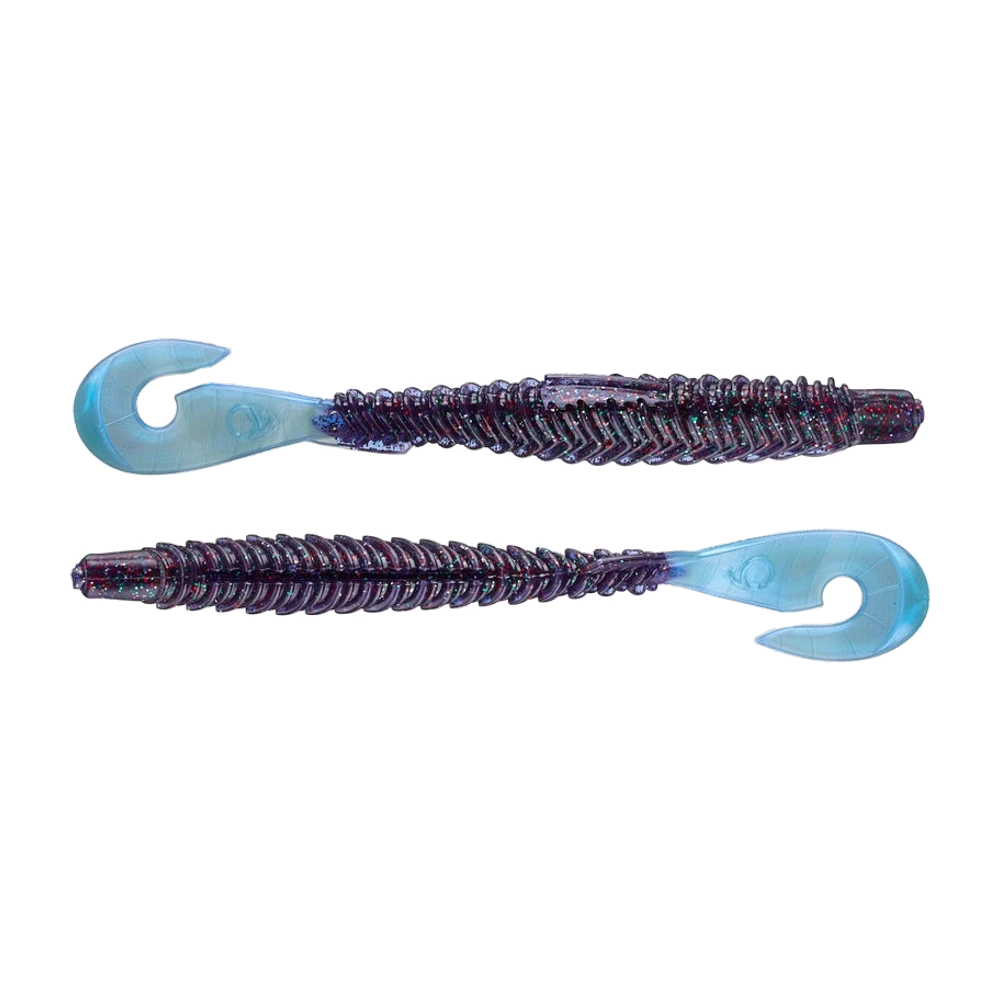
The Judge measures 15 cm / 5.9 in and comes in packs of five. 6th Sense describes it as a cross between a soft swimbait and a swimming worm, and the shape backs that up: the front half carries the slim, flattened profile of a fluke, the rear half is fully ribbed, and the whole thing finishes in a thin tail that undulates under the slightest water pressure. The two halves do different jobs. The front end holds the line of travel and stops the bait from rolling; the back end generates vibration at low speed, where a conventional paddle tail has nothing to say yet.
The manufacturer stresses one point that matters more than it sounds: the bait swims perfectly upright, belly down, without laying over on its side. You notice that most in sight fishing, when you follow the bait ten metres out and can see whether it holds its posture or runs crooked. A swimming worm that lays over loses half its profile and goes invisible from below.
Make your first cast in open water, in plain sight, before you fish a serious spot. You will see instantly whether your weighted hook is centred on the bait's axis. Ten seconds of checking saves an hour of fishing with a bait that spins on itself.
The hook slots are the real feature
The Judge is moulded with hook slots on the top and the underside of the body. They are not cosmetic: they are there to take the shank of a keel-weighted swimbait hook, the kind whose lead is moulded into a keel shape under the shank. Bury the point in the dorsal slot and you get a genuinely weedless rig, perfectly in line, with the keel of the lead stabilising the whole thing on the retrieve.
That rig gets the most out of the bait, and it is also the one most anglers skip, because it means keeping the right hooks in the box. A plain Texas rig on a wide-gap hook with no weight works, but the bait then stays very high in the water column and loses stability as soon as you speed up.
Swim jig and chatterbait trailer
The other intended use, and probably the most productive one on a cluttered lake, is as a trailer. Behind a 6th Sense Divine Swim Jig or a 6th Sense Fixed Jig Saw Vibrating Jig, the Judge stretches the silhouette noticeably and adds a slow undulation that contrasts with the frantic beat of a twin-tail trailer. On a bladed jig that contrast is obvious: the head supplies the noise and the vibration, the trailer supplies the length and the slow movement. Plenty of anglers trim two or three centimetres off the nose to keep only the ribbed section and the tail, shortening the profile without touching the engine of the action.
Texas and Carolina
Both rigs work too, but they change the logic of the bait entirely. Texas rigged behind a bullet weight, the Judge becomes a falling and dragging bottom bait, where the tail does its work during the pauses. On a Carolina rig, behind a heavy weight and a metre-long leader, it glides above the bottom while the weight ploughs the substrate. That is the rig for late-summer offshore flats, when the fish are sitting on well-defined breaks.
Retrieve speed: slower than you think
The classic mistake with this kind of bait is reeling it like a paddle-tail shad. The Judge's ribbed body produces its vibration at very low speeds, and speeding up adds nothing to the action — it simply lifts the bait higher in the column. Two to three handle turns per second is a ceiling, and it is worth dropping to one slow turn with a one-second pause every five or six rotations. The bite often comes during that pause, when the bait noses down slightly and the tail keeps moving on momentum alone.
In very clear water on educated fish, the same reasoning applies as with a Zoom Swimmin' Super Fluke: the less you interfere with the rod, the more credible the bait stays. The Judge does not need sharp snaps, it needs a steady path.
The mistake that costs bites
Picking a weighted hook that is too heavy in order to keep contact. An oversized lead crushes the bait's posture, tips it nose-down and cancels the point of the upright swim. If you need a depth your hook cannot reach, change rigs rather than weight: move to a Carolina rig, where the lead is separated from the bait.
Not sure what to tie on?
Photograph your spot: CarnaFish reads the scene, cross-checks the conditions and gives you the zone, the lure and the retrieve. Free on iOS and Android.
Colours by water clarity
- Stained water or cluttered bottom: Blue Craw Flake, the flaked plum colour in the photo, whose translucent blue tail stays readable even when the body blends into the background.
- Clear water over hard bottom: Green Pumpkin, the all-purpose tone that passes for a crawfish as readily as for a small bottom-dwelling baitfish.
- Fish locked on baitfish: White or Pearl, reserved for the moments when you can see schools of small bait near the surface.
A swimming worm is never chosen on its own: it is chosen after you have worked out what depth the fish are holding at and what kind of bottom they are sitting on. That is exactly what CarnaFish does — one photo of the spot, and the AI suggests a zone, a depth and a lure family suited to the day's conditions. To build the reasoning before you even open the box, our guide to getting started with bass fishing covers the classic spots and the tackle.
What to remember
- A ribbed body and an undulating tail that generate vibration at very low speed, where a paddle tail is not yet working.
- The slots on the back and belly are made for a keel-weighted swimbait hook: that is the rig that actually exploits the bait.
- An excellent swim jig and chatterbait trailer, where it supplies length and slow undulation rather than a frantic beat.
- Per-bait weight is not stated by the manufacturer: the hook's lead is what sets the running depth.
FAQ
What hook should I use with The Judge 5.9?
A keel-weighted swimbait hook, with the shank seated in the slots moulded into the back and belly of the bait. That is the rig the body was designed around: it keeps the bait in line, makes it weedless and stabilises its posture on the retrieve.
How much does a single Judge 5.9 weigh?
6th Sense does not publish a per-bait weight, only the 5.9 in length and the five-count pack. In practice it matters little: running depth depends almost entirely on the lead of the hook you rig it on.
How fast should it be retrieved?
Slowly. The ribbed body vibrates at very low speeds, and speeding up only lifts the bait in the water column without improving the action. Two to three handle turns per second is a maximum, and a swim-and-pause cadence often does better.
Is it a good chatterbait trailer?
Yes, that is one of its best uses. Behind a bladed head it adds a long silhouette and a slow undulation that contrast with the fast beat of the blade. Many anglers trim two or three centimetres off the nose to fine-tune the profile.
Does the Judge suit perch?
In Europe, yes, on big lake or large-river perch, but 15 cm stays a selective size. To cover more perch, a shorter worm such as the 6th Sense Ned Fry Worm will draw more bites.
Can it be fished on a plain unweighted Texas rig?
Yes, and it is a valid rig over shallow weed or fish holding just under the surface. The bait then stays very high in the column and loses a little stability when you speed up, but it goes anywhere.
The full bass lure guideSeason-by-season strategy: which family of lure, when, and why.Go from theory to fish
CarnaFish reads your spot from a photo and gives you the game plan: zone, lure, retrieve. Free on iOS and Android.