6th Sense Ozzie 4.0: the soft jerkbait built for hover strolling
This lure shines under specific conditions. CarnaFish tells you in 10 seconds if today is one of them.
A single bass sitting two and a half metres above a sunken tree, perfectly visible on the forward-facing sonar screen. You have a three or four second window to show it something at exactly its depth, something that moves without travelling. A standard shad crosses the zone too fast; a heavy bait passes underneath. That is precisely the gap the Ozzie 4.0 fills.
Hover strolling, and why this bait is made for it
Hover strolling grew out of the spread of forward-facing sonar. The principle: rig a thin soft bait on a very light jig head, let it drop to the depth of a located fish, then hold it at that depth by combining a minimal retrieve with micro twitches of the rod tip. The bait barely moves forward. It hangs there, quivers, rolls on itself, and the angler flies it by depth the way you fly a drone.
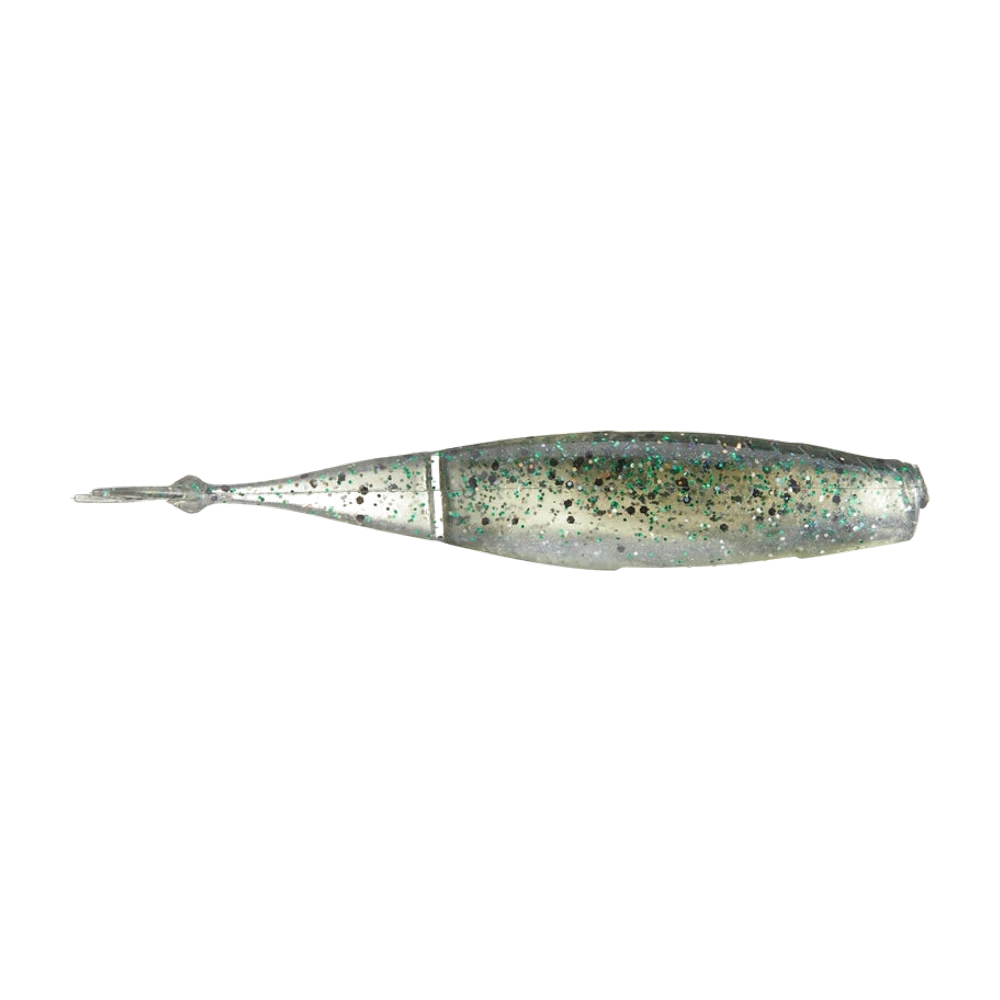
For that to work you need a bait that reacts to very small inputs. That is exactly what 6th Sense went after with the Ozzie 4.0, developed with Ben Milliken, a tournament angler also known for his videos. The body is segmented: instead of being a uniform cylinder, it is cut into sections that articulate against one another. A one-piece soft bait bends in an arc; a segmented body undulates. You see the difference on the first movement of the rod tip — there is no threshold to cross, the bait answers immediately.
The 3D body ridges add a surface roughness that grips the water. It is not a source of strong vibration, it is rather what stops the bait sliding too cleanly: it stays slightly behind your input, and that lag is exactly what makes the movement credible.
The forked tail and its ball
The Ozzie 4.0's tail is forked and flat, set horizontally, with a small ball moulded at its base. Each of those three features has a precise job.
The horizontal orientation puts the two points of the fork out to the sides, giving a lateral braking surface. Combined with the jig head, it makes the bait roll from one flank to the other instead of letting it nose down. That roll is what does all the work when hover strolling.
The forked shape creates drag during the fall: the points flutter, spread, close again, and the bait drops more slowly than a solid body of the same volume. You gain presentation time, which counts enormously when you are fishing a located fish.
The ball at the base, finally, acts as a calibrated hinge. It concentrates the flex at one point and at the same time stabilises the tail so it does not fold in on itself when you speed up. It is the same kind of detail as on the 6th Sense Masterclass Strobe Shaker, where an identical nub serves as a single flex point.
When hover strolling, the setting that changes everything is not head weight but the amount of slack. Keep the line just tight, without pulling: if you feel the bait's weight the whole time, you are stopping it rolling. If you have a loop of line, you are no longer transmitting anything. The right point is found at the rod tip, not at the reel.
The other two uses, and they matter
Spinnerbait and chatterbait trailer
This is the Ozzie 4.0's second recognised use, and it is not a fallback. On a vibrating jig, a trailer determines two things: fall rate and amplitude of movement. With a segmented body and a forked tail, the Ozzie 4.0 adds an undulation of its own to the blade's vibration, and above all it slows the swim slightly without weighing it down. Behind a Z-Man ChatterBait Jack Hammer, it is a trailer that adds bulk without killing the vibration.
On a spinnerbait the same principle applies in a quieter form: the forked tail avoids fouling on the wire frame and goes with the swim instead of braking it.
Rigged as a conventional soft jerkbait
On a weightless Texas hook or with a nose weight, the Ozzie 4.0 fishes like a Zoom Super Fluke: short twitches, side darts, pauses. It is more reactive to small inputs and slightly less inclined to wide darts than a classic fluke, because its segmented body absorbs part of the energy. For topwater work on active fish, a Z-Man Scented Jerk ShadZ stays punchier.
The classic mistake
Rigging it on too heavy a jig head. For hover strolling we are talking one and a half to five grams, no more. Beyond that the bait stops floating in the layer and becomes a shad that sinks. The second mistake is working it too much: three or four micro twitches, then leave the bait alone for two seconds. A bass rising to a hover-strolled bait needs those two seconds to commit.
Where and when it takes over
The Ozzie 4.0 is a located-fish bait, not a search bait. It excels in three precise situations: a single bass visible on sonar, a school suspended over structure, and a deadwood edge where fish hold at mid-depth. It needs water that is at least moderately clear, because the technique depends on the fish seeing the bait and rising to it.
In turbid water or on fish pinned to the bottom this approach gives nothing: there is not enough visibility for a near-stationary bait to be spotted, and a bottom rig is what you should be reaching for. It is also a bait that demands matching tackle — a soft spinning rod, thin braid, a fluorocarbon leader — because the steering happens at the rod tip.
Not sure what to tie on?
Photograph your spot: CarnaFish reads the scene, cross-checks the conditions and gives you the zone, the lure and the retrieve. Free on iOS and Android.
Colours by conditions
- Clear water, wary fish: a translucent shade with fine flake, which lets light through and creates no hard contrast. That is the default setting for hover strolling.
- Lightly stained water: dark back and pale flanks, a vertical contrast that stays identifiable when visibility drops to a metre.
- As a chatterbait trailer: an opaque white, which adds visible bulk behind the blade and shows up from a distance even in water churned by wind.
A technique bait before it is a box bait
The Ozzie 4.0 is not a bait to keep in the box just in case. It is a bait that presumes a technique, and a technique that presumes sonar or at least solid knowledge of the depth fish are holding at. Without that, its value falls to that of an average soft jerkbait.
That is also where CarnaFish can save time: a photo of the spot, and the AI suggests the zone, the depth and the type of presentation suited to the conditions, which tells you whether a mid-depth approach makes sense before you cast. To learn to work out on your own where fish hold on an unknown water, our guide to reading a fishing spot gives the basic reference points.
Key takeaways
- Segmented body and 3D ridges: the bait reacts to very small rod-tip inputs, with no trigger threshold.
- Horizontal forked tail with a ball: pronounced side-to-side roll, slowed fall and a stable flex point.
- A 1.5 to 5 g jig head for hover strolling, no more: beyond that the bait sinks instead of hanging.
- An excellent chatterbait and spinnerbait trailer, where it adds bulk without crushing the blade's vibration.
FAQ
What exactly is hover strolling?
A mid-depth presentation: a thin soft bait on a very light jig head, dropped to the depth of a located fish, then held there by a minimal retrieve and micro twitches of the rod tip. The bait quivers in place rather than travelling.
What jig head weight should I use with the Ozzie 4.0?
From 1.5 to 5 g depending on depth and wind. The aim is to stay on the edge of neutral buoyancy in the layer you are targeting: a heavier head turns the presentation into a plain descent.
Can it be used as a chatterbait trailer?
Yes, that is one of its intended uses. Its segmented body adds an undulation of its own to the blade's vibration and it slows the swim slightly without weighing it down, which is exactly what you want on a vibrating jig in cool water.
Do I need forward-facing sonar to fish it?
No, but that is where it gives its best, because the technique relies on presenting at a precise depth. Without sonar it remains usable by counting the drop along a known structure, or as a trailer.
What is the difference with a classic fluke like the Super Fluke?
The Ozzie 4.0's segmented body makes it more reactive to small inputs but absorbs part of the energy of big twitches. A Zoom Super Fluke produces wider side darts, the Ozzie a finer and slower action.
How many baits per pack?
Six pieces for the 4 inch version, which is 10.2 cm. It is a bait that wears out quickly when hover strolling, since every fish tears the nose a little where the jig head hook passes through.
The full bass lure guideSeason-by-season strategy: which family of lure, when, and why.Go from theory to fish
CarnaFish reads your spot from a photo and gives you the game plan: zone, lure, retrieve. Free on iOS and Android.