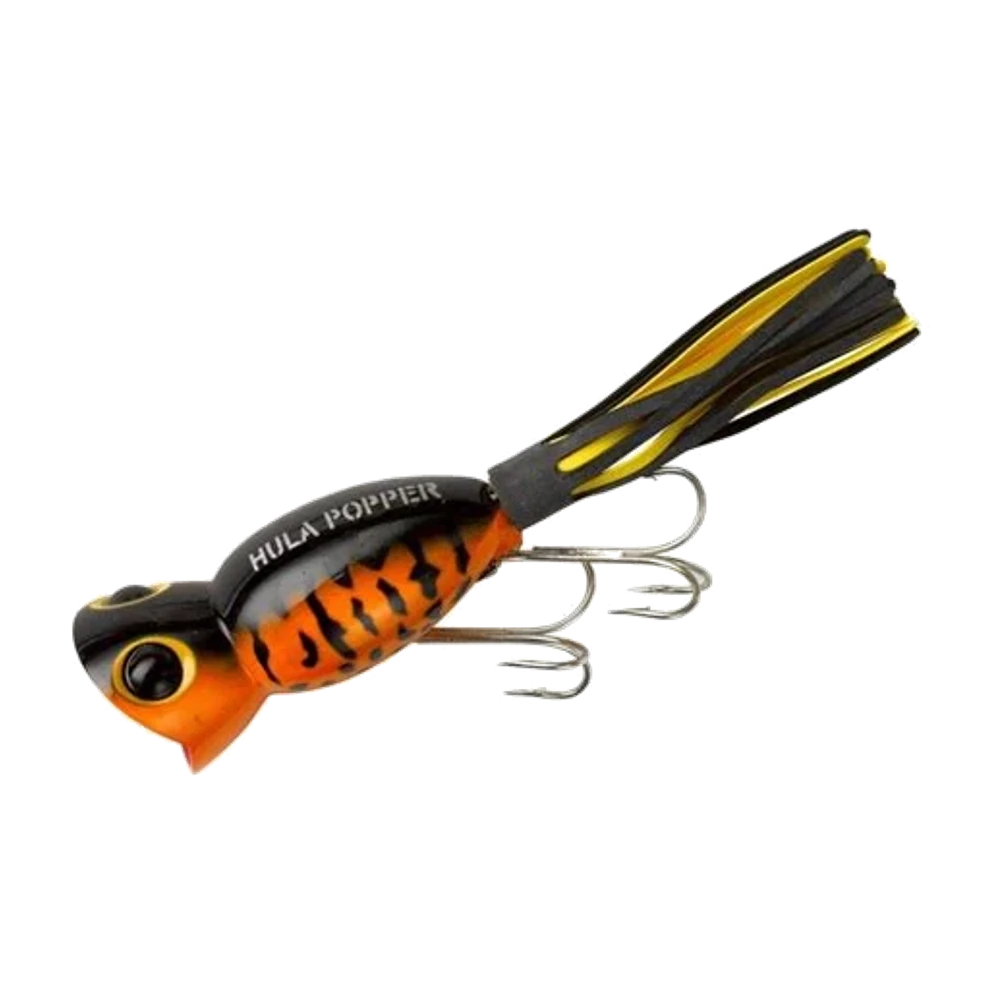
Arbogast Hula Popper: the lure that fishes while you do nothing
This lure shines under specific conditions. CarnaFish tells you in 10 seconds if today is one of them.
Late July, half past eight in the evening, a two-hectare pond. The water is at twenty-five degrees, lilies cover a third of the surface, and nothing is moving. The fish are there — you watched them sip insects ten minutes ago — but they are not chasing anything. Everything that moves fast goes by unnoticed.
In that situation, the answer is not a colour change or a size down. It is going slower than most lures allow. And nearly every topwater has a floor: below a certain speed, it stops producing anything at all.
The Hula Popper has no such floor, because its most important part does not need the lure to move. The soft rubber skirt mounted at the rear keeps opening and closing during the pause, driven by the residual tension in the line, by the faintest current, by the water settling back on its own. You can leave the lure still for thirty seconds: it is still working.
A big deep bloop and a breathing skirt
Two features, each one against the grain of what is made today.
The mouth is very wide and deeply cupped. It does not throw a fine vertical spray, it produces a cavernous, deep "bloop" that displaces a large volume of water. That sound carries in water thick with vegetation and, on an overgrown pond, it passes over the weed where a high-pitched signal dies out in three metres.
The rubber skirt is a passive system. Unlike a feather, which mostly waves when it is dragged, the rubber strands are stiff and elastic: compressed by the pop, they slowly reopen afterwards. That elastic recovery is what extends the movement long after the body has stopped.
Immediate practical consequence: the Hula Popper's retrieve is the pauses. The bloop only announces where the lure is and recompresses the skirt. Everything that triggers happens during the silence.
The retrieve: counting to absurd numbers
- Cast to the edge of the vegetation, into a gap between two lily mats, or against a reed bank.
- Touch nothing for ten seconds. The rings disperse, the skirt slowly opens. Bites already come at this stage.
- One bloop, decisive, wrist only, rod tip up. One.
- Pause of five to fifteen seconds. Watch the skirt. As long as it moves, the lure is fishing.
- A second bloop, then an even longer pause.
- Move the lure just thirty centimetres between sequences. A well-worked cast can last two minutes.
- Set the hook on weight. With this lure more than any other, the fish often inhales it without a spectacular splash.
| Conditions | Pause between bloops | Size |
|---|---|---|
| Warm water, active fish, dawn | 3 to 5 s | Medium to large |
| High summer, tepid water, midday | 10 to 15 s | Small to medium |
| Cool spring water | 5 to 8 s | Medium |
| Pike along a weed edge | 5 to 8 s | Large |
| Night, calm water | 8 to 12 s | Large, dark colour |
On the water: when you fish the Hula Popper, your watch is a better tool than your rod. Time a genuine fifteen-second pause just once — you will find it felt like a minute, and that in your normal fishing you never got past four seconds. A warm-water fish rises slowly, inspects, circles. It needs that time, and you are the one refusing it.
The skirt: care and tuning
It is the part that makes the lure, and it is also the most fragile.
Rubber ages. Exposed to light and heat, it hardens and loses its elasticity. A stiff skirt no longer reopens after being compressed: the lure becomes an ordinary popper. Store these lures out of the sun, away from soft plastics, whose plasticisers attack rubber.
The length can be tuned. If the skirt extends well past the treble, it cushions strikes and increases the misses. Trim it with scissors so it reaches just to the hook points. You lose a little volume and gain a lot in hook-up rate.
So can the density. A very full skirt brakes the lure and slows its travel even further — useful in high summer, a handicap in spring when you want to cover a bit more ground. Pulling out ten or so strands is a reversible modification and often pays.
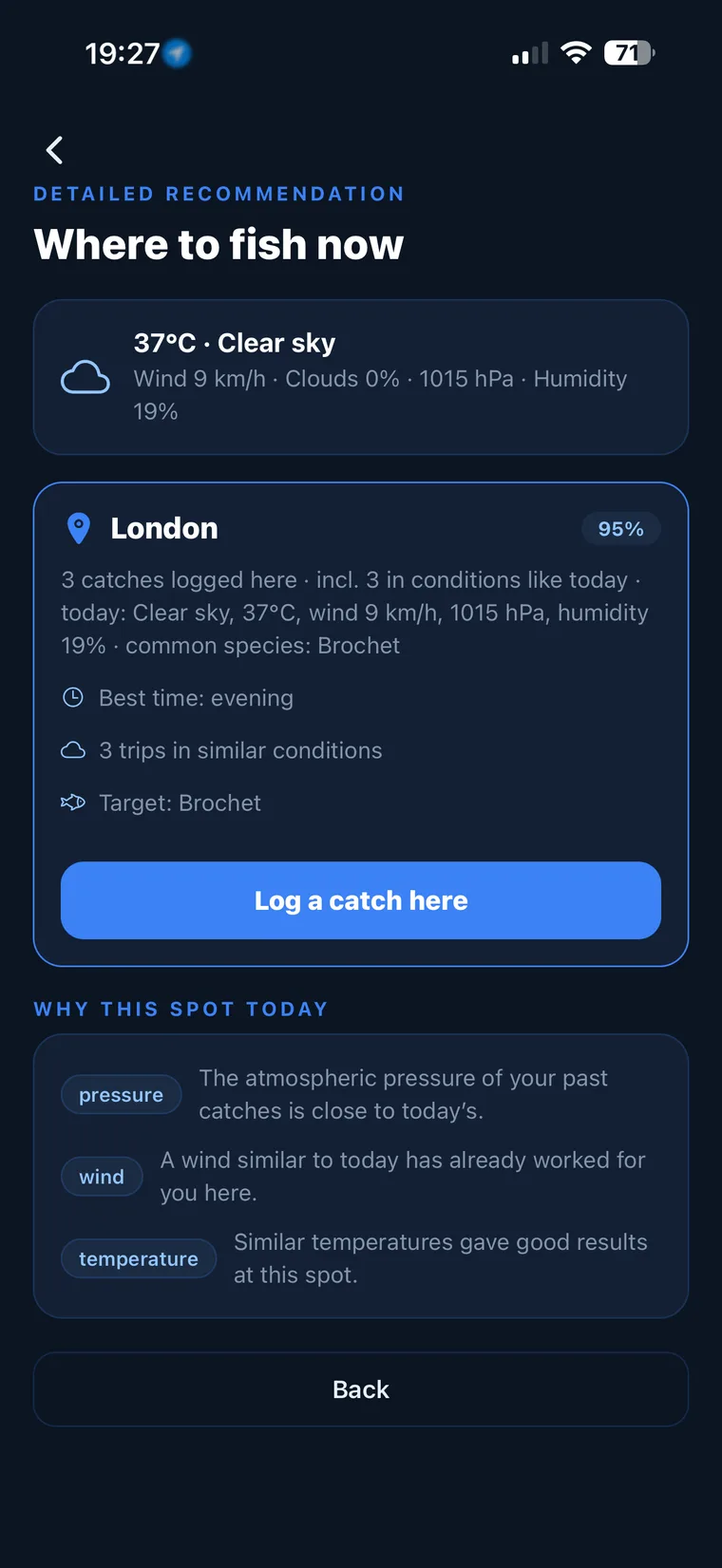
Not sure what to tie on?
Photograph your spot: CarnaFish reads the scene, cross-checks the conditions and gives you the zone, the lure and the retrieve. Free on iOS and Android.
Where it shines, where it is the wrong choice
Its ground:
- Weedy ponds and gravel pits, along the edge of lilies, reeds or drowned timber.
- Warm summer water, between twenty and twenty-eight degrees, when activity is low and the fish are tight to cover.
- Shallow pike margins, where the deep bloop calls a fish sitting in the weed without spooking it.
- Night fishing on small waters, where the sound does all the work.
- Tiny gaps where you only get one cast in.
Its contraindications:
- Searching large areas. Thirty centimetres a minute is not a rate for covering a lake.
- Chop and wind, which drown the bloop and stop the skirt working cleanly.
- Clear, cold water, where the fish do not need you to slow down that much and the bulk of the lure starts to look suspicious.
- Dense, closed weed, where two exposed trebles snag instantly. A weedless lure is compulsory there.
Hula Popper or a modern popper
A Rebel Pop-R is slimmer, faster, better suited to a brisk cadence and to searching a margin. It produces a crisper, higher-pitched spray, and it accepts linked pops. It is the logical choice as soon as you want to move.
The Hula Popper plays the exact opposite: a deeper sound, more water displaced, and above all that ability to keep emitting a signal at a complete stop. The two do not replace each other, they occupy opposite ends of the spectrum.
On closed vegetation mats, neither of them gets through: a weedless lure like the Booyah Pad Crasher takes over. The Hula Popper fishes the gaps and the edges, the frog fishes the mat itself.
Our guide to choosing a pike lure applies these trade-offs to weedy margins. And if you are torn between edge and mat when you reach an overgrown pond, CarnaFish analyses a photo of the spot and answers.
Key takeaways
- The rubber skirt keeps working at a dead stop: the lure fishes during the pauses.
- A very wide mouth and a deep bloop, a signal that carries in water thick with weed.
- One bloop, then five to fifteen seconds of silence, and thirty centimetres of travel.
- Trim the skirt level with the hook points to cut down on missed fish.
- Unsuited to searching, to wind, and to closed vegetation mats.
FAQ
Why a rubber skirt rather than a feather?
Rubber is elastic: compressed by the pop, it reopens slowly afterwards and keeps moving while the body is still. A feather mostly waves when the lure is being dragged and dies away much faster at rest.
How long should I wait between bloops?
Five to fifteen seconds depending on temperature and activity. In high summer on tepid water, fifteen seconds is nothing excessive: most anglers stop at four and miss the window when the fish comes up.
Should I trim the skirt?
If it extends well past the hook points, yes. Too long a skirt cushions strikes and multiplies the misses. Cut it level with the points: you lose a little volume and gain a lot in hook-up rate.
Does it catch pike?
Regularly, on shallow weedy margins in summer. The deep bloop calls a pike sitting in the weed nicely. Use the largest size then and check the hooks, which were originally sized for bass.
Can I fish it in the lilies?
In the gaps and along the edges, yes. On a closed mat, no: its exposed trebles snag instantly. You need a weedless lure designed to slide over the vegetation.
How do I keep the skirt supple?
Store the lure away from light and heat, and never put it in contact with soft plastics: their plasticisers attack rubber and harden it. A stiff skirt no longer reopens and the lure loses everything that makes it worthwhile.
The full bass lure guideSeason-by-season strategy: which family of lure, when, and why.Go from theory to fish
CarnaFish reads your spot from a photo and gives you the game plan: zone, lure, retrieve. Free on iOS and Android.