Strike King HC KVD Wakebait: the 2.5 body turned loose on the surface
One lure, endless conditions. CarnaFish reads your spot from a photo so you are not just guessing.
A still summer morning, no wind, along a weed edge still in the shade. A popper makes too much noise, a walking bait demands constant wrist work, and a crankbait digs down where there is nothing to find. What you want is a lure that travels on its own leaving a wake, slowly enough that a fish has time to come up. That is precisely the slot the HC KVD Wakebait fills.
A squarebill body repurposed as a surface lure
Strike King makes no secret of the lure's origin: the size and shape come straight from the KVD 2.5 Squarebill, a crankbait with a long track record just under the surface. It is a clever move, because a short, deep body shoves a lot of water — exactly what you want when you are after a pronounced wake.
The manufacturer's spec table runs to two columns, length and weight: 6.4 cm / 2.5 in for 14 g / 1/2 oz. There is no buoyancy class column in that table, unlike other hard baits in the range. The written description, on the other hand, presents an unambiguous topwater lure retrieved so it throws a wake: that is what can be stated, and nothing beyond it. If you need to know exactly how it behaves at rest, the only reliable answer is a test at the bank.
A small naming note: the lure appears under more than one spelling within the description — the table identifies it by its body, 2.5 Wake, while the text calls it a 2.5 Wake Bait. Do not be surprised to find it listed differently from one retailer to the next.
An almost vertical bill, and why that makes sense
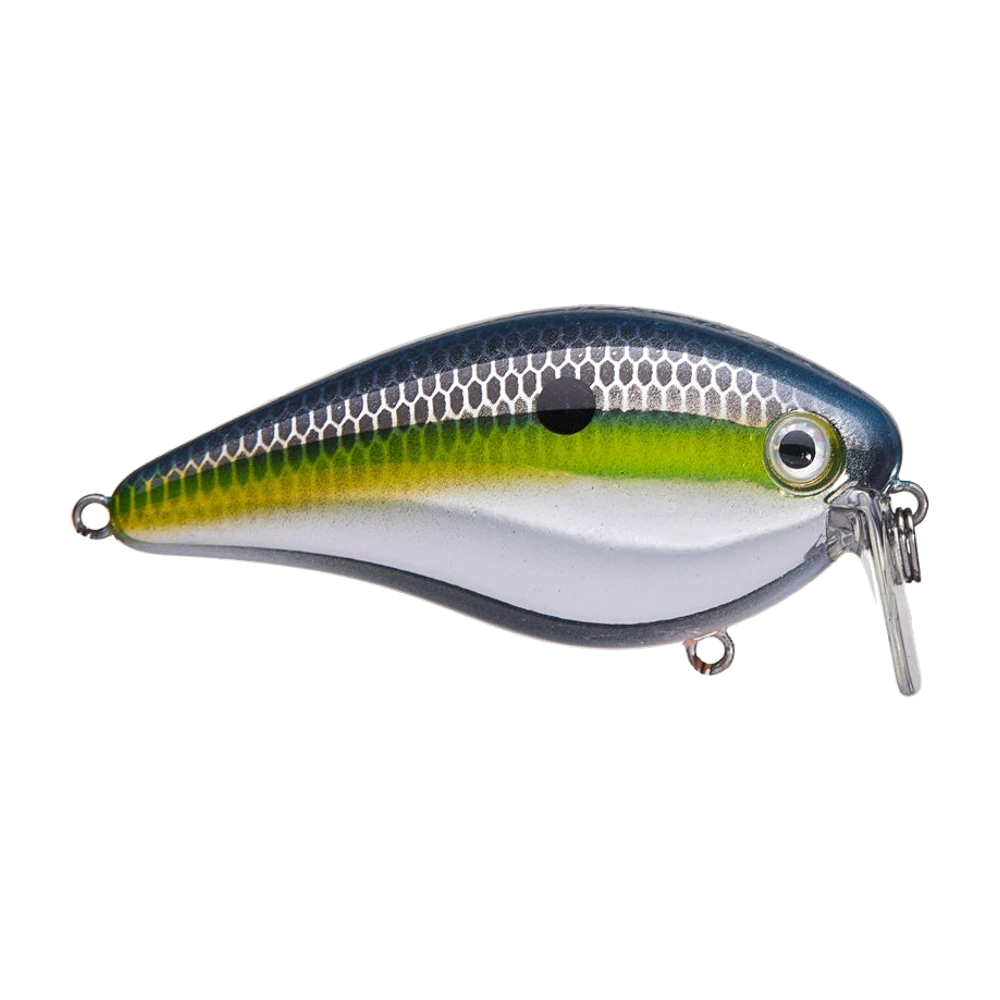
On the product photo the bill is short, narrow and angled very steeply downward, close to vertical. It is not the wide square lip of the crankbait the body came from. A lip set that way does not pull the bait down: it makes the bait push against the water, holding it on the surface while kicking it alternately left and right. That is an observation from a product photo rather than a published specification, but it explains the behaviour the manufacturer describes.
Also on the photo, the line tie sits on the nose above the bill and carries a split ring. Both hook hangers, belly and tail, are empty: the lure is photographed bare, so the image tells you nothing about the factory hooks.
Speed is the real adjustment
A standard wakebait has a well-known flaw: push it slightly too fast and it blows out, rolls over or leaves the water altogether. Strike King states this one can be waked at higher speeds than most wakebaits on the market — a marketing comparison with no number attached, so treat it as a design intention rather than a measurement.
What it means in practice is that you have a range to play with instead of a single workable speed. Start at the slowest retrieve that still leaves a clean V behind the bait, then build up. In warm water with active fish, the faster version draws more violent strikes; in cooler water or on shut-down fish, the extreme crawl is what pays.
Never strike at the sound. On a topwater lure the fish often misses on the first pass, and a reflex hookset rips the bait out of the zone. Keep reeling at the same pace until you feel weight in the rod, then set sideways rather than upward.
The rattle, and what it actually contributes
The bait carries a rattle chamber that produces a distinctive clacking sound. On the surface, sound carries differently from mid-water: it also travels along the air-water interface, and a bass holding three or four metres below picks it up before it sees anything. That is the brand's central argument for the model — covering water fast and calling fish from a distance.
In practice that makes it a lure for slightly stained water or low light rather than gin-clear water at midday. With clear water and a bright sky, a silent topwater will often go down better.
The classic mistake: fishing too far from cover
A wakebait only earns its keep when it runs tight to something. A reed edge, a pad field, a laydown, a line of docks. Thrown into open water it makes noise for nobody. Aim within half a metre of the cover and accept that you will lose a few baits in the vegetation: that is the entry fee for this kind of fishing.
Where and when to use it
The window is warm water: eighteen to twenty-eight degrees, with a preference for first and last light, and for overcast days that stretch surface activity. From post-spawn through the whole summer it works over one-to-three-metre flats, wherever fish rise to feed.
In Europe its short, chunky build and heavy wake also make it a pike lure on shallow summer bays. For that, add a leader: surface strikes are violent and bare line does not last long against a pike's jaw. Heavy fluorocarbon is usually enough, soft wire is safer if you know there are big fish about.
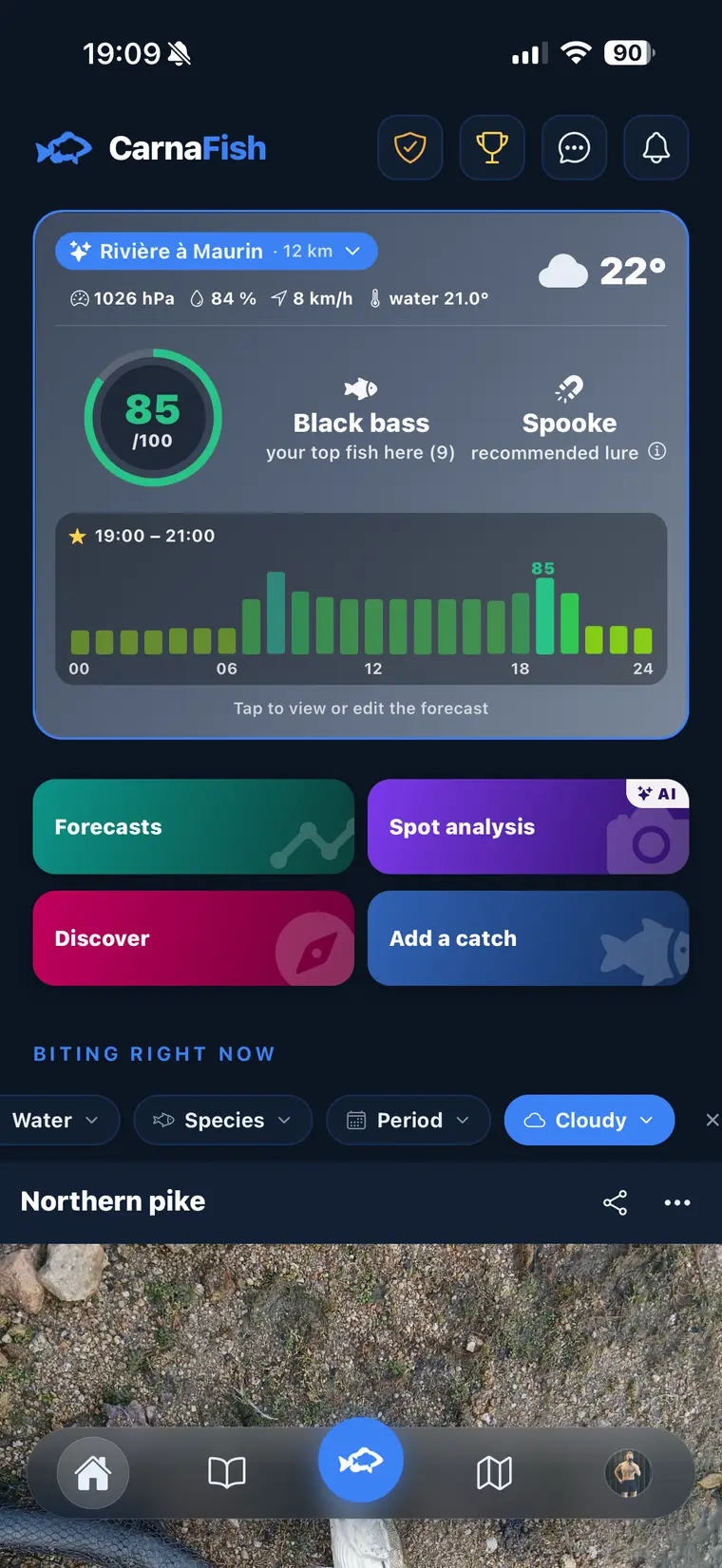
Not sure what to tie on?
Photograph your spot: CarnaFish reads the scene, cross-checks the conditions and gives you the zone, the lure and the retrieve. Free on iOS and Android.
Rod, line and knot
A medium casting rod of around two metres, with a tip that absorbs the strike without tearing out. Thin braid is the best choice: it floats, which stops you pulling the nose of the bait under, and it transmits contact. In very clear water, add a metre of fluorocarbon leader.
Use a loop knot or a snap: just as on a Rapala Shad Rap, a knot cinched against the eye binds the bill and cuts the amplitude of the side-to-side track. And since the description never details the factory hooks, check the points before the first outing.
Colours by light level
- Clear water, bright sun: Sexy Shad, the grey-and-white barred pattern of the Strike King palette — it is the colour family of the lure photographed here, with its blue-black back and chartreuse band.
- Vegetation edges: Bluegill, imitating the small sunfish bass feed on around weed.
- Overcast or stained water: Black Back Chartreuse, whose dark back shows a clean outline when seen from below against the sky.
Where it fits in the topwater box
The HC KVD Wakebait does not do the same job as a walking bait like the Strike King KVD Sexy Dawg: that one needs continuous wrist work and covers a lot of ground, this one is happy on a straight retrieve and is usable by a beginner from the first cast. And when the band to search drops below the film, the Strike King KVD 1.5 Squarebill — from the same body family — takes over the first metre. If you want to compare sub-surface approaches, the 6th Sense Speed Wake explores the same idea with a longer body.
Knowing when the surface window is open beats burning an hour insisting: that is what CarnaFish does, analysing a photo of your spot and suggesting the zone, the depth and the lure type that match the day. To get the timing right, our season-by-season predator fishing guide walks through the calendar in detail.
What to remember
- 6.4 cm / 2.5 in and 14 g / 1/2 oz, on a body borrowed from the KVD 2.5: short, deep, and therefore very good at pushing water on the surface.
- The spec table publishes no buoyancy class; only the written description identifies it as a topwater lure.
- Speed is the main adjustment, and the maker claims a wider usable range than average.
- It only fishes when run tight to cover — in open water it does nothing.
FAQ
How fast should this wakebait be retrieved?
Start at the slowest speed that still leaves a clean V-wake, then build up until you find the reaction. Strike King claims it holds at higher speeds than most wakebaits, which gives you a comfortable range to work within.
Is the HC KVD Wakebait floating?
The manufacturer's spec table has no buoyancy column, so it cannot be stated from the data sheet. The written description does, however, clearly present it as a topwater lure retrieved to throw a wake.
What exactly are the size and weight?
6.4 cm / 2.5 in for 14 g / 1/2 oz, according to the table published by Strike King. That is the only version documented in this description.
How does it differ from a popper or a walking bait?
A popper works on the spot by spitting water, a walking bait needs constant wrist input. The wakebait only asks for a straight retrieve, which makes it the easiest topwater lure to pick up.
Does it catch pike in Europe?
Yes, on shallow summer bays, where its heavy wake pulls fish from a distance. Add a leader in heavy fluorocarbon or soft wire, because surface strikes are particularly brutal.
Should I set the hook as soon as I see the strike?
No, that is the most common mistake in topwater fishing. Keep reeling at the same pace until you feel the fish's weight in the rod, then set sideways rather than upward.
The full bass lure guideSeason-by-season strategy: which family of lure, when, and why.Go from theory to fish
CarnaFish reads your spot from a photo and gives you the game plan: zone, lure, retrieve. Free on iOS and Android.