SPRO Zero Minnow Wakebait: a surface wake on a 12.7 cm body
Not sure this lure fits YOUR spot today? CarnaFish tells you in 10 seconds, from a photo.
Late June, six in the morning, a flat reservoir bank running two hundred metres, mist on the water and not a ripple. You cast flat, retrieve slowly, and the only thing you can see is a V travelling towards you. Then the V disappears into a hole in the surface. Wake fishing lives entirely inside that image, and the Zero Minnow from SPRO's Essential range is built to produce it.
What a wakebait does that a popper doesn't
A wakebait doesn't spit, doesn't walk and doesn't blow bubbles. It travels just under the film, pushing water ahead of itself and leaving a V-shaped track and a trail of boils behind. The signal is continuous, not intermittent: a fish doesn't have to turn up at the right second, it only has to cross the track.
That's a difference in kind from a walking stickbait like the Rapala Skitter Walk, which needs rod input and draws refusals when a fish misses the target. The wakebait is happy with a straight retrieve. The trade-off is precision: you can't make it dance on the spot over a piece of cover. It covers water, it doesn't pick a target.
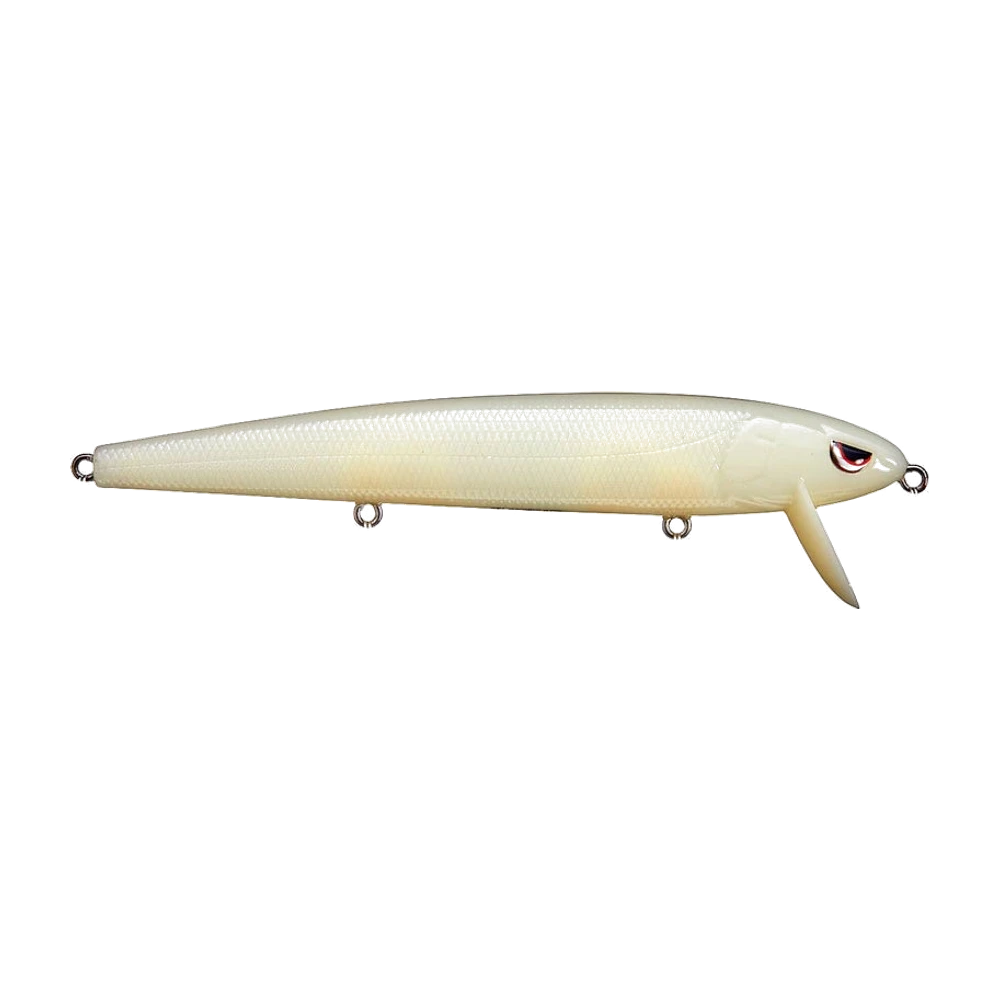
The Zero Minnow has a long minnow body, and in the product photo its lip is a narrow, pointed blade moulded in the same material as the body rather than in clear plastic — an observation from a product photo, not a specification. A lip that slim explains the nature of the signal: less frontal resistance than a wide-plate wakebait, so a long roll rather than a short waddle.
The table's numbers, and one question left open
SPRO's table lists one version and three columns: 5 in, which is 12.7 cm, half an ounce or roughly 14 g, and a depth of 0-1 ft, meaning the film down to 30 cm.
Fourteen grams on a 12.7 cm body is deliberately light. A hollow body of that size shifts a lot of water for its mass, which is exactly the condition for generating a wake at low speed. The flip side shows up on your first cast into the wind: SPRO claims unmatched castability, but that's the maker's own line, and a tall, light bait stays more sensitive to a crosswind than a dense crank of the same weight.
One point needs saying plainly. The table has no class column, and the maker's prose never mentions measured buoyancy: it places the bait in a topwater arsenal, which is a usage category, not a figure. So we know the stated depth is 0-30 cm; we do not officially know what the bait does at a dead stop. In practice a wakebait has to float at rest to throw a wake, but check it at the bank before you try a pause over weed.
The setting that changes everything on a wakebait is rod-tip height. Rod high and the bait rides out of the water and loses its boil; rod flat on the surface and it digs in and the wake fades. Find the point, tip about fifteen centimetres off the water, where you can see the V without seeing the bait's back. That setting, not the speed, does half the work.
When this bait genuinely earns its place
SPRO claims year-round effectiveness with a peak from early spring through the height of summer. That squares with what a topwater does, provided you spell out the real conditions: water above 15 °C, low light, and above all a calm or barely rippled surface. Choppy water drowns the bait's track in the waves, and the wake stops meaning anything.
The windows are dawn, dusk, overcast days and summer nights. The spots are shallow flats, weed edges, pond backs and submerged plateaus in one to two metres. As soon as the vegetation gets thick and genuinely mats the surface, this bait is out of its depth: three bare trebles collect everything, and that's the territory of a hollow-body frog like the SPRO Bronzeye Frog. In Europe a 12.7 cm profile interests pike as much as bass — with the obvious consequence: on pike water you need a leader, or you'll hand over your bait on the first strike.
Working it: the speed that builds the wake
The rule is simple and counter-intuitive. Retrieve at the slowest speed that keeps the boil visible, and not one turn faster. Too slow and the bait sinks and the V vanishes; too fast and it lifts off, rolls onto its flank and stops pushing water. Between the two lies a narrow band where the bait works, and your job is to hold it for the whole length of the retrieve.
The internal rattle, which SPRO describes as a loud knocking sound, adds a second line of attraction. It counts most at night and in stained water, when the silhouette no longer reads and fish home in on sound and pressure.
Two variations are worth having. First, a one-second pause every five metres, which breaks the rhythm and converts followers. Second, a diagonal pass along a weed edge, the bait tracking the vegetation line instead of cutting across it. Bass sitting in the cover come out sideways; they only have twenty centimetres to travel.
The classic mistake
Striking at the sound. It's the universal topwater error and it costs half the fish in a session. When the boil erupts, the bait isn't in the mouth yet. Wait until you feel weight in the rod, then sweep sideways, never a sharp lift. With three trebles and a stiff rod, an early strike rips the bait free and turns a bite into nothing.
Not sure what to tie on?
Photograph your spot: CarnaFish reads the scene, cross-checks the conditions and gives you the zone, the lure and the retrieve. Free on iOS and Android.
Rigging and hooks
SPRO states a trio of razor-sharp Gamakatsu trebles, so three hooks. The maker does not give their size. The product photo does show three hook hangers — two belly and one tail — but the bait is pictured bare, with no trebles fitted at all, which is an observation from a product photo rather than a specification.
Three trebles on a 12.7 cm bait changes the setup. You need a rod that cushions: 2.10-2.20 m, medium to medium-heavy, moderate-fast at most. For line, floating monofilament is the most logical choice because it doesn't pull the bait's nose down; fluorocarbon of 0.28-0.35 mm also works, as long as you accept the bait riding slightly lower. Straight braid is best avoided unless you're very disciplined on the strike: it forgives nothing. For the connection, loop knot or snap, never a knot cinched onto the eye.
Colour by light
- Overcast sky, milky or lightly stained water: the pearl bone shown here, a tone that reads from below without flashing. It's the catch-all wake colour.
- Into the light, at dawn and at night: a black back or an entirely dark body. On the surface a fish sees a silhouette against the sky, not a colour — contrast beats realism.
- Clear water and risen sun: a roach or silver shiner pattern with a grey-green back, for days when fish inspect the prey before committing.
A topwater only works if fish are high in the water column, and that's a reading of conditions before it's a choice of lure. That's exactly what CarnaFish makes easier: a photo of the spot, and the app tells you which zone to work and at what depth, enough to know whether the surface is the right bet this morning. If you're fishing pike water, our guide to choosing a pike lure usefully covers the leader question.
Key takeaways
- 12.7 cm for roughly 14 g with a stated 0-30 cm depth: a surface-film bait, not a mid-water minnow.
- The maker publishes no buoyancy class; "topwater arsenal" is a usage category, not a measurement.
- The right speed is the slowest one that keeps the V visible; beyond it the bait lifts off and the signal dies.
- Three trebles as stated: a cushioning rod, a delayed sideways strike, and a leader wherever pike swim.
FAQ
Does the SPRO Zero Minnow float at rest?
SPRO's table has no buoyancy column and the prose doesn't mention it. The stated depth is 0-30 cm and the bait is presented as a topwater tool, which is a use rather than a measurement. Check it yourself by stopping the retrieve at the bank.
How fast should I retrieve it?
At the slowest speed that keeps the boil and the V visible behind the bait. Faster, and the wakebait lifts off and rolls onto its side; slower, and it sinks and stops pushing water.
What's the difference with a walking stickbait?
A wakebait works on its own on a straight retrieve and leaves a continuous track, whereas a stickbait such as the Rapala Skitter Walk needs rod action and produces an intermittent signal. The first covers water, the second targets a specific spot.
Can it be fished for pike?
Yes, 12.7 cm is a perfectly coherent size for pike on the surface at dawn and dusk. Fit a heavy fluorocarbon or titanium leader: three trebles on a bitten-off bait means a lost lure and an injured fish.
Monofilament or braid?
Floating monofilament is the most logical: it doesn't pull the nose down and it cushions the strike. Braid gives perfect transmission but forgives no early strike, which is exactly the most common mistake with this kind of bait.
The full bass lure guideSeason-by-season strategy: which family of lure, when, and why.Go from theory to fish
CarnaFish reads your spot from a photo and gives you the game plan: zone, lure, retrieve. Free on iOS and Android.