Clutch Darter Glide Bait: the 18 cm glide you can burn
Before tying this one on, it helps to know if the spot actually calls for it. CarnaFish reads the scene from a photo.
A glide bait normally dictates its own rhythm: you cast, let it settle, and string together slow pulls while the body rocks from one side to the other. It is beautiful, it is effective, and it is slow — slow enough that covering a bank takes an hour where a spinnerbait would do it in ten minutes. The Clutch Darter was designed to escape that constraint, and that is roughly the only thing worth knowing before you tie one on.
A glide you retrieve at spinnerbait speed
Justin Kimmel, who worked on this bait with Clutch, fishes American herring lakes where bass chase slim, fast forage out in open water. In that setting a slow glide is not credible: the real prey is moving. So the Darter takes a very thin baitfish profile — a narrow body seen from above, far slimmer than a swimbait of the same length — and tolerates retrieve speeds at which most glide baits blow out and roll.
In practice that opens two distinct registers with one lure, and this is the point to keep:
- Short pitch, towards the bank: over a few metres the bait produces nervous, tight darts, a run of quick deviations rather than a wide glide. That is the presentation that works along a cluttered edge, a dock, a laydown.
- Long cast, open water: at the end of the retrieve, with plenty of line out and a flatter angle of pull, the same bait shifts into wide, slow glides, the classic glide behaviour.
You do not have to choose once and for all: you change register by changing the length of the cast and the height of the rod. That is unusual, and on its own it justifies the room it takes up in a box.
Buoyancy in the copy, slow-sink in the table: which one wins?
This has to be said plainly, because the source contradicts itself. The maker describes a proprietary lamination process that gives the bait excellent buoyancy for its size. But the maker's own spec table rates the Darter Slow-Sink, alongside its measurements: 7-1/4 in, that is 18.4 cm, and 2 oz, around 56.7 g.
The two claims only conflict on the surface. A bait of 18 cm at this density should go down decisively; the lamination lifts its buoyancy to the point where the descent becomes very slow, almost suspended. But it does descend. In practice, then, you reason as you would with a sinking bait: count it down after the cast, know that a long pause takes you towards the bottom, and do not count on it rising at rest. If you need a glide that climbs on every pause, this is not that bait. We go with the maker's table, which is the measured figure, rather than the marketing line.
Run the sink test before you fish, watch in hand, alongside the boat. On a bait sold as buoyant by the copy and sinking by the table, that is the only way to know where your particular one stands, with the trebles you have actually fitted. Two trebles heavier than stock turn a slow sink into a plain sink.
The tackle, non-negotiable
At 56.7 g this is no longer a bait you throw on an all-round outfit. You want an XH swimbait rod of 2.20 to 2.40 m (7'3" to 8'), parabolic enough to absorb the bait's inertia on the cast and on the strike, a good-sized casting reel and 50 to 65 lb braid, or 0.45 to 0.55 mm fluorocarbon if you want more cushioning. A solid round snap at the nose: a tight knot on the eyelet blocks the pivot and kills the glide, exactly as it does on a jerkbait.
Hardware and the fibre tail
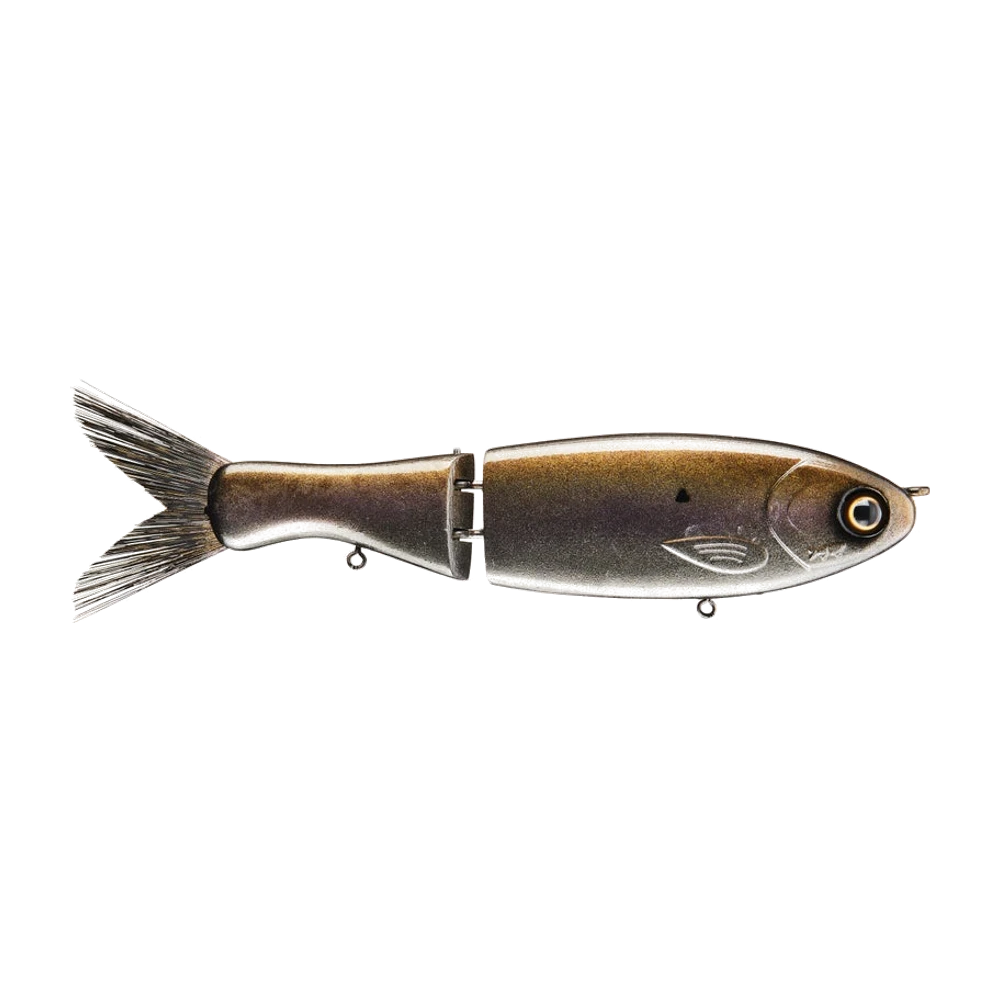
The Darter is listed with BKK trebles and heavy split rings. In the photograph, though, it is shown bare: belly hangers empty, nose eyelet free, which does let you see the central hinge and the tail clearly. So always check what is actually in your box, and if you change the trebles, stay at the stock weight — that is the only way to keep the attitude and the sink rate the bait was built around.
The soft brush fibre tail is not decoration. It adds a little drag at the rear, which stabilises the body at higher speeds and keeps it from rolling. Rinse it in fresh water and let it dry flat: fibres that dry clumped together in a closed box lose their volume and part of that effect.
The classic mistake
Working the Darter like an ordinary glide, with long slow pulls, and concluding that it does not glide all that much. Its point is elsewhere: you have to retrieve it faster than instinct tells you to. Start with a brisk straight retrieve, no rod action at all, just to watch the bait work. Only then add rod-tip strokes. Plenty of anglers only find the fast register after several sessions, because they default to the habits learned on a slow glide.
Where and when, in Europe
In the United States this is a herring-lake bait, fished over deep water on bass feeding up in the column. In Europe, 18 cm and 57 g place it straight into pike territory: the edges of big waters, drop-offs, reed-bed margins, reservoirs and gravel pits in late summer and autumn, once the coarse fish shoal up. The fast register is precisely what most glides lack when you need to cover a large gravel pit efficiently.
For pike, a titanium or 0.80 mm fluorocarbon leader is mandatory — a bait at this price deserves not to be lost to a bite-off. For European bass it stays usable but oversized on most waters: if you want this gliding action on smaller fish, a reduced format such as the Bucca Brand BFS Trick Shad 2.5 makes far more sense.
Not sure what to tie on?
Photograph your spot: CarnaFish reads the scene, cross-checks the conditions and gives you the zone, the lure and the retrieve. Free on iOS and Android.
Colours by water clarity
- Clear water: olive bronze back with purple sheen over a pearl belly, exactly the finish shown here. That is the register of a slim coarse fish seen side-on, with no aggressive flash.
- Lightly stained water: a decidedly dark back over white flanks. The dorsal contrast stays readable when light struggles to get through.
- Low light or coloured water: a solid dark finish. At those moments it is the silhouette and the water displacement that carry the message, not the detail of the paint.
A niche bait, and openly so
The Darter does not replace a slow glide: it does a different job, covering ground with a glide action. In a box it sits alongside a Westin Swim Glidebait or a Savage Gear 3D Roach Shine Glider, which remain more relevant when you need to slow right down on an identified spot. Choosing between the two approaches comes down to one question: do you know where the fish is, or are you still looking for it?
That is exactly the question CarnaFish helps you settle faster: a photo of the swim, and the AI suggests a zone and a presentation consistent with the day's conditions. To place the glide bait among the other families worth having for pike, our guide to choosing a pike lure runs through the options.
Key points
- 18.4 cm (7.25 in) for about 56.7 g (2 oz), rated slow-sink in the maker's table despite copy praising its buoyancy: treat it as a sinker.
- Two registers from one bait: short nervous darts on a short pitch, wide glides at the end of a long cast.
- It is retrieved faster than instinct suggests — that is its whole advantage over a classic glide.
- An XH swimbait outfit is mandatory, plus a titanium or 0.80 mm fluorocarbon leader wherever pike are present.
FAQ
Does the Clutch Darter float or sink?
The maker's spec table rates it Slow-Sink, while the marketing text praises its excellent buoyancy for its size. The two can be reconciled: the lamination slows the descent a great deal, but the bait does sink. Treat it as a slow sinker and count it down.
What exactly are the length and weight?
7-1/4 in and 2 oz according to the maker, that is 18.4 cm for about 56.7 g. It is a large bait and belongs on a dedicated swimbait outfit.
Can you really burn it?
Yes, that is its reason for existing. Its very thin body lets it hold a coherent action at speeds where most glides blow out, which makes it a search bait rather than only a spot bait.
What rigging and leader?
A solid round snap at the nose, never a tight knot on the eyelet, which would block the pivot. Braid of 50 to 65 lb, and a titanium or 0.80 mm fluorocarbon leader as soon as pike are in the area.
Should I change the factory hooks?
The bait is listed with BKK trebles and heavy split rings. If you replace them, keep the same weight: heavier trebles noticeably speed up the descent of a bait already rated slow-sink and change its attitude in the water.
Is it suitable for bass in Europe?
It catches bass, but at 18 cm it is oversized for most European waters. Its natural ground here is pike on big gravel pits and reservoirs. For the same action on bass, look for a glide of 10 to 13 cm.
The full bass lure guideSeason-by-season strategy: which family of lure, when, and why.Go from theory to fish
CarnaFish reads your spot from a photo and gives you the game plan: zone, lure, retrieve. Free on iOS and Android.