Baitsanity Micro BFS Glide Crank: the floater that dives to 40 cm
Not sure this lure fits YOUR spot today? CarnaFish tells you in 10 seconds, from a photo.
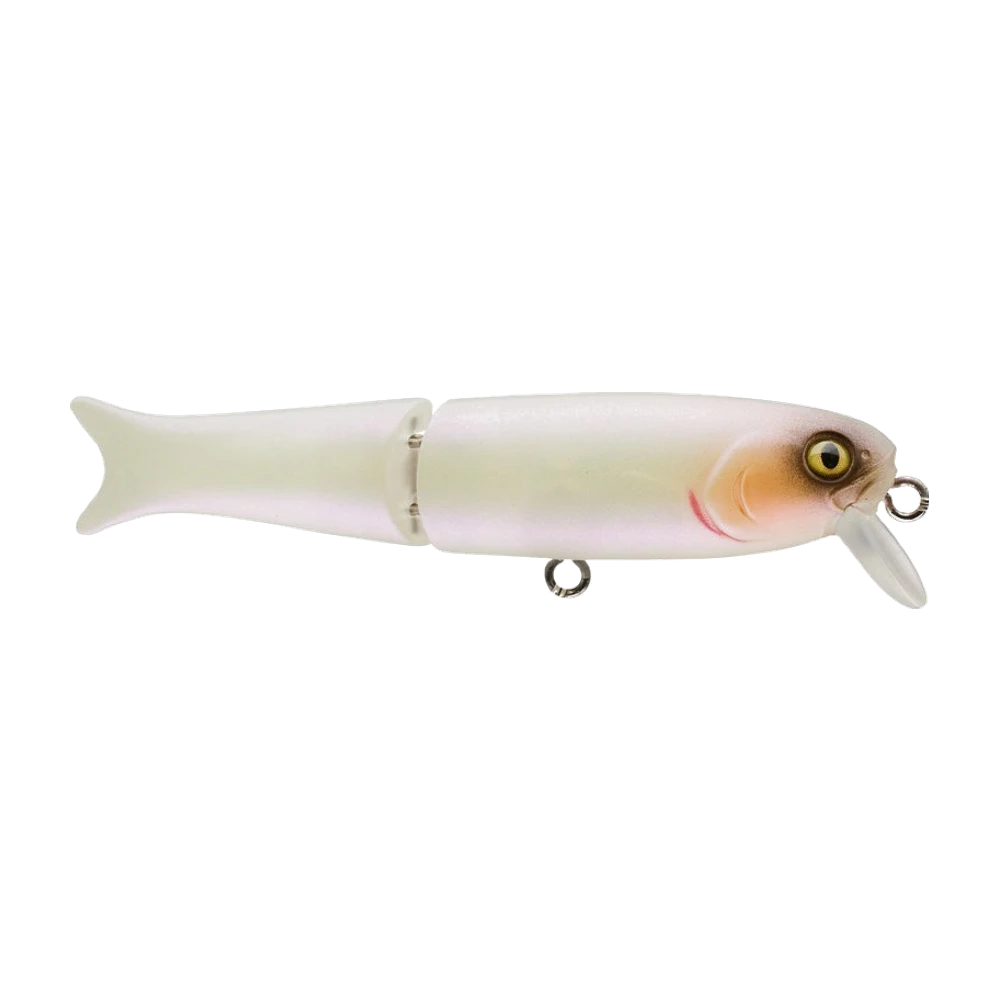
A small lowland creek, a metre of water at best, fry scattering under the bank and fish that refuse anything over seven centimetres. That is the most common summer setup, and the one most tackle boxes have no answer for. The Baitsanity Micro BFS Glide Crank Minnow is a 5 cm jointed hard bait weighing two grams, built to fill exactly that slot.
Two grams, and the tackle that goes with it
The maker states 2 in and 0.07 oz, so 5.1 cm for about 2 g. That casting weight rules out most predator tackle straight away: a rod rated 5-20 g never loads, the lure flies ten metres and lands limp.
Two outfits work. The first is a BFS setup, for bait finesse system: a light casting rod with a shallow-spool reel able to throw under three grams. That is the tackle this bait was drawn for, and it gives the most accuracy under overhanging branches.
The second, easier to come by, is ultralight spinning rated 1-7 g with a small reel and thin nylon. You lose some placement accuracy, you gain distance and you avoid backlashes. Either way, stay between 0.12 and 0.16 mm: a thicker diameter chokes the action of a body this size and costs half your casting range.
Floating, and a 40 centimetre dive
That is the most important figure on the spec sheet, and the one people skim past. The maker describes a floating bait that dives to roughly 1.25 ft on a straight retrieve, so 38 centimetres, and that floats straight back up the moment you stop reeling.
Forty centimetres is very little. It means this is a strictly subsurface tool: banks, weed tops, shallow creeks, fish pinned just under the surface. On a lake where fish sit at two metres it is useless as it comes out of the box — and that is exactly what the maker anticipated with the dots.
The immediate rise on the pause is the other half of the system. It lets you clear an obstacle simply by stopping the retrieve: the bait floats up, passes the branch or the rock, and dives again on the first turn of the handle. On a cluttered creek, that is the difference between ten casts and ten snags.
The two tungsten dots, the real tuning tool
The bait ships with two 0.08 g adhesive tungsten weights. On a 2 g body that sounds trivial — it is actually 8 % of the total weight if you stick both on, and that is more than enough to tip a floater into a slow sink.
Where to stick them
Start with a single dot, under the belly, slightly ahead of the hook hanger. That is the most neutral position: it slows the rise without tilting the bait. Drop the lure in a bucket before you fish and watch it: if it still floats up but slowly, you are there.
With both dots, one either side of the belly to keep it symmetrical, you get something close to a slow sink and you can reach towards a metre by slowing the retrieve. Do not push further: this is not a depth bait, and piling weight on it kills the tail kick.
The classic mistake
Sticking the dots high on the flank. They show, the bait spins, and above all you move the centre of gravity up instead of down — the exact opposite of what you want. Everything goes under the belly, and degrease the surface before sticking, or the first fish takes the dot with it.
A single treble, and what that changes
The Micro BFS carries one treble. On a 5 cm jointed bait that is a sound choice: two trebles on a body that short tangle constantly and lock the joint. But it changes how you set the hook.
With a single anchor point at the back of the front section, a good share of the hits end as contact without penetration, especially from perch, which inhale rather than snap. Do not strike hard: keep reeling for half a second, let the fish load itself against the line, then follow through. A violent set on two grams of lure and 0.14 mm line either tears the treble out or breaks the line.
The adjustment that changes everything on a jointed micro bait is not the weight, it is the knot. A knot cinched tight on the nose eye of a 5 cm body locks the joint badly enough to cancel the movement. Switch to a loop knot and the tail kick doubles in amplitude — you can see it with the naked eye in the first thirty centimetres after the splashdown.
Not sure what to tie on?
Photograph your spot: CarnaFish reads the scene, cross-checks the conditions and gives you the zone, the lure and the retrieve. Free on iOS and Android.
Where and when it really works
The maker positions it for bass, panfish and trout, in ponds and small creeks. In Europe, that translates into three concrete uses.
On perch, along a pond bank or a quay wall, when schools are pushing the year's fry on the surface. The 5 cm size matches the forage of the moment exactly, where an Illex Cherry 44 plays vibration and displaced volume instead.
On river trout, fished downstream or across in slow currents, with the rise on the pause letting you clear the stones. A DUO Tetra Works Toto covers the same size range but sinks, so it works a different layer.
On bass, finally, on small waters where the fish are educated and a jointed 5 cm bait gets eaten where a standard swimbait is refused. In soft plastic, a Fox Rage Micro Fry fills a neighbouring slot with a slower approach.
Its limit is twofold: it does not go down, and it does not cast into a headwind. On a big windy lake it is the wrong tool, and no amount of tuning fixes that.
Colors by light
- Clear water and strong light: the iridescent pearl white in the photo, which stays translucent and mimics a fry without becoming a hard patch of color.
- Weedy bottom or slightly green water: an olive or brown back, which avoids an over-contrasted silhouette above a light bottom.
- Low light, end of day: a golden or amber shade, which stays readable as the light drops without going fluorescent.
On a bait this small, color matters less than the path it takes. If three passes through the same spot give nothing, move a metre before you change lure.
Knowing whether the bank fishes at the surface
A bait that dives forty centimetres only makes sense if the fish are in that layer. That is exactly what CarnaFish helps you work out: one photo of the spot, and the AI suggests the zone to work, the likely depth and the lure family that fits the day's conditions. For small streams and downstream approaches, our guide to river trout fishing covers positioning and casting angles.
Key takeaways
- 5.1 cm for about 2 g: you need a BFS outfit or ultralight spinning, nothing else casts it properly.
- Floating, a 40 cm dive on the retrieve, immediate rise on the pause: this is a strictly subsurface bait.
- The two 0.08 g tungsten dots supplied turn it into a slow sink and let you approach a metre.
- A single treble: follow the bite with the reel instead of striking hard.
FAQ
Does the Micro BFS Glide Crank Minnow float or sink?
It floats as it comes: it dives to about 40 cm on a straight retrieve and rises as soon as you stop reeling. The two tungsten dots in the pack turn it into a slow sink if you want to fish a little deeper.
What rod should I use for this lure?
A BFS outfit, meaning a light casting rod with a shallow-spool reel, or ultralight spinning rated 1-7 g. Two grams loads no conventional predator rod, and the cast becomes impossible to place.
How deep does it actually run?
About 40 cm bare, according to the maker, on a steady retrieve. With both dots under the belly and a slowed retrieve you can approach a metre, but no more than that.
Why only one treble on this bait?
Because a 5 cm jointed body with two trebles tangles constantly and locks the joint. The trade-off is deliberate: fewer anchor points, but a tail kick that actually works.
Is it suitable for trout?
Yes, it is one of the uses the maker lists. The 5 cm size and the immediate rise on the pause suit slow currents and stony bottoms where a sinking bait would snag.
Can you catch bass on a lure that small?
On small waters and educated fish, yes. A jointed 5 cm body often gets eaten where a standard swimbait is refused. On a big windy lake, though, the casting weight becomes a deal breaker.
The full bass lure guideSeason-by-season strategy: which family of lure, when, and why.Go from theory to fish
CarnaFish reads your spot from a photo and gives you the game plan: zone, lure, retrieve. Free on iOS and Android.