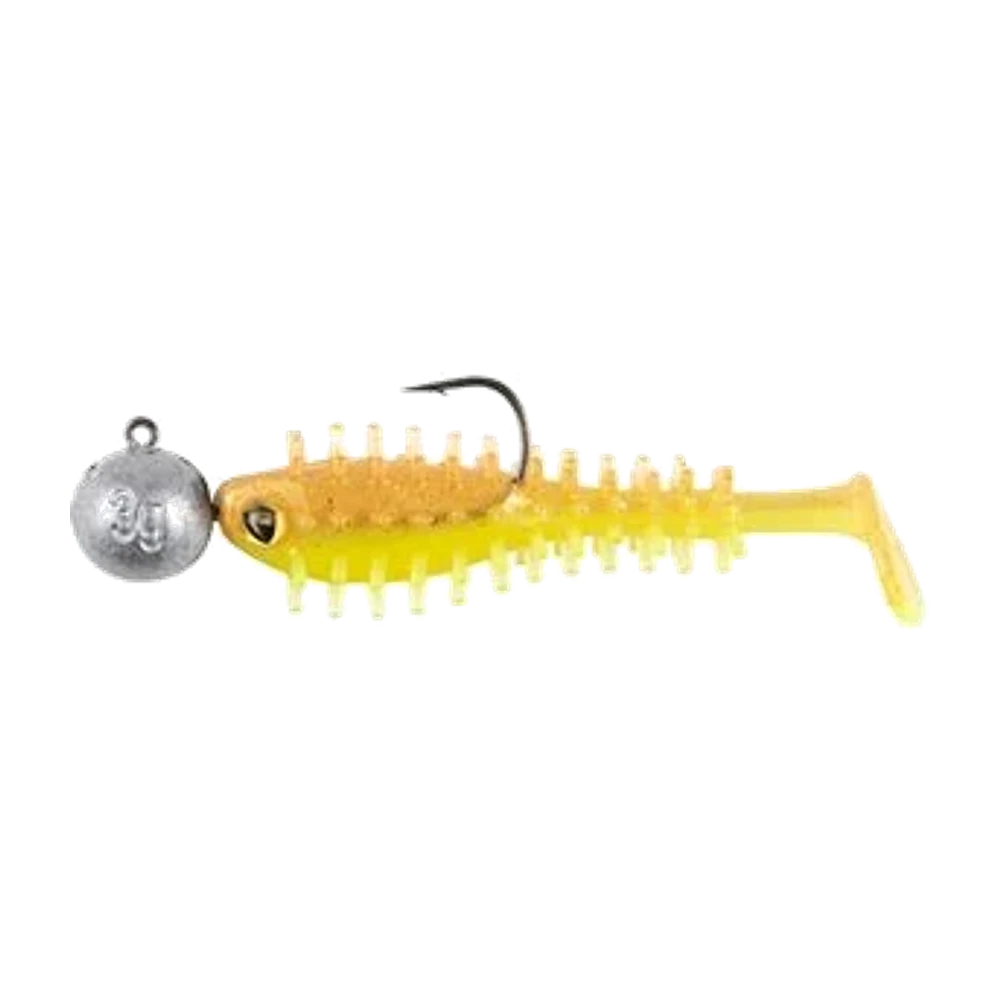
Fox Rage Micro Fry: the micro soft plastic that forgives soft bites
The right lure in the wrong spot still catches nothing. CarnaFish spots the zone that works, from a single photo.
Late summer, low clear water, the perch are glued to a margin and refusing everything. You switch to a micro lure, you see the bites come — and one in four gets landed. The rest are fish that nip, feel something hard, and let go before you have time to lift the rod.
That is not a lure size problem. It is a material problem. A micro hard lure gives you no grace period: the fish closes its mouth on a rigid block of plastic and spits it out within half a second. A soft plastic the same size compresses in the mouth, clears the hook point, and gives the fish the illusion of having grabbed something edible for one second longer.
The Micro Fry plays on exactly that: it is a miniature soft shad, designed for the situations where you would normally reach for a micro hard lure, and where bite conversion is the real issue.
A shad, not a shrunken hard lure
Three practical differences change how you fish:
- The body compresses on the hookset. On a fish nipping from behind, the material squashes and the point comes through. That is the main reason for the conversion gain on wary fish.
- The action does not depend on retrieve speed. The fine tail of an ultra-light shad kicks as soon as the lure moves, even on a simple drop or a light pull. A micro hard lure needs a minimum speed before its lip works.
- The lure fishes at every depth with the same body. You just change jig head. A micro hard lure is locked into the depth band it was designed for.
In exchange you lose what a hard lure does best: self-contained action, the flash of a hard finish, and the ability to be cast far with no added weight.
Weighting it right: the real setting
On a lure this size, the jig head is not an accessory detail, it is half the fishing. Too heavy and you crush the tail and the lure drops like a stone. Too light and you feel nothing.
| Situation | Jig head | Target depth |
|---|---|---|
| Margins, weed, very clear water | 1 to 1.5 g | 0.3 to 1 m |
| Gravel beach, standard spot | 2 g | 1 to 2 m |
| Hole, wall foot, quay | 3 to 4 g | 2 to 4 m |
| Cross wind or light current | +1 g | keep contact |
Use fine-wire, short-shank hooks. Thick wire on a 5 cm body demands a hookset force an ultra-light rod cannot deliver, and you lose precisely the fish you were trying to convert.
The retrieve: three sequences to try in order
- The straight retrieve just off the bottom. Cast, count the sink, then wind continuously and very slowly thirty centimetres off the bottom. Two or three casts to find out whether the perch are active.
- Short lifts. Two small twenty-centimetre lifts of the rod tip, a two-second pause, repeat. That is the sequence that converts the followers from the straight retrieve.
- The controlled drop. Semi-tight line, you simply let it sink alongside a vertical structure. The tail kicks all the way down. On lethargic fish, that is often the only sequence that works.
Set the hook by lifting the rod smoothly, with no sharp snap of the wrist. On fine line and a light-wire hook, a brutal hookset pulls out as many fish as it pricks.
On the water: when a perch follows you right to your feet without biting, do not cast again. Just let the Micro Fry sink vertically in front of you, rod high, with no action at all. The tail alone keeps working on the drop — and that refusal turns into a bite one time in three. It is a movement a hard lure cannot produce at a standstill.
Where it excels, where it is useless
Its ground:
- Clear, low late-summer water, on perch that see the lure for a long time before taking it.
- Urban spots — quays, wall feet, jetties — where you fish vertically at short range.
- Days with lots of small perch, when the job is finding the next size up in a dense shoal.
Its limits are sharp. It does not cast far: with a 1.5 g head, eighteen metres is already good going, and wind cuts that figure immediately. In stained or coloured water, its low bulk does not produce enough signal to be found. And it has no business on a big pike spot: the light wire it demands will not hold.
Not sure what to tie on?
Photograph your spot: CarnaFish reads the scene, cross-checks the conditions and gives you the zone, the lure and the retrieve. Free on iOS and Android.
Colours
In clear water, translucent with fine flecks, matching the dominant fry in the water. That is the only case where colour really matters on this lure, because a perch sees everything. Under grey skies or over a dark bottom, a more contrasted pattern — dark back, pale belly, a spot of colour on the tail — improves detection without going fluorescent, which tends to put off wary fish in clear water.
Micro Fry or micro hard lure
The Illex Tiny Fry 50 and the Zipbaits Rigge 56 cover the same size bracket with the opposite logic. They are hard lures: they cast well, they have self-contained action, they hold a given depth band and their finish throws a flash a soft plastic will never produce. On an active perch hunting in open water, they take the lead because they cover more ground.
The Micro Fry takes over in three situations: fish that nip without committing, vertical fishing at short range, and the need to change depth without changing lure. It is not an alternative, it is the complement — plenty of sessions are handled by starting on the hard lure to locate, then switching to soft on the fish you have found. On a drop shot, the body takes a nose-hooked drop shot rig on a fine hook very well.
Our guide to perch fishing with lures covers that alternation across a full day. And if you are torn between soft plastic and hard lure when you arrive at the bank, CarnaFish analyses a photo of the spot and answers.
Key takeaways
- The soft body compresses on the hookset: better conversion on perch that nip.
- Jig head of 1 to 4 g depending on depth, never heavier than necessary.
- Fine-wire hooks are essential; thick wire costs fish on ultra-light gear.
- The vertical drop with no action converts the followers along the margin.
- Useless beyond a twenty-metre cast and in coloured water.
FAQ
What jig head for the Fox Rage Micro Fry?
1 to 1.5 g along the margin and in clear water, 2 g on a standard spot, 3 to 4 g to fish between 2 and 4 m. The right setting is the lightest that still lets you feel the bottom.
Why prefer a soft shad to a micro hard lure?
Because it compresses in the fish's mouth and gives you time to set the hook. On perch that nip the back of the lure without committing, the conversion rate is markedly better than with a rigid lure.
What gear should I use with this lure?
An ultra-light rod rated 1 to 7 g, fine braid of 0.06 to 0.08 mm and a 0.14 to 0.18 mm fluorocarbon leader. The whole setup has to stay capable of transmitting a bite on a 5 cm lure.
Does the Micro Fry work in murky water?
Hardly. Its bulk and vibration are too weak to be detected at a distance in coloured water. In those conditions, a bulkier shad with a wide tail covers far better.
Can it be rigged on a drop shot?
Yes, nose-hooked on a fine hook. The tail then works without the lure advancing, which makes it a good option on a vertical spot with stationary fish.
How far can you cast it?
Around fifteen to twenty metres with 1.5 g, a little more with 3 g. As soon as there is wind, distance drops sharply: this lure is fished at short range, it is not a searching tool.
The full perch lure guideSeason-by-season strategy: which family of lure, when, and why.Go from theory to fish
CarnaFish reads your spot from a photo and gives you the game plan: zone, lure, retrieve. Free on iOS and Android.