Norman DD22: the crankbait that reaches fish at 5 metres
Rather not fish it blind? Photograph your spot — CarnaFish cross-checks the conditions and points you the right way.
There comes a point in a summer day when nothing works along the banks any more. The fish have slid out onto the first drop, five metres down, sitting on a gravel point or glued to a pile of sunken timber. From a float tube you can see them on the screen and you have nothing in the box that gets low enough to touch them. That's exactly the gap the Norman DD22 has been filling for decades.
A bill built for one job only
The DD22 isn't trying to be versatile. Its single purpose is to reach a layer of water most crankbaits never see: Norman states 15 to 18 feet, that is 4.6 to 5.5 m, and adds that on a long cast the bait goes past the 18-foot mark. You pay for that with the bill, a translucent plate nearly as long as the body, angled so the lure keeps its nose-down attitude all the way down.
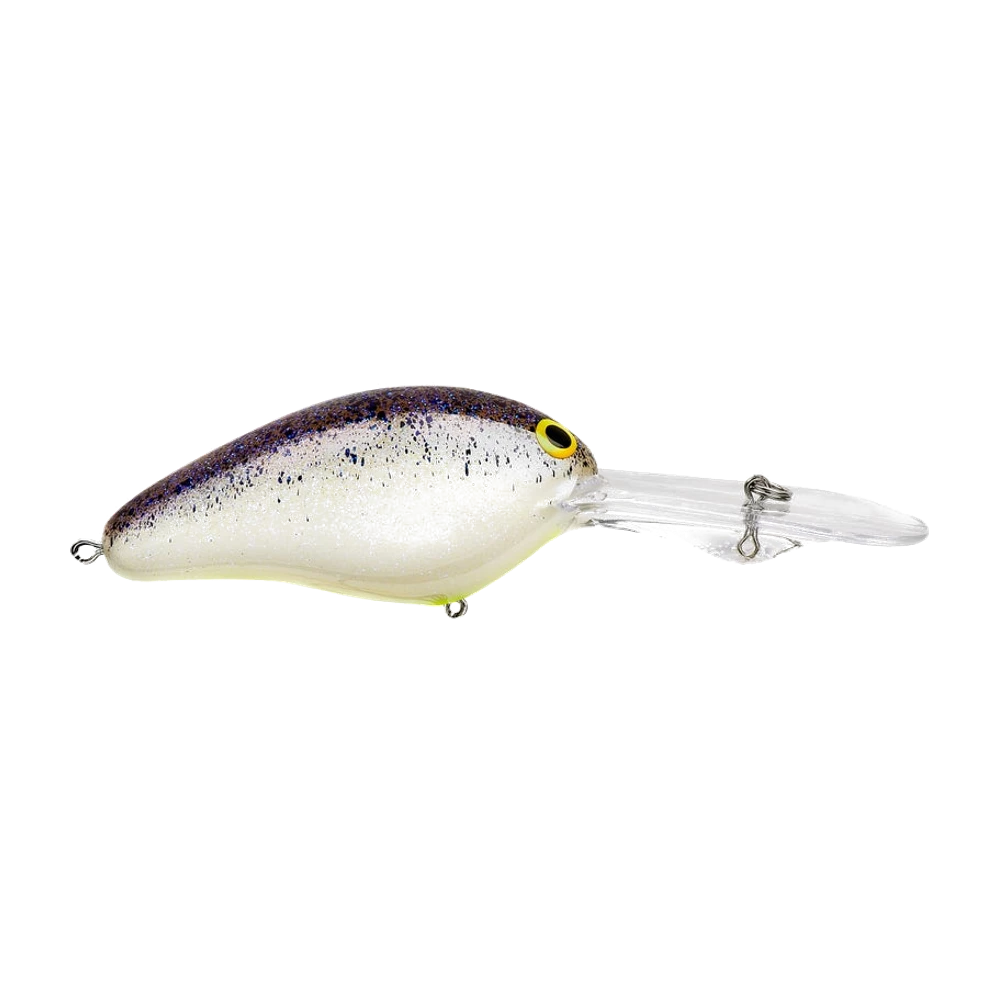
The detail that jumps out on the product photo is where the line tie sits: not on the nose, but mounted through the bill, well forward of the head. That's no small thing. Pulling from the bill applies the line's effort exactly where the downward force is generated, which steepens the dive angle and keeps the bait settled when it clatters into cover. Same logic as a Strike King 10XD or a Rapala DT16: the longer the bill, the further out the tie point has to move for the whole thing to stay controllable.
On measurements, Norman gives 3 in / 7.6 cm for 5/8 oz / 17.7 g. What matters is the ratio: a short, tall body carrying a lot of weight. That's what fires the thing a long way despite the wind drag of that bill, and casting distance is a full part of the depth you end up getting.
Floating, and that's half the technique
The manufacturer's table lists the DD22 as Floating. That isn't paperwork, it's the operating manual. Stop reeling and the body rises, and it rises backwards — nose first, since the bill acts as a rudder. Norman presents that reverse float as the mechanism that frees the lure once it has wedged itself into a branch.
In practice it's a reflex to build: when the bill hangs, don't pull. Go completely slack, give it line, let the bait back out a few centimetres and float over the obstruction, then pick it up gently. Nine times out of ten it releases itself. The angler who keeps everything tight and strikes on the first wooden thud buries the treble for good.
Slack line does as much work as the lure here. With a deep crank, always keep a small bow between the rod tip and the water: that bow is what lets the body back up on a pause. A permanently tight line stops the DD22 doing the one thing it was designed for.
A butyrate body and rattles that shout
Norman builds the DD22 from butyrate, a dense, slightly forgiving plastic that takes repeated hits on rock without splitting — which matters when the programme is three hours of grinding a boulder flat at five metres. The brand also describes a boisterous rattle system that creates a distinct acoustic signature.
That's both a selling point and a limit. On stained water, on a chopped-up lake, or when fish are actively feeding, the signal carries a long way and pulls in fish that never saw the lure pass. On clear, heavily pressured water on a flat calm day, it can push wary fish away instead. For that exact case, a quieter crank like a Bomber Fat Free Shad or a slightly shallower Strike King 6XD usually produces better days.
Where and how to work it
Contact is the action
A deep crank swimming through open water does nothing. The whole point of the DD22 is to hit something: the gravel of a ledge, the top of a brush pile, a rock slab. Cast past the zone, crank at a steady medium pace until you feel the first contact, then keep going and let the bill grind. Every time it stops dead, pause for half a second: the body lifts slightly, resets into its swim, and that off-balance second is very often when the bite comes.
The rest is spot reading. The profiles that produce are always the same: the edge of an old river channel, a rocky point running deep, drowned timber at the base of a drop. In Europe, that 4-to-6-metre band is mainly found on big reservoirs, deep gravel pits and impoundments, rarely in flowing rivers.
Tackle, which is not an afterthought
With 17.7 g of lure and a bill pulling hard, a stiff rod is counterproductive: it tears the treble out mid-fight. A parabolic cranking rod, one that bends down into the butt, absorbs head shakes and holds tension. A moderate-ratio reel, around 6:1, keeps you from winding too fast without wrecking your wrist. And fluorocarbon around 0.25-0.30 mm: thinner line runs the lure deeper, but you lose your margin against abrasion on rock. That trade-off is made spot by spot.
Norman's table lists size #2 trebles, and the copy mentions two hooks. Note, though, what the photographed sample actually shows: it appears bare, with two empty hook hangers, no split rings and no trebles fitted. That's an observation from a product photo, not a specification — check what the packaging you buy actually contains.
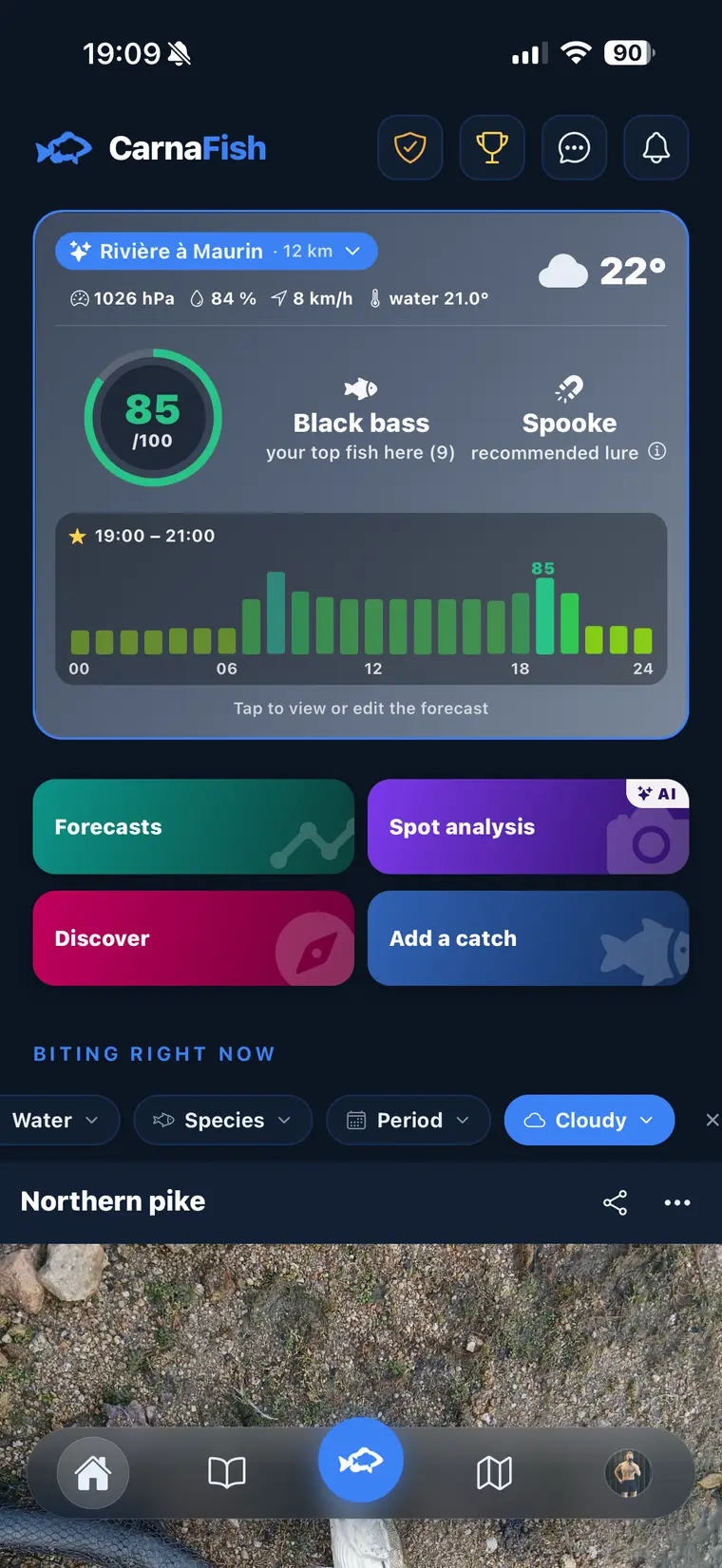
Not sure what to tie on?
Photograph your spot: CarnaFish reads the scene, cross-checks the conditions and gives you the zone, the lure and the retrieve. Free on iOS and Android.
Colour by water clarity
- Clear water: a pearl shad, dark flecked back over silvery white flanks, like the sample photographed. It works by silhouette more than by colour, which suits five metres down where light is already filtered.
- Lightly stained water: a citrus shad, natural on the back with yellow-green under the belly, keeping a credible base while giving the fish a visual anchor.
- Muddy water: chartreuse with a black back, the reservoir classic after rain, where contrast matters far more than realism.
A search tool, not a finishing bait
The DD22 covers a lot of water fast, and that's its real trade. It's there to find the level fish are holding at, not to pick them off one by one. Once you get a bite, running the same contour more slowly with a weighted soft-plastic rig, or dropping to a smaller crank like the Norman Deep Little N if the area turns out shallower than you thought, usually produces the follow-up fish.
All of which assumes you know where the drop is before you cast. That's exactly what CarnaFish does: a photo of the spot, and the app suggests the zone to cover, the likely depth and the lure type suited to the day's conditions. To learn to spot those structures by eye before you even switch the sonar on, our guide to reading a fishing spot walks through the clues to look for.
Key takeaways
- Norman states 4.6-5.5 m, deeper on a long cast: casting distance is part of the running depth.
- Listed as floating by the maker, it backs up and rises on the pause — that's the snag-release mechanism, and it only works with slack line.
- The line tie is mounted through the bill, which steepens the dive angle and settles the bait on contact.
- Short, heavy body, 7.6 cm for 17.7 g, with a loud rattle system that shines in stained water and can work against you on clear, pressured water.
FAQ
How deep does the Norman DD22 actually run?
Norman states 15 to 18 feet, that is 4.6 to 5.5 m, and notes the bait goes past that band on a very long cast. In practice the real depth depends as much on cast length and line diameter as on the lure itself: thin fluorocarbon and a forty-metre cast easily buy you another half metre.
Does the DD22 float or sink?
The manufacturer's table lists it as floating. On a pause it rises, and it rises backwards because of the bill angle. That behaviour is what lets you free it from a branch without pulling on it.
What line should I use with a deep crank like this?
Fluorocarbon around 0.25-0.30 mm is the right compromise. Thinner runs the lure deeper but you take a risk on abrasion against rock. Braid is best avoided here: it floats, it limits the dive and it removes the cushioning the treble needs.
Do I need a specific rod?
Yes, and that's often what's missing. A parabolic cranking rod that bends deep stops you tearing the treble out on the hookset and during head shakes. A stiff, tip-action rod multiplies lost fish with a 17.7 g bait thrown a long way.
Is it any good for zander?
On a deep lake, yes, provided you stay on a steady retrieve and keep looking for bottom contact. Zander respond well to a bill kicking up substrate, but they handle a lure racing above them badly: slow down as soon as the bites turn short.
How many trebles, and what size?
Norman's copy mentions two trebles and the table gives size #2. The photographed sample, however, appears bare with two empty hangers: that's an observation from a product photo, not a specification, so check the contents of the pack before you head out.
The full bass lure guideSeason-by-season strategy: which family of lure, when, and why.Go from theory to fish
CarnaFish reads your spot from a photo and gives you the game plan: zone, lure, retrieve. Free on iOS and Android.