Rapala BX Minnow: the balsa that finally accepts hitting rock
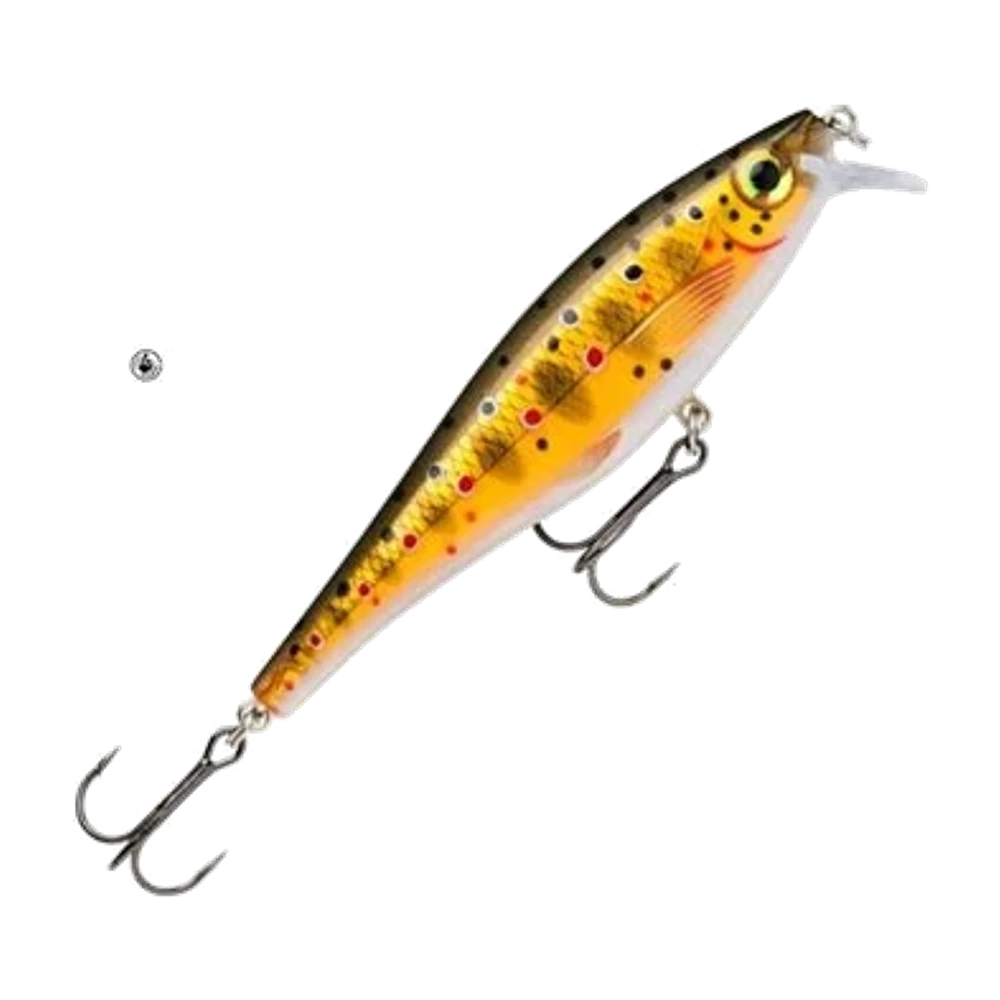
This lure shines under specific conditions. CarnaFish tells you in 10 seconds if today is one of them.
Every river angler knows the moment: you have a balsa minnow that swims beautifully, you cast it against a boulder because that is exactly where the trout is lying, and two sessions later its nose is split, the lip sits crooked and it swims on its side.
Balsa has an action hollow plastic cannot match — it is light, it reacts to the slightest current, it snaps back to horizontal instantly after a twitch. But it is soft wood, with paint that chips and a lip anchor that works loose.
The BX Minnow answers that compromise precisely: a balsa core wrapped in a moulded plastic shell. The wood provides the buoyancy and the liveliness, the plastic absorbs the impacts and holds the lip. It is a hybrid build, and understanding it changes how you use it.
What the double construction actually changes
Three effects, all measurable at the waterside.
- The lure is heavier than a bare balsa of the same length. That does not sound like an advantage, but on a river it is decisive: you cast into the wind coming up the valley, you reach the far bank, you fire flat casts under branches.
- Buoyancy stays high but not extreme. The BX rises decisively on the stop, more slowly than pure balsa. On a cluttered lie, that controlled rise gives you time to free the lure from a rock.
- The shell protects the paint and the anchor. You can bounce it off rock without writing it off by the end of the day. That is what allows genuinely close-contact fishing.
The honest trade-off: at very low speed and in dead water, bare balsa still starts working a shade earlier. On a lake with no current at all, you feel the difference. On a river, the flow erases it.
Fishing a river: the lure works against the current
With a floating minnow in a river, it is not your hand that creates the action. It is the water. Your only real decision is the angle at which you present the lure.
- Read the seam and position yourself downstream, or three-quarters downstream, of the lie.
- Cast three-quarters upstream, beyond the target zone, never onto it.
- Retrieve just fast enough to keep contact. The lure should vibrate in your hand without you having to tow it: the current does the work.
- Level with the obstacle — boulder, stump, foam line — give one short twitch and stop. The lure darts sideways then rises a few centimetres.
- Let it drop back on the drift for a second before picking up again. The bite almost always comes in that second.
On slow current or a mill pool, reverse the logic: a distinctly faster retrieve with more frequent twitches, to make up for the missing flow.
On the water: on a trout river, work upstream rather than down, and always cast beyond the lie. A trout sitting behind a boulder faces upstream. A lure arriving from behind, in its blind spot, is only seen at the last moment — and it bolts instead of attacking.
Choosing size and depth
| Size | Depth | Water |
|---|---|---|
| ≈7 cm | 0.6 to 1 m | Small rivers, riffles, classic river trout |
| ≈8 cm | 0.8 to 1.2 m | Medium rivers, perch along lake margins |
| ≈10 cm | 1 to 1.5 m | Big rivers, deep mill pools, better perch |
Two useful adjustments:
- Fluorocarbon in 0.18-0.20 mm keeps all the liveliness on the smaller sizes. Above 0.25 mm the lure visibly goes numb.
- A small fast-link clip is acceptable and saves you valuable time when you change lures ten times while working down a river. Stick to a light, fine model.
Tuning the action when the lure runs off line
A hard lure that has banged into rock ten times ends up swimming off line: it climbs to the right or the left instead of tracking straight, and it blows out of the water as soon as you speed up. That is normal, it takes ten seconds to fix, and almost nobody does it.
The rule is counter-intuitive: you bend the eye to the opposite side from the drift. If the lure runs to the right, you push the eye gently to the left. The movement has to be tiny — an eighth of a turn, no more — with fine flat-nosed pliers, holding the lip with your other hand so you do not strain the anchor.
Then check it by swimming the lure a metre from your feet, medium retrieve, rod high. It should track straight. Repeat until it does, always correcting in small increments: on a plastic-shelled body the eye holds well but does not forgive repeated back-and-forth.
That tuning also works as a purchase check. Take the lure out of the packet and swim it in front of you before you start your session: you will know at once whether it needs correcting, rather than working it out after twenty casts without a bite.
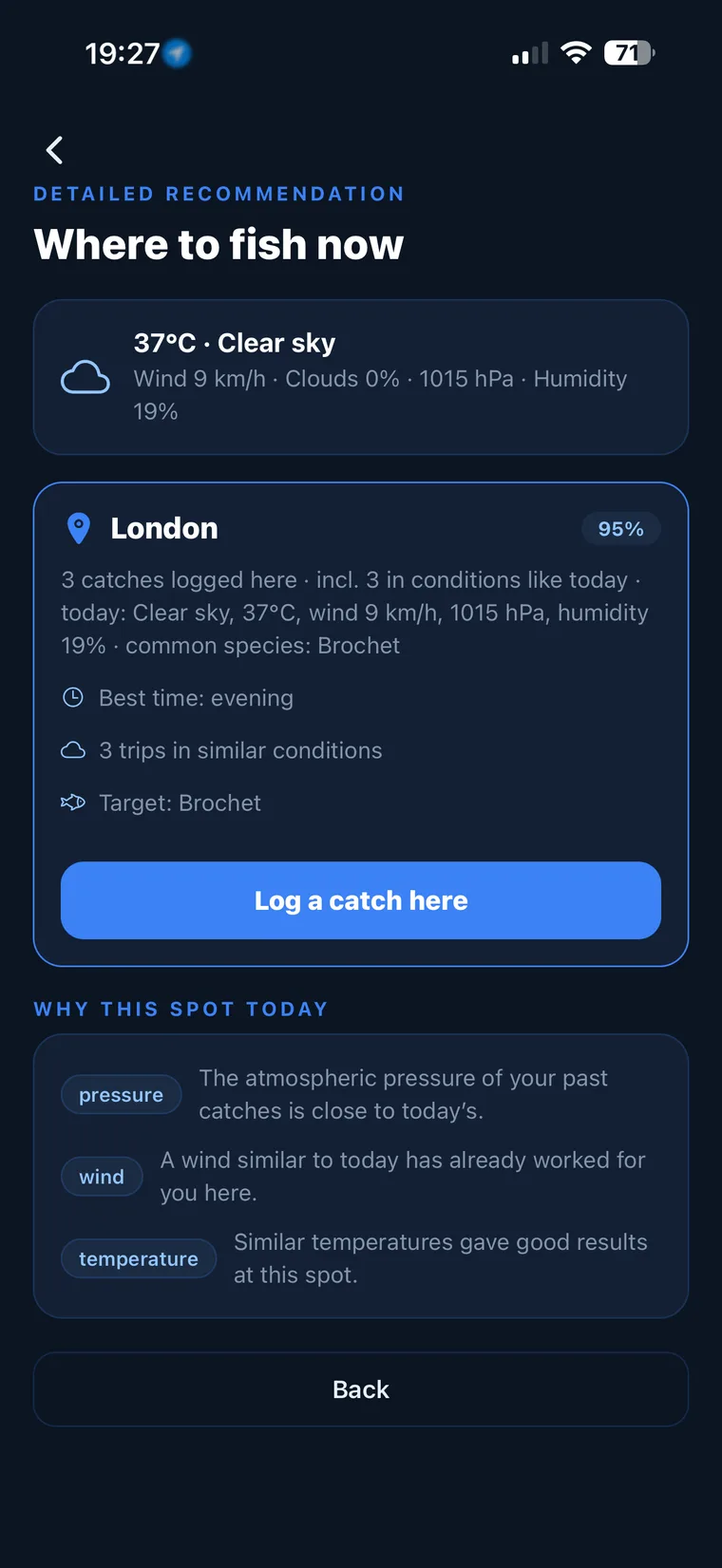
Not sure what to tie on?
Photograph your spot: CarnaFish reads the scene, cross-checks the conditions and gives you the zone, the lure and the retrieve. Free on iOS and Android.
Where it excels
- Clear rivers and small streams, on wild trout, in contact with rock and margins.
- Cluttered lies you would not dare fish with fragile balsa: under branches, against boulders, in open log jams.
- Windy days, where its extra mass saves your casts.
- Perch along lake margins, on rip-rap and jetties, early and late in the day.
The situations where it is the wrong choice:
- Deep water: past a metre fifty it will not get down. You need a sinking model fished on a count.
- Dead water and very apathetic fish: pure balsa or a lure with an even finer action will beat it.
- Long slow-trolled drifts on a lake: that is not its job.
BX Minnow or classic balsa
The Rapala Original Floater F11 is bare balsa. It is lighter, livelier at very low speed and rises harder on the stop — it is the better choice on calm water, on a fish that wants an action starting at a crawl, and when you are fishing clean, away from rock.
The BX Minnow takes the lead in exactly the opposite picture: current, wind, hard obstacles, and a day when you are going to bang it about. You lose a shade of finesse, you gain casting distance and an incomparably longer life.
If you want to get further down the water column on the same lie, a Rapala CountDown fished on a count is the logical companion. On heavily educated trout in gin-clear water, a Smith D-Contact worked in twitches will do better. Our guide to river trout fishing covers how to string these approaches together along one beat. And if you are unsure which way to work an unfamiliar beat when you get there, CarnaFish analyses a photo of the spot and answers.
Key takeaways
- Balsa core, plastic shell: the liveliness of wood with an impact resistance that allows close-contact fishing.
- Heavier than bare balsa: better casting into wind and under branches.
- On a river, cast three-quarters upstream and beyond the lie, never onto it.
- One single twitch level with the obstacle, then a second of drift: that is where the bite comes.
- On dead water with apathetic fish, pure balsa is still ahead.
FAQ
What is the difference with a classic balsa Rapala?
The BX adds a plastic shell around the balsa core. It is heavier, so it casts better, and it takes impacts against rock without breaking or chipping. In exchange, bare balsa starts working slightly earlier at very low speed.
How deep does it run?
Between 0.6 and 1.5 m depending on size, with fine fluorocarbon. It is a shallow-band lure: to fish deeper you need a sinking model or one with a longer lip.
Is it a good lure for river trout?
Yes, that is its home ground. Its toughness lets you run it in contact with boulders and margins, where trout actually lie, without having to nurse the lure.
What line diameter should I use?
Fluorocarbon of 0.18 to 0.20 mm on the small sizes, up to 0.25 mm on the 10 cm version. Above that the action goes noticeably numb, especially in slow current.
Should I fish upstream or downstream?
Upstream, casting three-quarters. Trout face upstream: a lure arriving behind them makes them bolt, a lure coming down towards them is seen naturally.
Does it catch perch?
Yes, especially along lake or river margins on rip-rap and jetties, retrieved with small twitches. The 8 and 10 cm sizes target the better perch.
The full trout lure guideSeason-by-season strategy: which family of lure, when, and why.Go from theory to fish
CarnaFish reads your spot from a photo and gives you the game plan: zone, lure, retrieve. Free on iOS and Android.