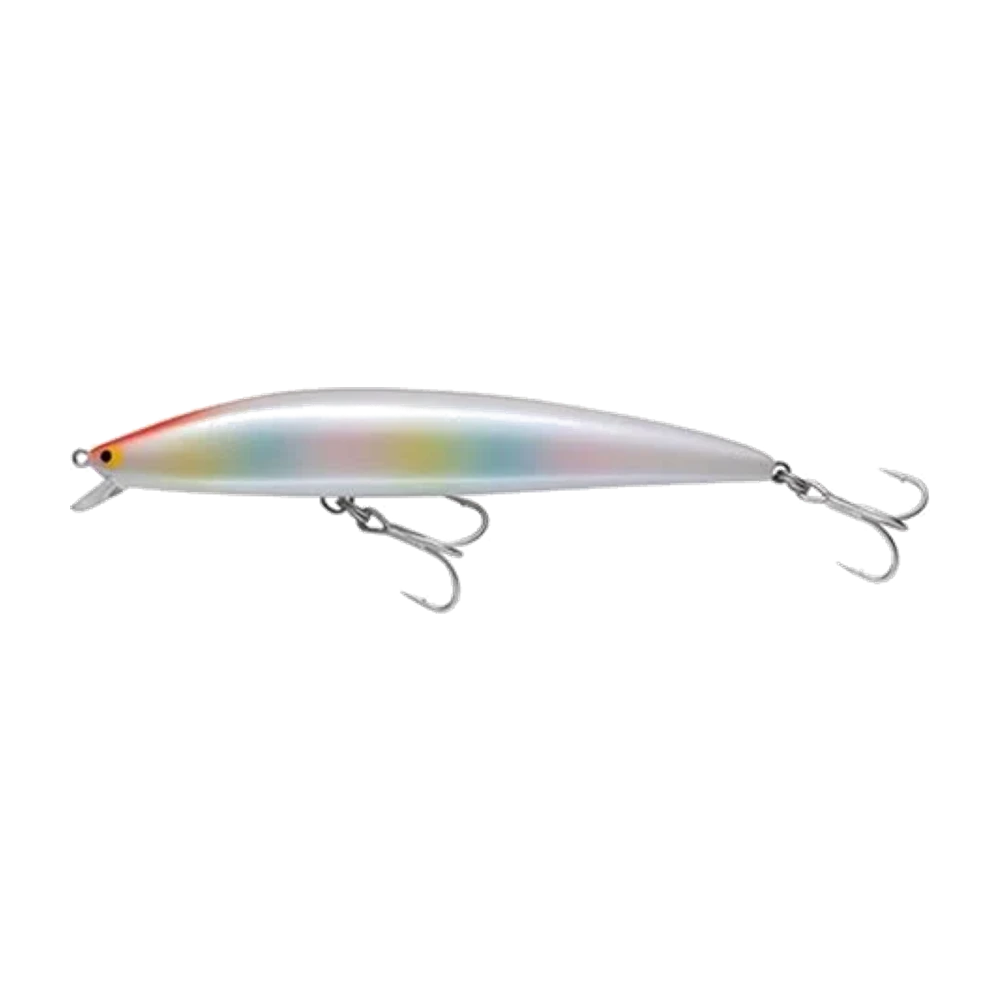
Tackle House Tuned K-Ten: the minnow that stays inside the wave
Rather not fish it blind? Photograph your spot — CarnaFish cross-checks the conditions and points you the right way.
You are out on a rocky point, there is a metre of swell, the wind is quartering into your face and bass are feeding fifty metres out. You cast your usual floating minnow: it helicopters in the gust, falls short, and the moment it meets a wave it blows out, comes clear of the water and starts buzzing in mid-air. You wind it back half fishing, half correcting.
That is exactly the scenario the K-Ten series was drawn for. This is not a lure of special effects: it is a lure that keeps swimming when the others stop. Its value shows on the ugly days, not on the flat-calm ones.
A mass that travels, then locks
The problem with long casting in saltwater is not rod power, it is the lure's balance in flight. A light, long minnow spins on itself, offers its flank to the wind and loses half its distance.
The Tuned K-Ten solves that with a weight transfer system: on the cast, the mass runs back towards the tail, the lure leaves like an arrow, nose first, and stays aligned all the way. As soon as you come back under tension and start winding, the mass settles back at the front and the lure finds its swimming attitude.
Three concrete consequences you feel in the rod:
- You gain real metres, especially into wind, where the difference against a fixed-ballast minnow shows most.
- The action starts immediately, with no two or three turns of floundering.
- The lure stays low in the wave instead of being lifted by the swell and breaking the surface.
Add a slim, dense profile and a deliberately tight action — a fast roll rather than a wide wobble — and you get a lure that holds in churned water. That is a conscious technical choice: in chop, a wide action becomes an anarchic one.
The retrieve: let the current do half the work
This is not a jerk lure. You can jerk it, but that is not where it catches.
- Cast across the current, not along it. Aim at the top of a run, a spill between two rocks, the edge of a foam line.
- Give it two seconds to let the lure sink 30 to 80 cm depending on the model. Count, so you can repeat exactly the same pass.
- Wind slowly and steadily, rod low, tip pointed at the lure. The current swings the lure round in an arc: that trajectory is what presents the flank to a holding fish.
- Slow down further at the end of the arc, as the lure comes into line with the current. That is where most bites land, at the moment it turns side-on before straightening up.
- Finish with two fast turns just before you lift the lure out: a following bass often commits on that final acceleration.
On the water: in a rough sea, do not try to feel the lure's action — all you will feel is the wave. The real reference is line tension. If it disappears for half a second, a wave has just pushed the lure towards you: give one extra turn of the handle to pick up the slack, or you will miss the bite that follows.
When the sea is flat and the bass are wary, flip the logic: a very slow retrieve broken up with one to two second pauses. The lure drops slightly during the pause and sets off again rising, which is often enough to decide a fish that was refusing the straight retrieve.
Choosing the size to suit conditions
| Conditions | Size | Target depth | Speed |
|---|---|---|---|
| Flat sea, fish on small prey | 9 cm | 20 to 50 cm | slow, with pauses |
| Moderate wind, short chop | 11-12 cm | 50 cm to 1 m | sustained straight retrieve |
| Big sea, strong current, headwind | 13-14 cm | 80 cm to 1.2 m | sustained, rod low |
| Night fishing, calm water | 11-12 cm | 30 to 60 cm | very slow, pure straight retrieve |
The simple rule: you go up in size to keep control, not to attract more. A heavier model stays in the water when it is churning, and that is the only criterion that counts on those days. Conversely, on a flat sea the 14 cm reads as a block and gets refused.
On depth, rod angle counts as much as speed. Rod high and the lure climbs and scratches the surface. Rod low, tip almost in the water, and it holds 30 to 40 cm deeper. You adjust your layer of water without changing lures.
Rigging: simple, but two points not to miss
The leader. Fluorocarbon of 0.30 to 0.40 mm over 1 to 1.5 m, joined to braid with a slim connection knot. Heavier, and you choke an already tight action. Finer, and you break off on the first rock — and in saltwater you are always fishing near rocks.
The connection. A direct knot or a good-quality small round snap. Avoid angular snaps and heavy swivels at the nose: they make the lure nose down and distort its attitude.
The hooks. Stainless is not a luxury, it is compulsory. Rinse in fresh water after every session and check the points: one rock is enough to blunt them, and a 60 cm bass hooked on a folded point comes off on the first jump. If you are fishing in the rocks, opposed singles cut your snags noticeably without losing hook-up rate.
Not sure what to tie on?
Photograph your spot: CarnaFish reads the scene, cross-checks the conditions and gives you the zone, the lure and the retrieve. Free on iOS and Android.
Where it excels, and where it is useless
Its window is clear: churned water, current, and fish feeding in mid-water. Swept rocky points, estuary mouths on the flood, passes between islets, beaches with a well-formed line of foam. Anywhere you have to cast far, fish below the surface and keep control.
It is unsuited in three cases. On visible surface feeding, when bass are smashing fry in open water, a surface stickbait like the Xorus Patchinko 140 does a job this minnow never will. Over more than 4 or 5 m of water it does not go deep enough: that is the territory of soft plastics on a jig head. And in very dirty water after a blow, its discreet action goes unnoticed against a lure that pushes plenty of water.
K-Ten or a classic saltwater minnow
Against a Shimano Exsence Silent Assassin, the difference lies in the character of the action rather than in distance: both cast far thanks to a weight transfer, but the Exsence offers a slightly wider action and a deeper profile, which speaks better on calm water and active fish. The K-Ten keeps the advantage when the sea builds, because its tight action does not degenerate.
Against a Daiwa Shoreline Shiner Z Vertice, the philosophies are close and the real difference is density: the sinking K-Ten lets you choose your layer of water by counting, where a floating model imposes its own.
Our guide to lure fishing for sea bass explains how to read a current line before you even cast. And if you are unsure which size to tie on in front of a building sea, CarnaFish analyses a photo of the spot and answers.
Key takeaways
- The weight transfer gives distance into wind and an action that starts instantly.
- A deliberately tight action: that is what stops it blowing out in chop.
- Cast across the current, slow down at the end of the arc: the bite almost always comes there.
- Go up in size to keep control when it churns, not to attract more.
- Useless over clear surface feeding and over more than 4 m of water.
FAQ
Does the Tuned K-Ten float or sink?
The range is built around dense models that sink slowly at rest. That is what lets you choose your layer of water by counting seconds after the cast, and hold under the surface when the swell is working.
Which size should I start with?
An 11 or 12 cm covers most shore situations: heavy enough to cast in moderate wind, slim enough not to spook a bass feeding on small prey. You then fill in towards the 14 cm for a big sea.
What retrieve speed?
A straight, steady retrieve, a little slower than your natural instinct. The action is already very lively: winding faster only lifts the lure towards the surface without adding any signal.
Can it be fished at night?
Yes, and that is one of its best windows. Switch to a very slow retrieve with no twitches, and to plain light or frankly dark colours. At night it is the regularity of the signal that counts, not the colour.
Should I replace the stock hooks?
Not automatically, but check the points after every session on rocky ground. If you do change them, stay with an equivalent wire diameter in stainless: heavier trebles make the lure nose down and change its attitude.
What is the difference from a classic floating minnow?
A floater stays high and rises at rest, which limits the layer of water you can reach and leaves it vulnerable to the swell. This model sinks at rest: you choose your depth, and you stay in the water when the sea gets up.
The full sea bass lure guideSeason-by-season strategy: which family of lure, when, and why.Go from theory to fish
CarnaFish reads your spot from a photo and gives you the game plan: zone, lure, retrieve. Free on iOS and Android.