Bassday Crystal Popper: the sea bass popper that holds up in chop
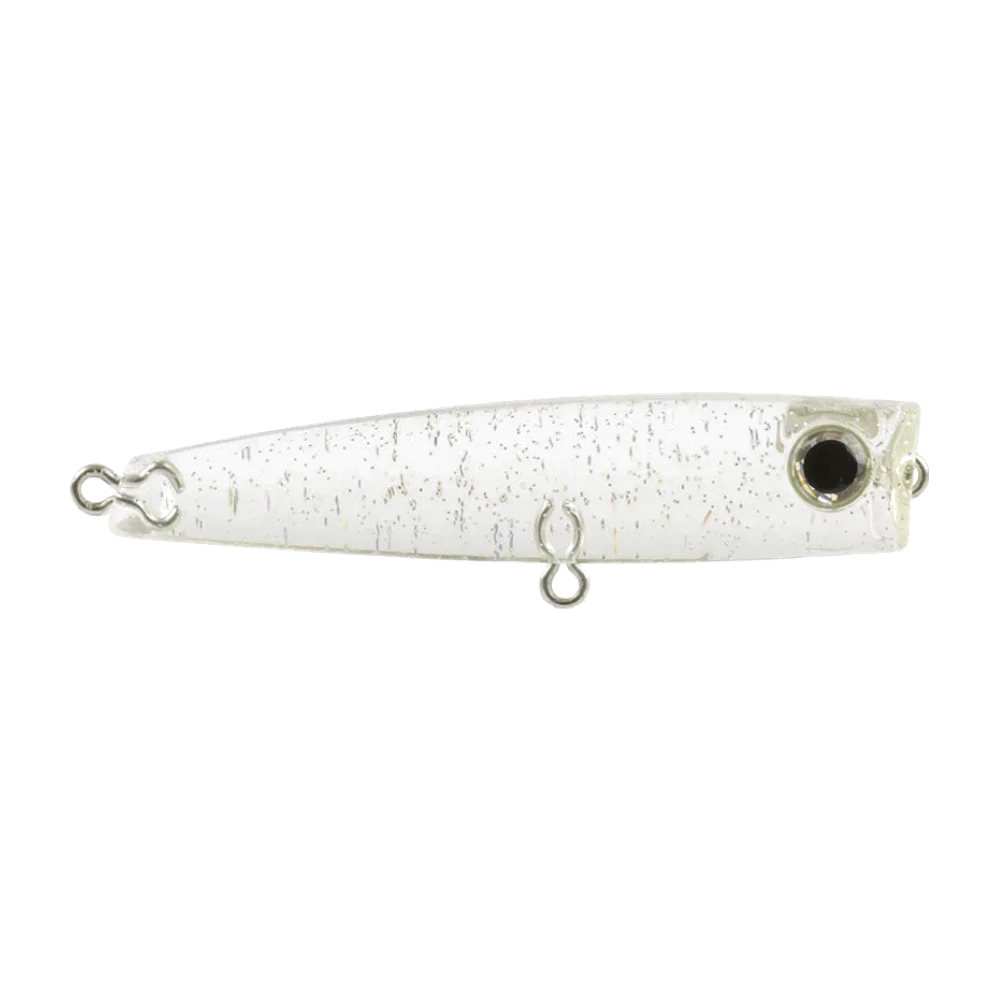
One lure, endless conditions. CarnaFish reads your spot from a photo so you are not just guessing.
A compact, light popper is a wonder on glassy water. At sea, that setup turns against you within ten minutes. A crosswind caps your casts at twenty-five metres, the swell swallows the spray, and in thirty centimetres of chop your lure vanishes between two wavelets without a single sea bass five metres away suspecting it exists.
Fishing a popper from the shore therefore demands two qualities that have nothing to do with finesse: density, to cast far into the wind, and a spray strong enough to be seen and heard in broken water. The Crystal Popper is calibrated for that. It is heavy for its size, its cupped mouth throws a genuine column of water, and it comes back flat immediately, ready for the next pop.
It is a lure for rock and wind, not for flat calm. How you fish it follows entirely from that.
Density and a cupped mouth: two deliberate choices
Three technical points explain its behaviour.
- The weight-to-length ratio is high. A 9 cm model weighing around 17 g casts on a flat trajectory even into a three-quarter headwind. On a rock mark where the bass patrol at forty metres, that distance is the price of entry.
- The mouth is genuinely cupped, not merely bevelled. On the pop it grabs a volume of water and throws it forward with a deep sucking sound. That sound, more than the spray itself, is what cuts through the background noise of a rough sea.
- The return to horizontal is fast. The lure does not stay nose-up after the pop: it flattens out in a fraction of a second, which lets you link pops with no dead time. In a rough sea, that responsiveness is what lets you keep a continuous signal going.
A word on hooks, which are not optional at sea. The stock trebles on many poppers are sized for freshwater. On a bass over sixty centimetres taken in the rocks, fit reinforced stainless trebles or heavy-wire singles, with split rings to match. And rinse with fresh water after every session, without exception.
The retrieve: two rhythms depending on the sea state
Unlike freshwater poppers, this lure is not fished one single way. The state of the surface dictates.
Calm to rippled sea — the spaced rhythm:
- Cast and let the lure settle for two seconds, line slightly tight.
- One firm pop from the wrist, rod tip down.
- One to one and a half seconds of waiting.
- Keep going to the shore, slowing further over the last ten metres.
Rough sea, chop, short swell — the continuous rhythm:
- Cast beyond the target zone, down the wind line if you can.
- Link the pops with no pause, taking up a little line between each one.
- The lure should leave a continuous trail of foam rather than isolated sprays.
- Mark a single dead stop when you pass over a rock head or a current seam.
On the water: with a saltwater popper, never strike at the spray. Sea bass very often miss their first attack, or hit the lure to stun it before coming back. Keep exactly the same rhythm after a miss: half the time, it is back within two seconds. An angler who stops working the lure the moment he sees an explosion loses most of his second chances.
Read the mark before picking a size
| Size | Conditions | Use |
|---|---|---|
| 7 cm, around 10 g | calm sea, inshore bass, small fish | beaches with gullies, estuaries |
| 9 cm, around 17 g | general use, moderate wind | rocky points, rip channels, breakwaters |
| 10 cm, around 20 g | strong wind, swell, big bass | rock ledges, tidal currents |
Two parameters outweigh everything else in choosing a size: the wind and the size of the fish present. On an exposed rock mark, the heavy version is nearly always the right starting point, even if you think the bass are small — a lure you cannot place catches nothing.
Rig straight onto 0.35 to 0.45 mm fluorocarbon, joined to 0.15 to 0.20 mm braid with a slim connection knot. The heavy fluorocarbon is there as much to take abrasion on rock and shellfish as to hold the fish.
On timing, the classic window stays the two hours either side of low-water slack on rock marks, and the flood on beaches, at dawn or dusk. Our guide on how to read a fishing spot covers the markers to look for before you even take out a rod.
Where it gives everything, and where it disappoints
- Exposed rocky points and plateaus, in a rough sea, on a dropping tide.
- Breakwaters and rock armour where the current creates a visible seam on the surface.
- Bass hunting over shoals of fry or sandeels, when you need to reach a moving zone quickly.
- Headwind or crosswind, the situation where many topwaters become unusable.
It is out of place on a flat calm sea in the middle of the day in very clear water, where its strong spray and marked noise can spook wary fish — a discreet pencil does far better there. It is also worthless in deep water with no surface activity: it is strictly a topwater, with no plan B. And it is too big and too noisy for small estuary bass in calm water, except in its smallest size.
Not sure what to tie on?
Photograph your spot: CarnaFish reads the scene, cross-checks the conditions and gives you the zone, the lure and the retrieve. Free on iOS and Android.
Crystal Popper or Sugapen
Both lures come from the same maker and yet cover opposite situations, which makes them a coherent pair to keep together.
The Bassday Sugapen is a sinking pencil that works just under the surface, with a discreet side-to-side movement and no water thrown. It is the lure for a calm sea, clear water and wary bass that refuse anything that bangs. It is fished on a continuous retrieve rather than in pops.
The Crystal Popper plays the exact opposite: strong signal, noise, spray, casting distance. When the sea gets up and the Sugapen becomes invisible in the chop, you change lure without changing mark. The practical rule fits in one sentence: as long as you can see the lure working at thirty metres, the subtle one is enough; the moment you lose sight of it, you need the popper.
To cover even more water on the surface with a wide side-to-side movement, the Xorus Patchinko 140 fills the third slot in that box. Our guide to lure fishing for sea bass covers how to work through these three families on a single tide. And if you are torn between a noisy and a subtle topwater when you reach a mark, CarnaFish analyses a photo of the spot and answers.
Colours
- Clear water, sunrise: pearl, sardine blue, green back. You copy what is already swimming there.
- Grey sky, stirred water: black back or red head on a white body, to give an aiming point in a broken surface.
- Backlight, end of day: a plain dark silhouette. Seen from below, a topwater is only a cut-out against the sky.
Key takeaways
- High density for its length: it casts a long way, including in a crosswind.
- A genuinely cupped mouth: the sucking sound cuts through the background noise of a rough sea.
- Two distinct rhythms — spaced pops on a calm sea, linked pops in chop.
- Never stop after a missed attack: the bass often comes back within two seconds.
- Reinforced stainless hooks are compulsory, and a fresh-water rinse after every session.
FAQ
Which Bassday Crystal Popper size should I choose?
The 9 cm covers most shore sessions. Move up to 10 cm in strong wind or swell, or when you are targeting big fish on a rock ledge, and drop to 7 cm on calm beaches and estuaries.
How do I work it in a rough sea?
By linking the pops with no pause, so as to produce a continuous trail of foam rather than isolated sprays. On a calm sea, on the contrary, space each pop by one to one and a half seconds.
Should I strike when a bass attacks?
No, not immediately. Sea bass frequently miss on the first pass, or hit the lure before coming back. Keep the same rhythm going: a good half of the time, it is back within the next two seconds.
What leader should I use?
Fluorocarbon of 0.35 to 0.45 mm joined to 0.15 to 0.20 mm braid. The diameter is there as much to take abrasion on rock and shellfish as to hold the fish.
Should I change the stock hooks?
At sea, yes, as soon as you fish in rock or good fish are possible. Fit reinforced stainless trebles or heavy-wire singles with matching split rings, and rinse everything in fresh water after the session.
When should I prefer a sinking pencil?
On a calm sea, in very clear water and in broad daylight, when the bass refuse any noisy signal. Practical marker: as long as you can make out your lure working at thirty metres, the subtle one is enough; the moment you lose it in the chop, switch to the popper.
The full sea bass lure guideSeason-by-season strategy: which family of lure, when, and why.Go from theory to fish
CarnaFish reads your spot from a photo and gives you the game plan: zone, lure, retrieve. Free on iOS and Android.