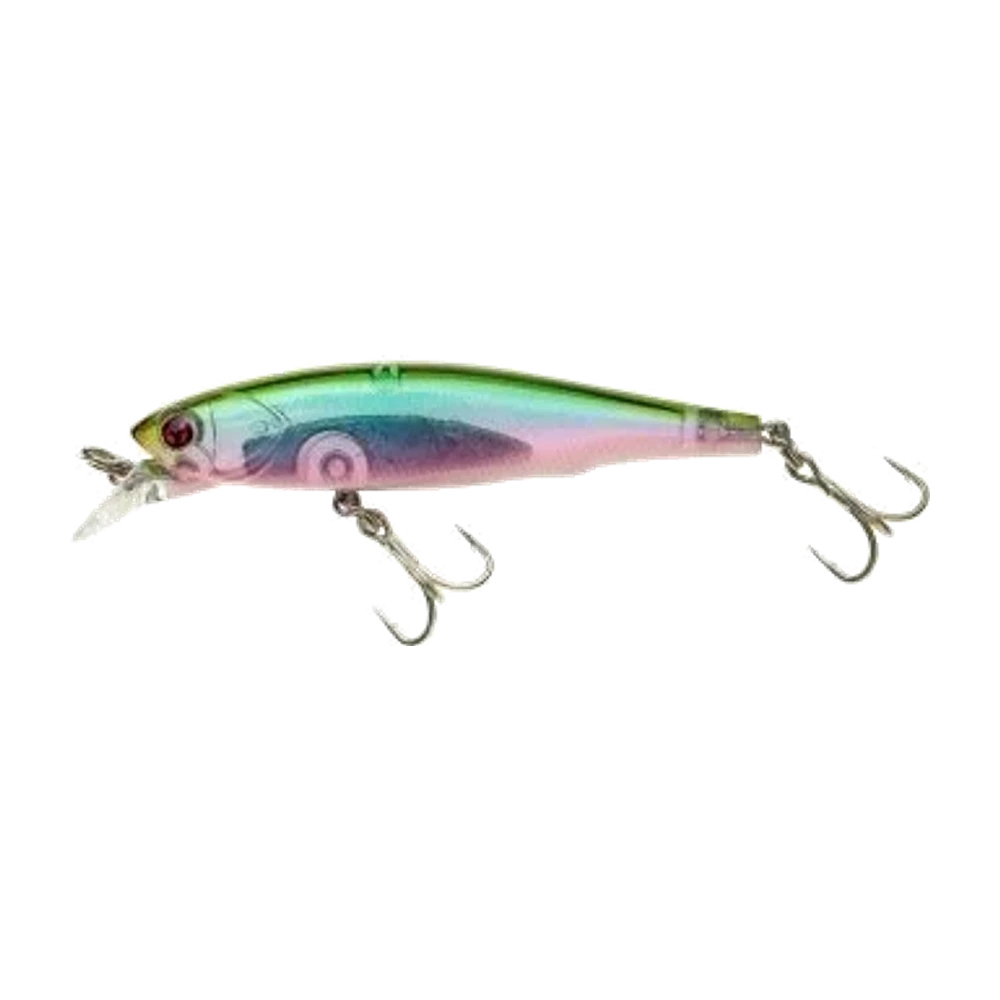
Sakura Bagsy Minnow: holding its action when the sea gets up
One lure, endless conditions. CarnaFish reads your spot from a photo so you are not just guessing.
There is one mistake almost everyone makes fishing for bass from the shore: chasing distance at all costs. You buy the lure that casts furthest, you spool fine braid, you send it sixty metres out — and you wind back a lure that spent half the trip breaking the surface, laying over on its flank or spinning on itself in the waves.
A lure that is not swimming does not catch fish, however far you sent it. The real criterion on an exposed mark is not "how far does it go" but "over what proportion of the retrieve does it swim properly".
The Bagsy Minnow is built around that constraint: a minnow body weighted to carry into the wind, but tuned for a tight action that does not blow out when the surface is churned up.
Why a tight action holds better in a wave
A wide-amplitude minnow that rolls heavily and beats hard is very effective in flat water. As soon as swell or short chop crosses its path, that same amplitude becomes a flaw: the body of water changes direction under the lure, the amplitude adds to the movement of the water, and the lure comes off its axis.
The Bagsy makes the opposite choice:
- A high beat frequency and reduced amplitude. The lure vibrates rather than wobbles. That signature stays readable even when the water is moving around it.
- Deliberately limited roll. Less lateral flash than a wide-rolling minnow, but a path that does not lay over when a wave catches it up.
- A moving internal weight for casting, which resets to the front within the first few turns of the handle. That is what gives you both the range and an action that starts immediately.
- A short lip, which holds the lure in the top layer of water without trying to go deeper — and that is where bass feed close in.
Read the current before you cast
With this lure, the casting angle matters more than the distance. Bass sit facing the current and wait for food to be brought to them.
- Work out which way the flow runs by watching the foam or the weed on the surface for a minute before you fish.
- Cast upstream, at 45 degrees, never directly against the current.
- Let the lure drift, winding in nothing but slack. It is already swimming on the current alone.
- Pick up a slow retrieve when the lure comes round across the flow, in the seam between fast and slack water.
- Slow down further over the last five metres. A large share of bites come just before the lure comes out, as it tracks along the rocky edge.
With no current, on a beach on a making tide, switch to a steady straight retrieve with a one-second pause every ten turns: the lure rises slightly then picks its action back up, and that brief stall triggers followers.
On the water: into a headwind, do not try to compensate by casting harder. Drop the rod tip towards the water for the whole retrieve and shorten your leader to forty centimetres. You remove the wind's grip on the line, which gives you back more useful contact than the five metres of distance you were trying to gain.
Settings by mark
| Mark | Size | Speed | Leader |
|---|---|---|---|
| Sandy beach, flat sea | 10 cm | medium straight | 0.28-0.30 mm fluoro |
| Rocky point, short swell | 13 cm | slow, constant contact | 0.35 mm fluoro |
| Estuary, pushing current | 13 cm | drift then slow | 0.30 mm fluoro |
| Visible surface feeding | 10 cm | fast, no pauses | 0.28 mm fluoro |
Check the split rings after every session on the rocks. On a saltwater lure fished close in, they are what let go before the hooks, and generally on the best fish of the day.
Where it excels, where it falls short
Its ground is that of the shore angler exposed to wind:
- Open beaches and rocky points, where you have to reach a precise area despite the breeze.
- The end of the ebb in an estuary, when the current concentrates prey in a narrow seam.
- Slightly churned water, not flat: that is exactly the condition where its tight action takes the lead.
It falls short in two cases. On an oily calm sea in very clear water with wary bass, its constant vibration is sometimes too insistent — a looser-swimming lure or a topwater stickbait gets in front of it. And it does not go down: beyond a metre twenty you need a different family, and there is no point trying to force it deeper by slowing down.
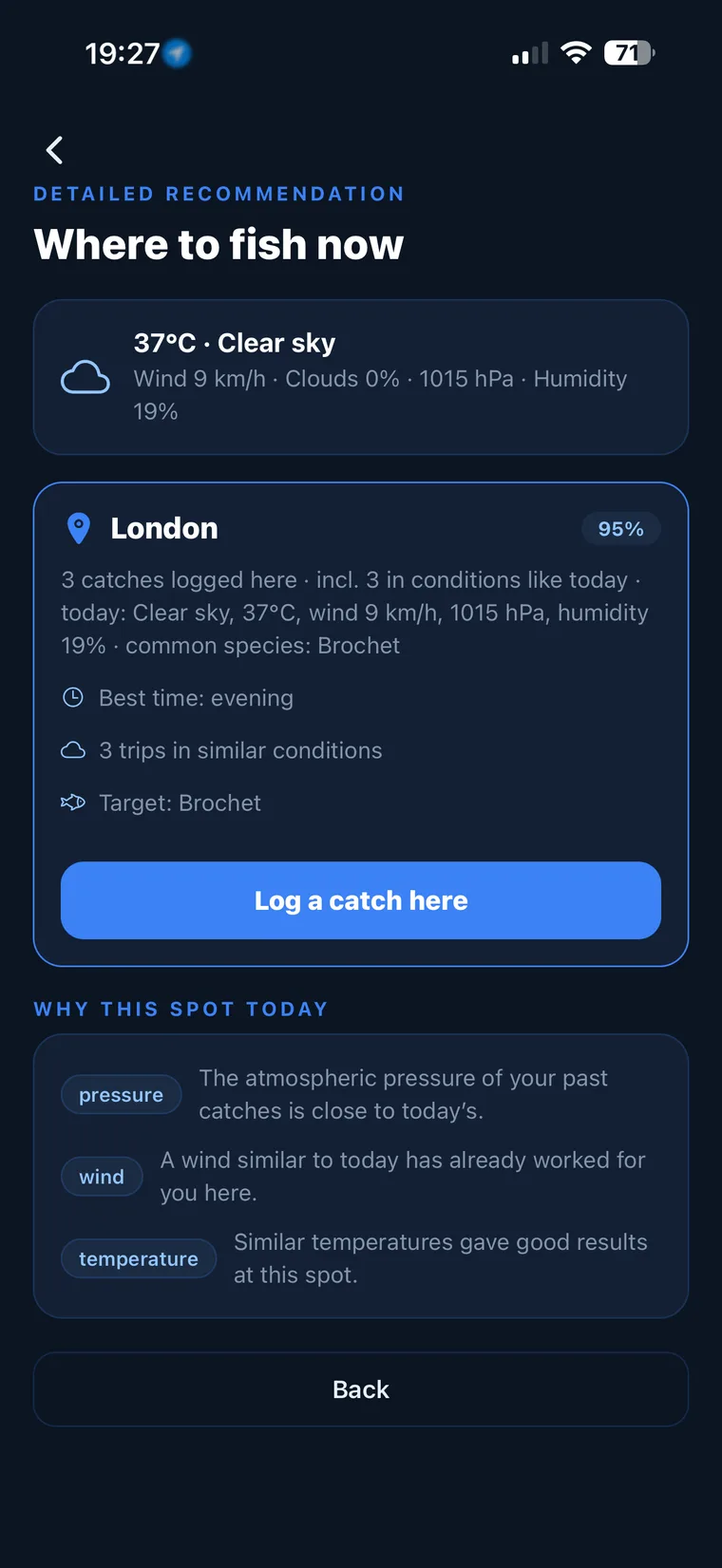
Not sure what to tie on?
Photograph your spot: CarnaFish reads the scene, cross-checks the conditions and gives you the zone, the lure and the retrieve. Free on iOS and Android.
Colours
In clear water, stay with blue or green backs and silver flanks — a sandeel or sprat imitation covers the essentials. In water churned by wind or loaded with sand after a blow, switch to solid pearl white or a very dark-backed silhouette. At dawn and dusk, silhouette contrast matters more than the shade, exactly as with a surface lure.
Bagsy Minnow or Slim Minnow SW
The Sakura Slim Minnow SW has a slimmer profile and relies on a less emphatic, more discreet action. It is the right choice in a flat sea, on bass that inspect at length, or when the bait present is very slim. The Bagsy takes the lead as soon as the wind gets up, the surface breaks, or you simply have to reach a more distant area without sacrificing the action.
Against a Duo Tide Minnow Slim, the difference is one of philosophy: the Tide Minnow Slim is a finesse lure with a gliding action, built for calm water and long drifts, while the Bagsy is a lure for degraded conditions. Plenty of shore anglers carry both and swap according to the state of the sea rather than the time of day. If you need to fish higher still, a few tens of centimetres under the surface over a rock shelf, the Tackle House Feed Shallow remains the reference for that precise layer.
Our guide to lure fishing for sea bass covers how to read a tide before you choose. And if you are unsure what to tie on facing the sea in front of you, CarnaFish analyses a photo of the spot and answers.
Key takeaways
- Tight, high-frequency action: it stays readable when the surface is churned up.
- The moving weight gives distance without delaying the start of the action.
- Cast at 45 degrees upstream of the current, never straight against it.
- Slow right down over the last five metres, along the rocky edge.
- It does not go below around 1.2 m: no point trying to force it deeper.
FAQ
Does the Sakura Bagsy Minnow really cast far?
Yes, thanks to its internal weight shifting to the rear on the cast. But the main point is not raw distance: it is keeping a clean action through the whole retrieve, including into a headwind.
How deep does it run?
Between 0.5 and 1.2 m depending on speed and leader diameter. It is a top-layer lure, and you should not try to force it deeper by slowing down.
What size should I choose for shore bass?
The 13 cm covers the most situations on decent bass and casts better into wind. Drop to 10 cm when fish are feeding on small bait or when the prey present is visibly slim.
Should I fish it fast or slow?
Slowly in current, where the flow already swims the lure. Faster on visible surface feeding, with no pauses at all. In a flat sea, a one-second pause every ten turns triggers followers.
What leader should I use?
Fluorocarbon of 0.28 to 0.35 mm depending on the ground. Shorten it to forty centimetres into a headwind: the line catches less wind and contact with the lure stays crisp.
When should I prefer another lure?
On an oily calm sea with wary bass in very clear water, where a more discreet action or a surface lure is often more effective. And as soon as you need to fish below a metre twenty.
The full sea bass lure guideSeason-by-season strategy: which family of lure, when, and why.Go from theory to fish
CarnaFish reads your spot from a photo and gives you the game plan: zone, lure, retrieve. Free on iOS and Android.