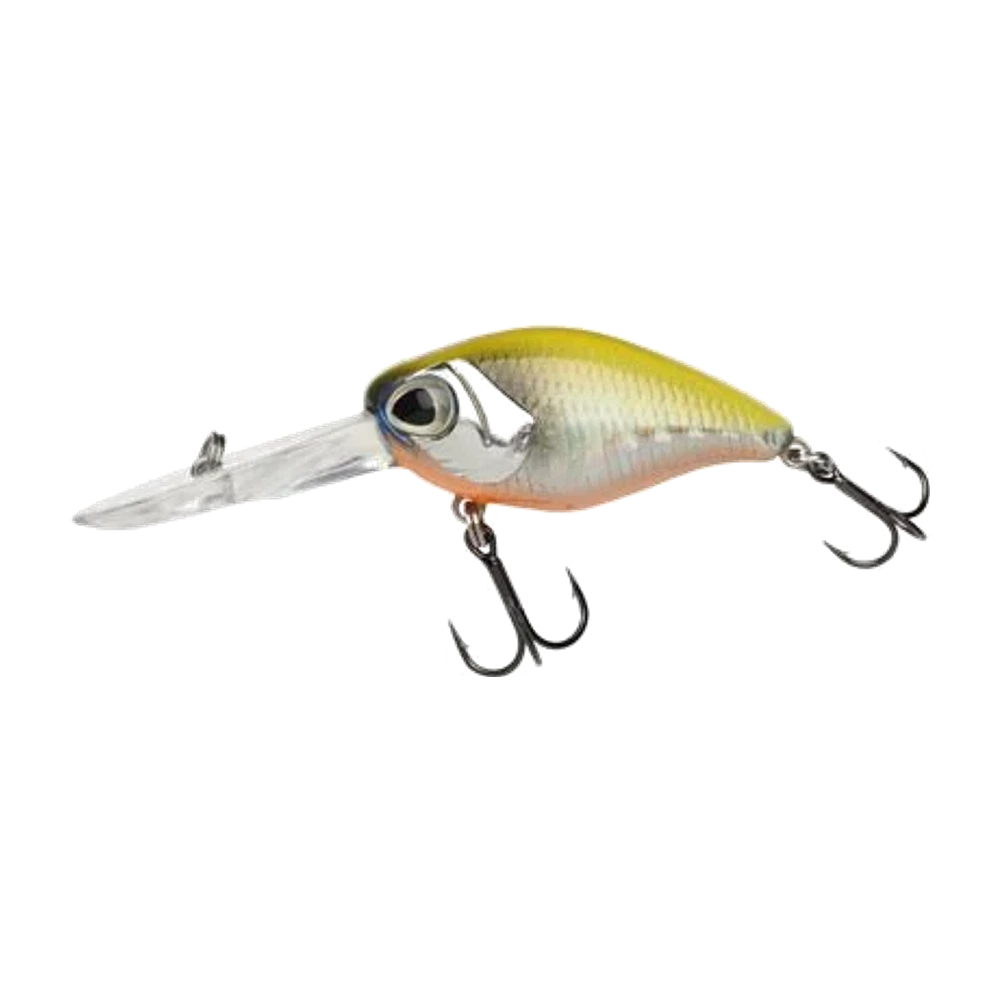
Berkley DEX Trencher: the crankbait that ploughs the bottom for zander
Rather not fish it blind? Photograph your spot — CarnaFish cross-checks the conditions and points you the right way.
Zander have a reputation as a fish you catch slowly, on soft plastics, in contact with the bottom. That is true most of the time. But there are days when you spend two hours dragging a shad along a rock wall without seeing a thing, while the sounder shows fish glued to the stone. They are there, they are not moving, and your slow presentation triggers nothing.
The contact crankbait turns the problem on its head. Instead of offering a prey item the zander has to decide to eat, you send it something that cannons violently off its own rock. The DEX Trencher is built for that: a long lip that digs down to the bottom and, on every obstruction, produces an uncontrolled deflection.
A lip built to hit, not to avoid
A classic searching crankbait aims to swim cleanly at a given depth. This one aims for the opposite: contact.
Three things set it apart from a generic crank of the same size.
The lip is long and angled forward. It takes the lure down fast, in the first few metres of the retrieve, and it works as a bumper. It is the lip that hits, not the hooks.
The body is back-weighted and floats. Direct consequence: as soon as you stop, the lure backs up slightly and rises at an angle, nose up. That release movement is what gets you out of snags and, incidentally, triggers a good share of the bites.
The roll is wide, not tight. A tight-vibrating crank is built for clear water and fast fish. A wide roll displaces more water at low speed, which the lateral line of a zander picks up very well in stained water or at night.
The retrieve: cause the contacts, then ease off
This is not a straight retrieve. It is a retrieve driven by the obstructions.
- Cast long and parallel to the rock wall, never at right angles to it. You want to stay in the contact zone as long as possible, not cross it in three metres.
- Wind at medium speed for the first few turns to take the lure down to its depth. Rod low, tip towards the water.
- Ease off as soon as you feel the first contact with the bottom. You should feel a regular scratching in the blank, not continuous ploughing.
- When the lip hits a rock, stop for half a second and give a little line back. The lure lifts, kicks sideways, then resumes its swim. That deflection is the trigger.
- After three or four contacts, make a full one-second pause. The lure rises at an angle. A lot of bites come exactly there.
On the water: a zander's bite on a crank does not feel like a pike's. It is not a knock, it is a stall — the action stops dead and you think you have hooked the bottom. Get into the habit of striking every time the vibration cuts out abruptly without you having felt the lip knock. You will lose a few lures to genuine snags, and you will gain fish you thought were rocks.
A variation for night fishing or very cold water: a continuous crawl with no pauses, simply trying to keep the lip in contact. On apathetic zander, the regularity of the signal does more than the deflections.
Setting the depth without changing lure
The running depth of a crank is not a constant. Three parameters shift it noticeably.
| Parameter | Effect on depth |
|---|---|
| 0.25 mm instead of 0.35 mm fluorocarbon | gains around 30 to 50 cm |
| A 40 m cast instead of 20 m | gains 30 to 60 cm over the middle section |
| Rod low, tip in the water | gains 20 to 40 cm |
| Very fast retrieve | brings the lure up |
These settings stack. With the same model you cover a band of about a metre by playing on line, distance and rod angle alone. That is faster and more precise than changing lure at every spot.
Size, on the other hand, answers to the season more than to depth: a 6.5 cm in late winter and spring, when zander are on slim prey, an 8 or 9 cm in autumn when they are following shoals of this year's roach.
Not sure what to tie on?
Photograph your spot: CarnaFish reads the scene, cross-checks the conditions and gives you the zone, the lure and the retrieve. Free on iOS and Android.
Spots, season, and what does not work
Its spots are anywhere the bottom is hard and irregular: rock armour on canals and dams, bridges, breakwaters, piers, gravel plateaus, the tails of weirs. Anything offering stone the lip can kick off.
Its best window is autumn and early winter, then spring again. In high summer on warm water, zander often lift off the bottom and follow shoals in mid-water: the contact crank no longer belongs there.
It is flatly wrong over soft, flat mud, where it meets no obstruction and loses all its point. It is also to be avoided over bottoms full of dead wood: a long lip with two trebles in among branches means a lure lost per cast. There, a soft plastic on a jig head remains the only sensible answer.
Trencher or a classic diving shad
Against a Rapala Shad Rap, the difference is one of character: the Shad Rap offers a fine, discreet action, cut out for clear water and wary fish, with a more modest depth. The Trencher plays permanent contact and violent deflection, which speaks far better in stained water and to fish pinned to the bottom.
Against a Berkley Flicker Shad, we stay in the same house but not the same job: the Flicker Shad is a trolling and searching lure at constant speed, very regular. The Trencher is a cast-and-retrieve lure for a precise spot, whose whole point lies in the irregularities.
Our beginner's guide to zander lure fishing covers how to spot rock armour that holds fish before you even cast. And if you are unsure what size to tie on in front of an unfamiliar rock wall, CarnaFish reads a photo of the spot and answers.
Key takeaways
- The long lip works as a bumper: it seeks contact instead of avoiding it.
- The deflection after a knock on the rock is the main trigger, not the steady swim.
- Cast parallel to the rock armour to stay in the contact zone.
- A zander bite shows up as the vibration stopping dead: strike every time, even if you think you are snagged.
- No use over soft or flat bottoms, to be avoided in dead wood.
FAQ
Can you really catch zander on a crankbait?
Yes, as long as you stay in contact with a hard bottom. A zander sitting on rock armour reacts very well to a lure bouncing off the stones beside it, often better than to a slow presentation it has all the time in the world to examine.
How deep does the DEX Trencher run?
Between 1.5 and 4 m depending on the size of the model, but above all depending on your setup: thin fluorocarbon, a long cast and a low rod easily gain you a metre over the opposite configuration.
How do I avoid losing the lure in the rocks?
Ease off from the first contact and give a little line back on every knock: the lure floats and frees itself by backing up. Simply avoid bottoms with dead wood, where no setting will save you.
What colour should I choose for zander?
Crawfish or brown tones over rocky ground in clear water, and strong colours such as white or chartreuse as soon as the water colours up. Zander react mainly to contrast and vibration, not to the exact shade.
What is the best season?
Autumn and early winter, when zander concentrate on hard bottoms, then spring. In high summer they often leave the bottom to follow shoals in mid-water, and a contact crank becomes the wrong tool.
Should I change the stock hooks?
Not necessarily, but if you fish rock a lot, check the points every session. Some anglers fit inline singles to cut snagging: you lose a little in hook-up rate but gain in number of passes.
The full zander lure guideSeason-by-season strategy: which family of lure, when, and why.Go from theory to fish
CarnaFish reads your spot from a photo and gives you the game plan: zone, lure, retrieve. Free on iOS and Android.