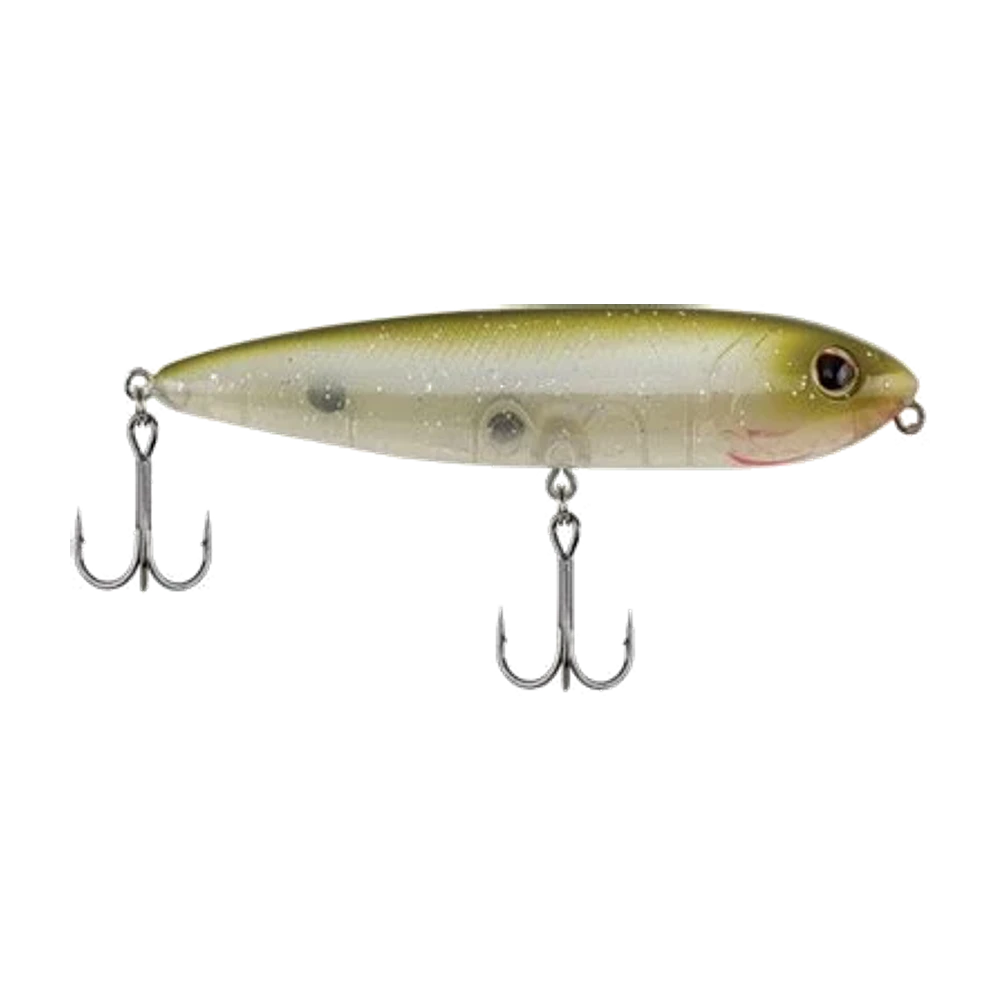
Berkley J-Walker: the walking bait you steer with the reel handle
The right lure in the wrong spot still catches nothing. CarnaFish spots the zone that works, from a single photo.
Walk the dog is the topwater technique that puts off more anglers than any other. On paper it is simple: a small tap of the rod tip, a quarter turn of the handle, and the lure sets off zigzagging. On the water it is another story. You lose the rhythm after five metres, the lure runs dead straight, you speed up to catch it back, it jumps sideways, and you end up giving up in favour of a popper that forgives everything.
The J-Walker tackles that problem through design rather than technique. Its mass distribution and profile keep the zigzag regular even when your coordination is not perfect — and above all, it keeps walking when you speed up, which opens a use most stickbaits do not allow: covering water fast.
A stickbait that forgives, and that casts a long way
Three features explain its behaviour.
The rear weight. It stabilises the cast and gives the lure a slightly nose-up resting position, head out of the water. From there, the first twitch starts the zigzag immediately: no warm-up phase where the lure slides straight ahead.
A constant side-to-side width. On many stickbaits the zigzag flattens as soon as you speed up: the lure ends up running straight and shivering. The J-Walker keeps its lateral travel at speeds where others break down. That is what lets you use it as a search bait.
A rattle. It gives a low-frequency audible signal, useful in slightly stained water or when the fish are scattered over a big area.
The direct consequence: it floats at rest but it is not fished at rest. This is a lure of continuous movement, the opposite of a popper that lives on its pauses.
The retrieve: the movement comes from the reel
The classic walk the dog action taught to beginners puts the rod to work. On this lure, flip the division of labour around.
- Cast long and close the bail. The lure lands nose-up, ready to go.
- Point the rod tip down towards the water, at forty-five degrees left or right of the line. Then barely move it again.
- Give short, sharp twitches with the wrist alone, no amplitude — five centimetres is enough.
- Sync a quarter turn of the handle to every twitch. The handle is what creates the slack and takes it back, so it is what builds the track. The rod only passes on the impulse.
- Find your cadence and stick to it. Two or three twitches a second give a tight zigzag, one a second a wide, slow one.
- Drop in a two-second burst of speed every five or six metres, then return to the rhythm. That change of speed is what converts followers.
On the water: if your lure runs dead straight, it is not that you are pulling too hard — it is that you are not giving back enough slack between twitches. The zigzag is born in the split second when the line goes loose. Drop the rod tip ten centimetres instead of adding force, and the walk comes straight back.
Which size for which context
| Context | Size | Rhythm |
|---|---|---|
| Bass, margins and weed beds | 10 cm | Tight, fast zigzag |
| Bass, big open water or wind | 12 cm | Wide, steady zigzag |
| Shore sea bass, beaches and points | 12 to 13.8 cm | Fast and continuous |
| Stained water, scattered fish | 12 to 13.8 cm | Slow and wide, for the rattle |
In freshwater, the 10 cm covers most bass situations. In saltwater, always go up: wind, residual swell and distance call for a heavier lure, and a sea bass is not put off by a big profile on the surface.
Not sure what to tie on?
Photograph your spot: CarnaFish reads the scene, cross-checks the conditions and gives you the zone, the lure and the retrieve. Free on iOS and Android.
Two very different windows
For bass, it is a morning and evening lure along the margins, but also — and this is less well known — an excellent midday tool over big open flats in summer, when the bass are following bait in open water. There the ability to walk fast really pays: you cover a hundred metres of bank or flat in a handful of casts.
For shore sea bass, it works over beaches, shallow rocky points and weed edges, at dawn, at dusk and over spread-out feeding activity. Unlike a popper, it does not need intense surface activity: a fast zigzag is enough to bring up a fish sitting two metres down.
It is poorly suited, on the other hand:
- In a rough sea or heavy waves. The zigzag disappears in the chop and the lure skips out of the water.
- In very cold water. Below ten degrees or so, topwater stops producing, whatever the quality of the lure.
- On short, cluttered spots. A walking bait needs several metres to express its movement; under a low branch, a compact popper works on the spot.
- On very educated fish in clear, flat water, where bulk and noise become a handicap.
J-Walker or Zara Spook: the technical demand changes everything
The Heddon Zara Spook is the historic walk the dog benchmark, and it is still deadly — but it demands a clean action. Badly worked, it runs straight, and it is precisely this lure that discourages so many anglers. The trade-off is a longer, slower glide, which gives a real edge on fish that are slow to commit.
The J-Walker reverses that compromise. It is more forgiving of your technique and it keeps its action at speed, which makes it a better searching tool and a better choice in wind. It loses a little in long glide and in finesse on very educated fish.
The Lucky Craft Sammy 100 sits between the two: finer than the J-Walker, easier than the Spook, but lighter, so less comfortable as soon as you have to cast far or into a crosswind.
In practice: the J-Walker to search and for tough conditions, the Spook or the Sammy to work on a fish you have located. Our beginner's guide to bass fishing covers the windows where topwater beats everything else. And if you are not sure whether the day's conditions justify a surface lure, CarnaFish analyses a photo of the spot and answers.
Key takeaways
- The zigzag comes from the reel handle, not the rod: a quarter turn per twitch, rod tip low and still.
- A lure running straight means a lack of slack, not a lack of force.
- It holds its action at speed: this is a genuine topwater search bait.
- 10 cm for bass, 12 cm and up as soon as there is wind or you move to the sea.
- Off the point in a rough sea, in cold water and on short cluttered spots.
FAQ
How do you make the walk the dog work with the J-Walker?
Rod tip pointed at the water at forty-five degrees to the line, small five-centimetre wrist twitches, and above all a quarter turn of the handle synced to every twitch. The handle creates and recovers the slack, so it is what builds the zigzag.
Why does my lure run in a straight line?
Almost always because the line stays tight between twitches. The zigzag happens during the moment of slack. Drop the rod tip ten centimetres to give more slack, rather than pulling harder.
Can you use it in the sea for bass?
Yes, that is one of its good grounds: beaches, shallow points and weed edges, at dawn and dusk. Go up to the bigger sizes, 12 cm and over, to handle wind and distance.
Should you work in pauses?
No, this is a continuous-movement lure, unlike a popper. The only useful change is a two-second burst of speed every five or six metres, which converts fish that follow without attacking.
What is the difference with a Zara Spook?
The Spook offers a longer, slower glide, deadly on hesitant fish, but it demands a precise action or it runs straight. The J-Walker is more forgiving and keeps its zigzag at speed, which makes it a better search bait and a better choice in wind.
What setup should you use?
A 0.16 to 0.20 mm braid for the retrieve and for hooksets at range, with a metre of 0.30 to 0.40 mm fluorocarbon leader. A snap is acceptable on this type of lure and will save you time when you swap models.
The full bass lure guideSeason-by-season strategy: which family of lure, when, and why.Go from theory to fish
CarnaFish reads your spot from a photo and gives you the game plan: zone, lure, retrieve. Free on iOS and Android.