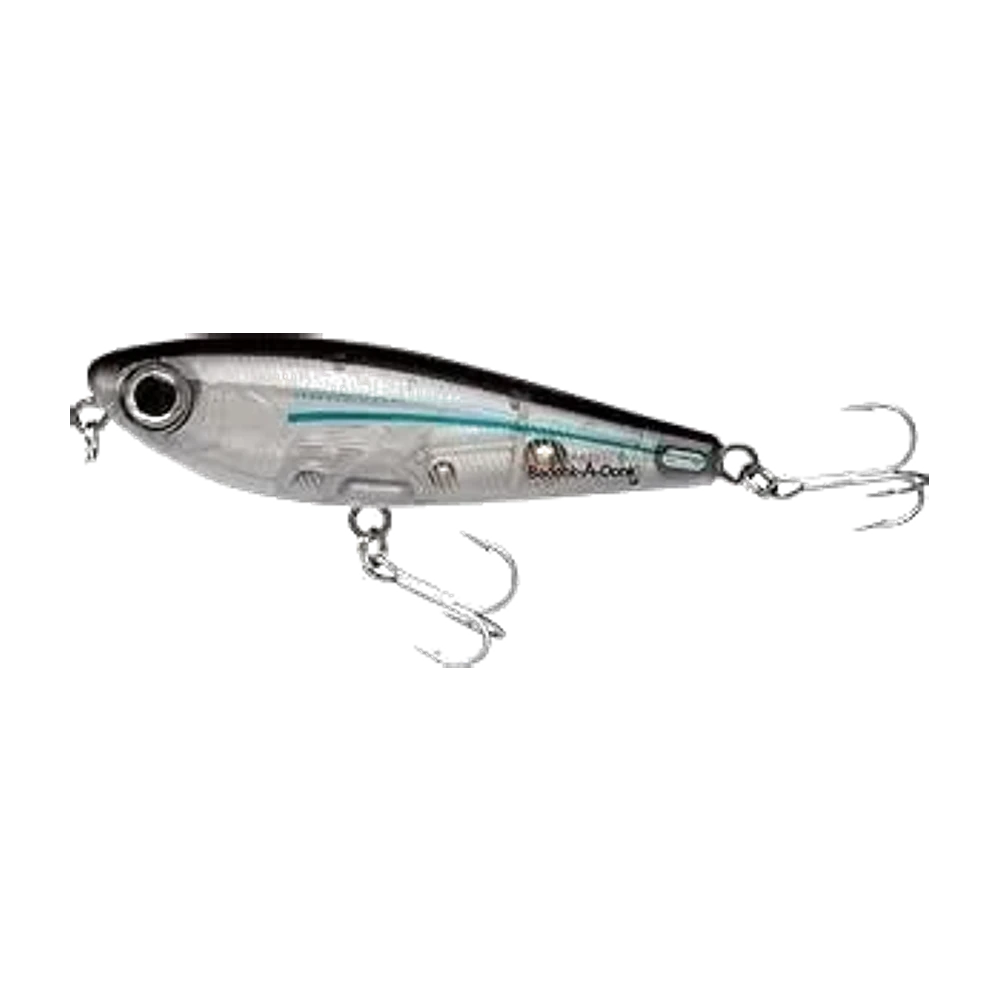
Bomber Badonk-A-Donk: walking a stickbait in chop
The right lure in the wrong spot still catches nothing. CarnaFish spots the zone that works, from a single photo.
A walking bait on a still pond is easy: two flicks of the wrist and the lure sets off in a clean zigzag. The same lure in twenty centimetres of chop, with a quartering wind and three metres of belly in your line, does nothing at all. It skips, it goes sideways, it tracks straight. And you spend the session trying to rescue a lure that is not working.
The Badonk-A-Donk was designed for exactly that context: a body heavy enough to cast far into the wind, a wide glide that stays readable even when the surface is moving, and internal rattles that carry the sound signal where the visual one is lost in the foam.
It is a bass lure in the truest sense: the one you reach for when the sea is a little up and poppers stop producing.
What makes it workable when it is rough
Three things, all tied to mass and where it sits.
- Mass concentrated at the rear. The lure tips up on the cast, which cuts wind resistance and lengthens your casts noticeably. On a shore mark where fish are hunting forty metres out, those extra metres are not a detail.
- A wide glide rather than a tight one. Where a slim stickbait makes small fast hooks, the Badonk sets off firmly sideways on every pull. That amplitude gives the fish time to see it appear and disappear behind a wave.
- Rattles. They come in different tonal versions. The higher, more metallic tone carries better in chop; the duller tone is preferable on flat calm, where too strong a signal spooks fish.
There is also a version that works just under the surface rather than on it: useful when bass refuse to show their heads but still follow.
The retrieve: continuous cadence, no pauses
Unlike a popper, the Badonk is not fished with silences. What triggers here is the regularity of the zigzag and the trail it leaves.
- Cast into the wind or quartering, never straight across: a line belly taken broadside kills all contact.
- Drop the rod tip close to the water, on the downwind side, to shorten the belly.
- Give short, sharp wrist pulls, one per half turn of the handle, keeping the line just tight between them.
- Hold the cadence: roughly two pulls a second. The zigzag settles in after three or four pulls, not before.
- When a wave rolls over the lure, do not correct, keep the cadence. The lure comes back out by itself.
- Do not strike at the boil. You strike when you feel the weight. It is the hardest rule to keep, and the one that decides how many fish reach the net.
On the water: if your zigzag only goes one way, it is almost never the lure — it is your line belly pulling. Move two metres to get back in line with the wind before you touch the front split ring or change lure.
Matching size and version to conditions
| Conditions | Version to favour | Why |
|---|---|---|
| Flat sea, dawn, clear water | Small size, dull rattle | Discretion, fish that see everything |
| Short chop, force 3 to 4 | Big size, high-pitched rattle | Sound replaces sight |
| Bass following without taking | Subsurface version | Visible target without breaking the surface |
| Strong tidal current | Big size, cast up-tide | Mass holds the track |
For line, braid of 0.15 to 0.20 mm and a metre of 0.35 to 0.45 mm fluorocarbon leader. Braid is essential: nylon stretches too much to transmit a sharp pull at thirty metres, especially with a belly in the line.
Colours and light
Colour matters little on a surface lure: the bass sees it from below, cut out against the sky. What counts is silhouette contrast and, secondarily, the flank as the lure rolls.
- Before daylight and at night: pearl white or solid black. Both extremes work; mid-grey is what works least well.
- Full daylight, clear water: blue or green back over a silver flank, to match the local bait fish.
- Coloured water after a blow: dark back with a pink or orange belly, which stays readable in the turbidity.
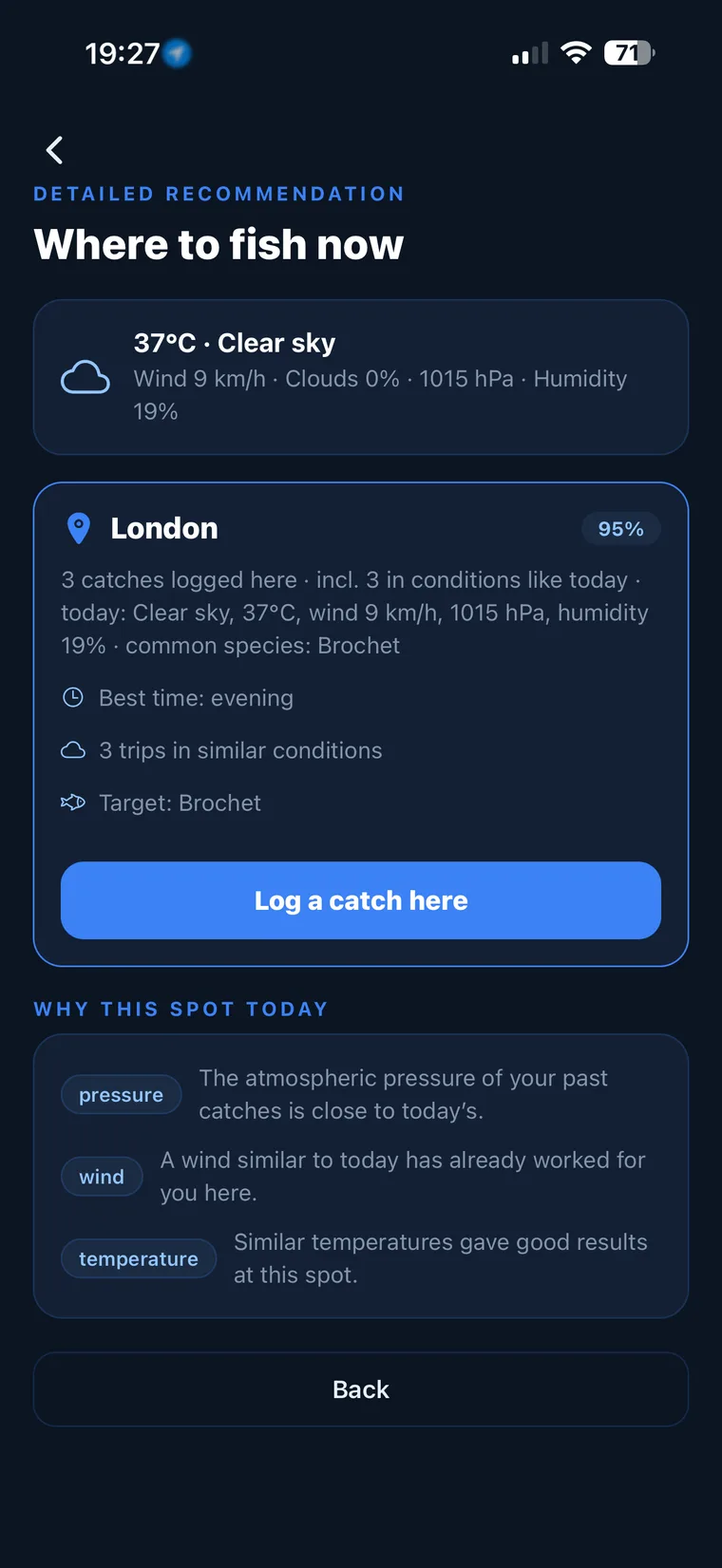
Not sure what to tie on?
Photograph your spot: CarnaFish reads the scene, cross-checks the conditions and gives you the zone, the lure and the retrieve. Free on iOS and Android.
Where it produces, and where it is pointless
It excels over rocky plateaux under forty centimetres to two metres of water, on bay exits late on the ebb, and in current seams where the flow concentrates bait. The best window is still the last hour before daylight and the first after — but unlike many surface lures, it stays playable in broad daylight if the sea is rough.
It is wrong in very shallow, glass-flat water on a wary bass: too much noise, too much bulk. It is equally wrong as soon as the wind exceeds what your rod can handle and the line belly becomes impossible to control — at that stage, a sinking lure working below the surface is the better answer. Finally, it is not a river pike lure: its mass and size are set up for fast saltwater fish.
Badonk-A-Donk or a classic walking bait
The Heddon Zara Spook is the ancestor of the type and remains a reference in calm water: its glide is lazier and more buoyant, and it excels at low speed. The Badonk is denser, louder and more stable in wind — the trade-off being that on an oily calm it often does too much.
The Rapala Skitter Walk sits between the two: lighter, tighter zigzag, very effective on bass close in but much harder to cast into the wind.
If bass refuse a true surface lure, a shallow minnow burned just under the top like the Cordell Red Fin works in a completely different register: a continuous trail instead of a zigzag. Our guide to bass fishing with lures covers how to choose between these families according to the tide. And if you are unsure when to switch from surface to subsurface, CarnaFish analyses a photo of the spot and answers.
Key takeaways
- Its rear-weighted mass lengthens casts into the wind: that is its first argument.
- The wide zigzag stays readable in chop where a slim walking bait falls apart.
- Continuous cadence, no pauses: regularity triggers here, not silence.
- Strike on weight, never on the boil.
- Too loud and too bulky on a flat sea with wary fish.
FAQ
How do I get a steady walk-the-dog with this lure?
Rod tip near the water, line just tight, short wrist pulls at about two a second, half a handle turn between each. The zigzag takes three or four pulls to settle: do not judge it on the first few metres.
Does the Badonk-A-Donk work in broad daylight?
Yes, provided the sea is rough. Chop breaks up visibility and makes bass less wary, and the lure is designed precisely to stay workable in those conditions. On a flat calm, stick to the dawn and dusk windows.
Should I choose the loud version or the quiet one?
High-pitched rattle when the sea is moving and the visual signal is lost, dull rattle in calm weather and clear water. If you only buy one for shore fishing, the loud version covers more situations.
Why do I miss so many surface bites?
Because you are striking on sight. Bass often miss their first attack or take the lure sideways: strike at the moment of the boil and you pull it away. Keep working the lure until you feel the weight in the rod, then strike by leaning into it.
Which hooks for saltwater?
Stainless trebles the same size as the originals, changed at the first sign of corrosion. An opened split ring or a rusted treble is the most ordinary cause of a lost fish on a good bass.
Is this lure any good for pike?
It can catch pike, but that is not its water. Its mass and profile are set up for long casts in the sea. In fresh water, lighter walking baits with a slower glide give better results.
The full sea bass lure guideSeason-by-season strategy: which family of lure, when, and why.Go from theory to fish
CarnaFish reads your spot from a photo and gives you the game plan: zone, lure, retrieve. Free on iOS and Android.