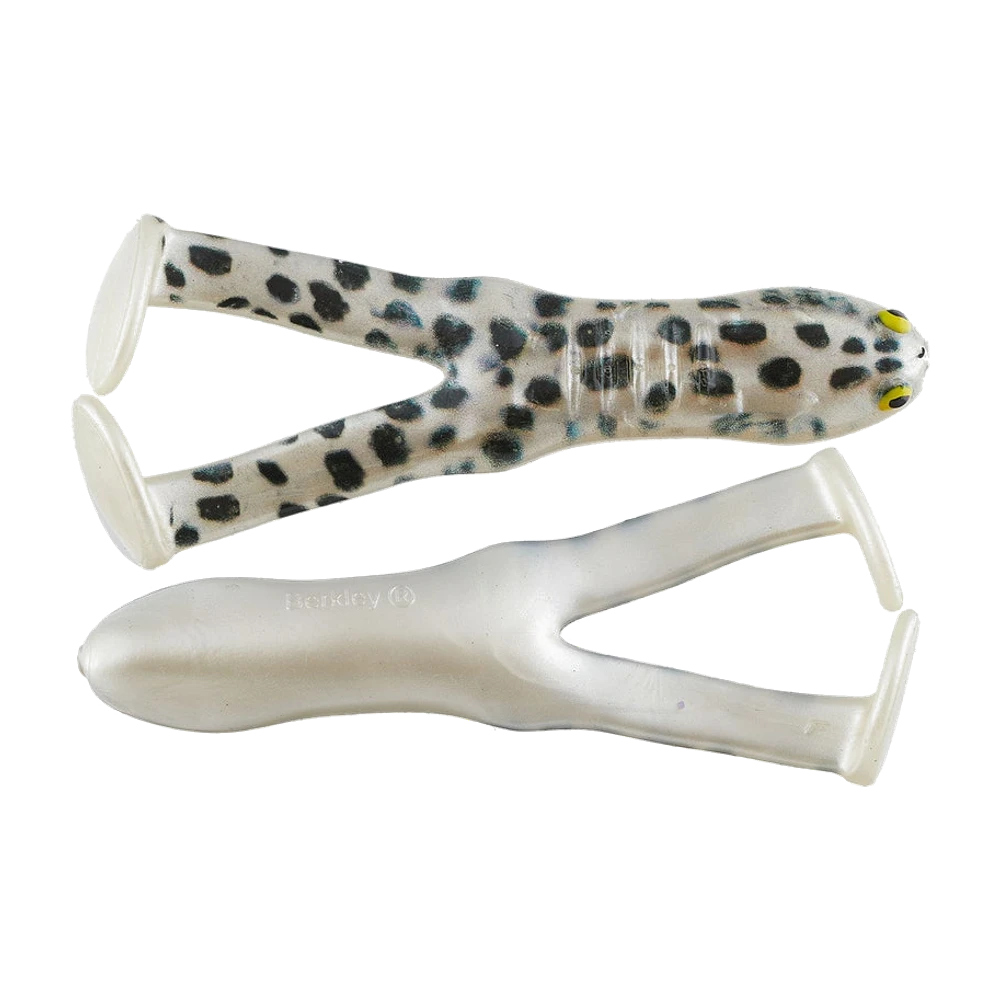
Berkley Beat'n Paddle Frog: the soft frog that beats the surface
Not sure this lure fits YOUR spot today? CarnaFish tells you in 10 seconds, from a photo.
There is a point in summer when topwater fishing stops being a gamble: the moment the lily pads close over and there is no longer a single opening where anything but a genuinely weedless lure can go. A crankbait will not enter, a Texas-rigged shad will enter but announces nothing, and that is where a soft paddle-footed frog becomes the only honest tool. Berkley's Beat'n Paddle Frog belongs to that family - not a hollow frog you walk in place, but a solid body you pull in a straight line, slapping the water the whole way.
Two paddles, and nothing else to understand
The body is moulded with two oversized paddle-tail style feet, the same shape you would find on a swimbait, grafted onto the back of a frog body. On the retrieve they beat alternately and produce a rhythmic slapping sound with a churned surface behind it. This is not a discreet noise: it is a broad signal that carries through a layer of vegetation, exactly where a silent lure would stay invisible to a fish holding underneath.
The practical consequence is simple and worth stating straight away: this lure only works while it is moving. Stop reeling and the paddles go quiet, leaving a piece of plastic sinking slowly. That is the opposite of a hollow-bodied frog, which you can dance in place over a hole in the weed for ten seconds. If that static presentation is what you are after, look at a SPRO Bronzeye Frog instead - the Beat'n Paddle Frog is built to cover water.
Start reeling before the lure lands. Half a turn of the handle during the drop gets the paddles working from the moment of impact, and you gain the three most productive metres of the cast - the ones along the weed edge, which is exactly where the fish is sitting.
A tougher material, for a specific reason
Berkley states a sturdier material than on an ordinary soft plastic, and on this type of lure that is not an empty claim. A soft frog gets fished through sunken timber, submerged branches and mats of vegetation: it takes constant abrasion, and on a soft formulation the feet end up torn off after two or three fish. A firmer compound lets you stay on the same bait for a full session, which changes the real cost of a spot when the pack holds only five.
There is a trade-off, and it is worth knowing: a firmer compound compresses slightly more slowly on the hookset. Nothing fatal with a well-sharpened hook, but it means you cannot rush the motion - more on that below.
Scent: what it changes, and what it does not
The body is loaded with Berkley's own PowerBait formula, which the brand says makes fish hold on up to eighteen times longer. On a bottom lure that argument is immediately obvious. On a topwater lure it matters for a subtler reason: in frog fishing, the gap between the strike and the hookset is the absolute weak point. The fish blows up on the surface, you see a geyser and nothing else, and you have no idea whether the lure is in its mouth. Half a second of extra hesitation is precisely what turns a miss into a landed fish.
The two hook options
The body carries perpendicular hook point keepers that lock the point in place and leave you a choice of two rigs:
- A single wide-gap weedless hook, 4/0 or 5/0, driven through the back with the point tucked into the keeper. This is the more weedless of the two, the one that goes anywhere, but it demands a firm hookset.
- A double frog hook, the kind used on hollow frogs, with both points seated in the keepers. Hooking percentage improves, passage through vegetation gets slightly less clean. Save it for sparse weed and reed edges.
In both cases, no fluorocarbon leader: braid straight through, 30 to 40 lb, on a rod with a real backbone. You have to be able to drag a fish out of a mat before it has time to wrap itself up in it.
Where and when to use it
The window is clear-cut: water above 18 C / 64 F, developed vegetation, and fish sitting in ambush under cover. Lily pads, surface weed, reed edges, the low branches of trees leaning over the water - anywhere you cannot put anything else through. Bass will happily come up for a surface meal as soon as the water warms, and a pike holding in a pond weedbed reacts to the same signal, provided you accept more misses: its bony jaw and sideways strike deal less well with a solid soft body than with a hard bait carrying trebles.
The classic mistake: setting on the sound
This is the beginner's mistake in frog fishing, and it costs dozens of fish every summer. The spray of water is not a hookset signal: it is an attack signal, which sometimes precedes the lure actually being taken by half a second, and sometimes corresponds to no take at all. Wait until you feel the weight in the rod, then set sideways without a wasted jerk. Counting a full second in your head, mouth shut, is enough to retrain the reflex.
The other mistake is retrieving too fast. The paddles already work at a moderate speed; push harder and they stall, the lure lying flat and sliding along in silence. Find the slowest speed that keeps the slapping regular, and stay there.
Not sure what to tie on?
Photograph your spot: CarnaFish reads the scene, cross-checks the conditions and gives you the zone, the lure and the retrieve. Free on iOS and Android.
Colours by light and water clarity
- Clear water, bright sun: a spotted Leopard pattern, translucent white marked with black. Seen from below the silhouette stays readable without glaring, which matches what a fish holding under the surface actually sees.
- Cloud cover or lightly stained water: pearl white, which returns what little light there is and keeps a clean profile against a grey sky.
- Stained water, late evening, fishing into the night: black. Counter-intuitive for many anglers, but on top it is the silhouette cut out against the sky that matters, not the colour itself.
What it adds alongside other frogs
The Beat'n Paddle Frog does not replace a hollow frog and does not try to. A Zoom Horny Toad plays in the same register of the noisy towed soft bait; a hollow frog like the Molix Frog lets you stay in one place instead. The choice comes down to cover density and the mood of the fish: if you have a hundred metres of weed edge to search, take the Beat'n Paddle Frog; if you have one located fish to convince, take the hollow frog.
That leaves the hard part, which is not the lure: knowing where to cast. That is exactly what CarnaFish does - one photo of the spot, and the AI suggests the zone to work, the depth and the lure type that suit the conditions of the day. For the rest of the method, our guide to getting started with bass fishing covers the water you should read before picking up a frog.
Key points
- The two paddle feet only work on a steady retrieve: this is a search lure, not a spot lure.
- Two rigging options thanks to the perpendicular keepers - a single weedless hook for heavy cover, a double frog hook for hooking percentage.
- Braid straight through and a powerful rod are not optional when you need to pull a fish out of a mat.
- You set the hook on felt weight, never on the sound of the strike.
FAQ
Is the Beat'n Paddle Frog a hollow frog?
No, it is a solid soft body that you rig yourself. It is fished on a steady retrieve and will not walk in place over a hole in the weed the way a hollow-bodied frog does.
Which hook should I use?
A wide-gap weedless hook in 4/0 or 5/0 for the cleanest passage through vegetation, or a double frog hook for better hooking percentage. The perpendicular keepers moulded into the body accept both.
What size is it exactly?
The manufacturer gives 9.9 cm / 3.9 in, sold five to a pack. The weight of the bare bait is not published, and in any case it depends on the hook you rig it with.
Can it be fished for pike?
Yes, in pond and backwater weedbeds, but with more misses than on bass. A pike's sideways strike on a solid soft body often ends with a torn lure and no fish.
Why do my fish keep coming off?
Almost always because the hookset went early, on the splash. Wait until you feel the fish's weight in the rod before setting, and check that the point is seated in its keeper rather than buried in the plastic.
How fast should I retrieve it?
At the slowest speed that keeps the paddles slapping regularly. Too fast and the lure lies over and slides silently; too slow and the paddles never start.
The full bass lure guideSeason-by-season strategy: which family of lure, when, and why.Go from theory to fish
CarnaFish reads your spot from a photo and gives you the game plan: zone, lure, retrieve. Free on iOS and Android.