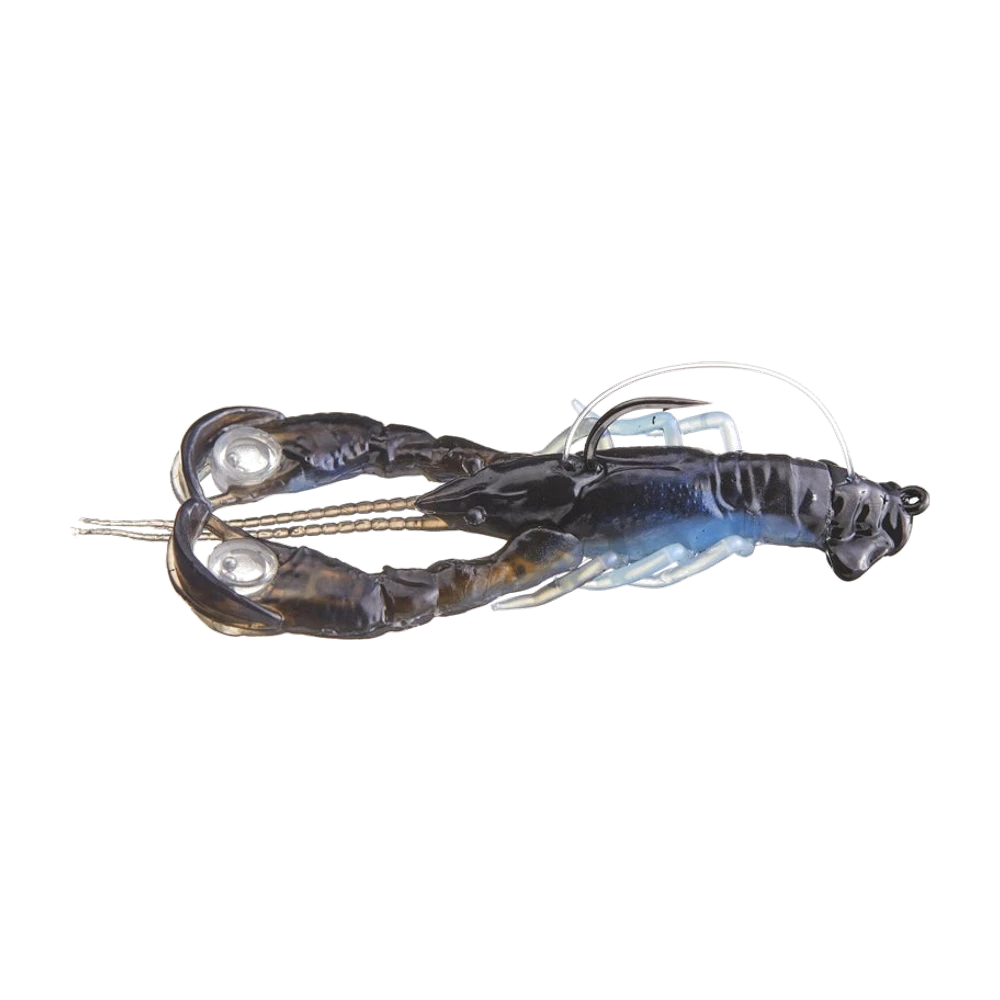
Berkley Clatter Craw: the pre-rigged craw with rattles in its claws
Not sure this lure fits YOUR spot today? CarnaFish tells you in 10 seconds, from a photo.
On a heavily fished water, a bass has already watched the same green Texas-rigged craw go past a hundred times over the season. It does not necessarily refuse it, but it watches it arrive, takes its time, and often ends up letting it go. That is exactly the context the Clatter Craw was designed for: keep the profile and the behaviour of a believable crayfish, and add an audible signal that standard rigs simply do not have.
Rattles in the claws, not in the body
The idea is worth pausing on, because it is less ordinary than it looks. Plenty of noisy soft baits house a rattle chamber in the body: the sound is there, but it is produced by the whole lure travelling. The Clatter Craw puts the rattles inside the claws themselves. The result is that the sound originates where the movement is finest and most frequent - at the tips of the two appendages that keep moving even when the body is lying still on the bottom.
In practice, you can make the bait clatter without moving it a centimetre. A vibration passed down the rod tip is enough to work the claws and therefore the rattles. That is exactly what you need on a located fish that refuses to follow: you stay in its zone, you produce a repeated signal, and you let time do the rest.
Let it settle, count to five doing nothing, then shake the rod tip for three seconds with the line almost tight. Start again. On a two-square-metre piece of cover, that sequence repeated four or five times convinces more fish than ten successive casts to different places.
Pre-rigged: what it changes and what it costs
That is the second design decision, and the brand owns it: the Clatter Craw arrives ready to tie. The single hook is already in place with the point coming out of the back, and a fluorocarbon weed guard fitted at the front protects it. A line tie at the rear of the body - the front of the lure in the water, since a crayfish backs away - takes the knot directly.
The upsides are real. The rig is perfectly aligned, which a home-made rig gets wrong one time in three when you force a hook through a thick body. The hook matches the size of the bait with no trial and error. And above all you change baits in thirty seconds, which matters when the feeding window lasts twenty minutes.
The downsides are real too, and need saying. The pack holds only two, where a standard craw comes eight or ten to a bag: the cost per bait is in another league. You choose neither the size nor the brand of the hook. And you cannot add weight: the fall rate is the one the manufacturer decided on, full stop. If you want a faster drop to reach six metres into the wind, this is not the right tool - a heavy Texas rig on a Berkley Chigger Craw will give you the control the Clatter Craw does not offer.
What the fluorocarbon weed guard is really for
A fluorocarbon weed guard is a few clear, supple strands set in front of the point. It pushes fine weed and twigs aside, and nothing more. It is not a lily-pad rig: in dense vegetation the point will eventually catch. Its domain is sparse sunken timber, low weed, rocky edges with a little branch work. Within those limits it has the advantage of taking almost nothing away from hooking power, unlike a point buried in the plastic on a standard Texas rig.
If the strands splay out after several fish, pinch them gently between two fingers to close them back toward the point. Do not cut them: shortening them removes most of what they do.
Where to use it first
Berkley's own description explicitly targets heavily pressured fisheries, and that is consistent with what the bait does. Three situations stand out:
- A precise, limited piece of cover: a sunken tree, a boulder, the corner of a dock. You know there is a fish there and you have to make its mind up. This is the best use.
- Stained water or an evening session, where the audible signal makes up for reduced visibility. The blue-black colour makes full sense here.
- Hard gravel or rock bottom, where a crayfish is a plausible prey item all year and where the claws catch enough relief to keep clattering.
Conversely, to search fifty metres of bank at a cast every ten seconds, the cost-to-benefit ratio is not in its favour. Leave that job to a tungsten football jig with a cheap trailer, and keep the Clatter Craw for the spots you want to work hard.
The mistake that kills the bait
Working it like a jig, with long vertical pulls. The pre-rigged body is light and a firm pull lifts it too high, takes it out of the bottom zone and cancels the whole point of the rattles, which need small repeated movements rather than one big displacement. Stay low, stay short, and let the bait work right against the substrate.
Not sure what to tie on?
Photograph your spot: CarnaFish reads the scene, cross-checks the conditions and gives you the zone, the lure and the retrieve. Free on iOS and Android.
Colours by water clarity
- Dirty water, silt bottom, evening sessions: the blue-black colour with translucent legs, which keeps a readable silhouette when colour no longer registers.
- Clear water over vegetated bottom: natural brown-green tones, closest to a European crayfish in summer.
- Gravel or rip-rap: orange-brown, matching a recently moulted crayfish and signalling a vulnerable meal.
Where it fits in a box that is already full
The Clatter Craw is not a volume bait. It completes a box rather than replacing anything in it: two in reserve, brought out when a spot resists and the standard rigs have already failed. In that role it does for sound what a Molix Real Craw does for visual realism, adding the acoustic dimension the latter does not have.
Knowing which spot to work hard remains the hardest part of fishing, and that is exactly what CarnaFish makes easier: one photo of the spot, and the AI suggests the zone to work, the depth and the lure type that suit the day's conditions. For the rest, our guide to getting started with bass fishing covers reading water and the basic tackle.
Key points
- The rattles sit in the claws: the bait clatters without needing to travel.
- Pre-rigged and ready to tie, so quick to deploy, but sold two to a pack with no way of adding weight.
- The fluorocarbon weed guard pushes fine weed aside; it does not replace a Texas rig in a dense mat.
- This is a spot bait, not a search bait.
FAQ
Does the Clatter Craw rig like a normal craw?
No, it comes already rigged. The single hook and the fluorocarbon weed guard are in place, and you tie straight to the line tie at the rear of the body, which is the front of the lure in the water.
How much does it weigh?
Berkley gives no weight for this model. The pack states 8.9 cm / 3.5 in and two baits, but no mass and no fall rate: you discover it on the first cast.
Can I add weight to it?
Not without altering the original rig, which defeats its purpose. If you need a fast drop or a lot of depth, switch to a weighted Texas rig with a standard craw.
Is the weed guard enough in lily pads?
No. A few fluorocarbon strands push aside fine weed and twigs, not a mat of vegetation. In anything dense you need a Texas rig with the point buried in the plastic.
Do the rattles spook fish in clear water?
Rarely, as long as the animation stays restrained. The sound the claws produce is faint and intermittent, nothing like the constant clatter of a lipless crankbait. If in doubt, space the shaking sequences further apart.
Why only two baits per pack?
Because each one comes rigged, with its hook and its weed guard. That is the price of the pre-rigged format, and it is what makes it a back-up bait rather than a search bait.
The full bass lure guideSeason-by-season strategy: which family of lure, when, and why.Go from theory to fish
CarnaFish reads your spot from a photo and gives you the game plan: zone, lure, retrieve. Free on iOS and Android.