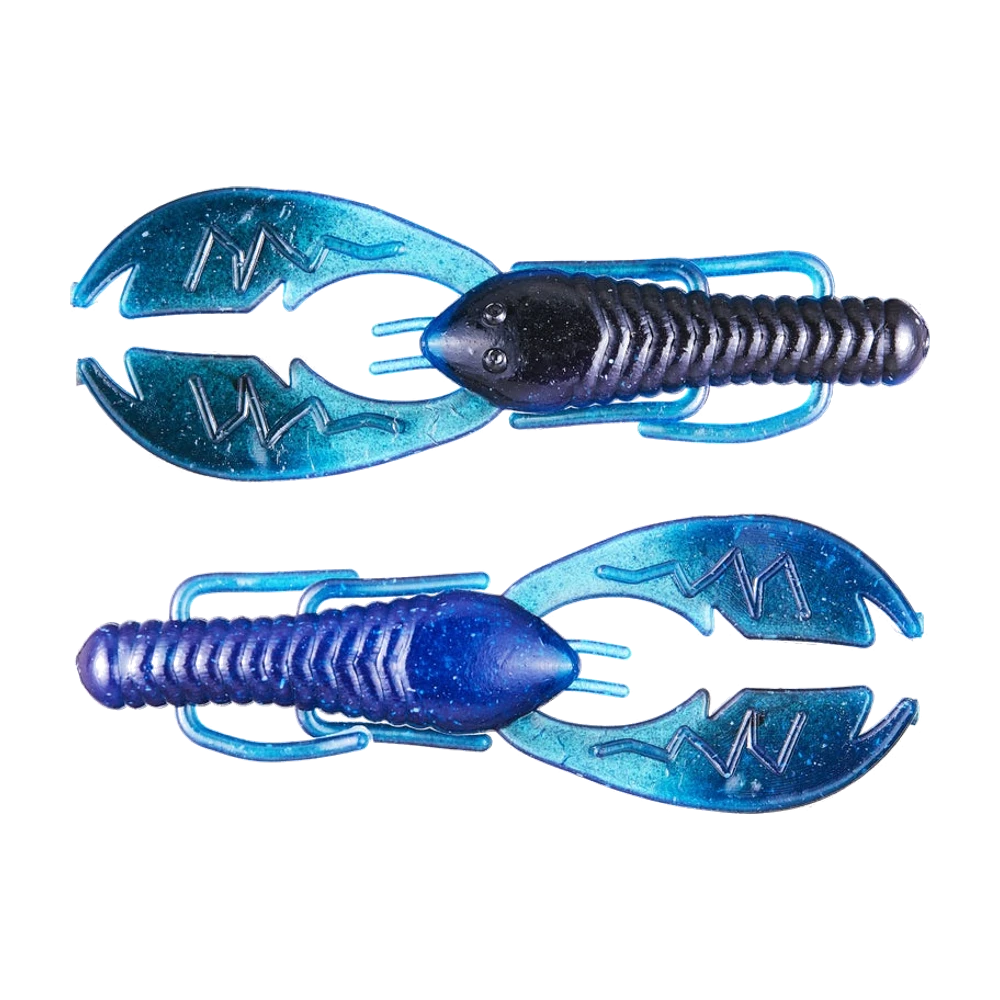
NetBait BaitFuel Paca Slim Craw: the slim craw with floating claws
Rather not fish it blind? Photograph your spot — CarnaFish cross-checks the conditions and points you the right way.
There is one moment where a soft plastic craw gives itself away: the pause. You have just dropped the bait against a laydown, you stop everything, and most imitations collapse onto their side with the claws buried in the silt. The Paca Slim Craw does the opposite — its claws are buoyant enough to lift and stay raised while the body rests on bottom. That is the defensive posture of a cornered crawfish, and it is exactly what a bass is reading at that second.
A slim body and claws that work on their own
NetBait has been building out its Paca family for years; the Slim is the narrow interpretation of it. The body is ribbed and solid — not hollow — and that changes two things. First it displaces more water than a smooth body of the same diameter: every rib catches the flow and sends back a short, quiet vibration that carries better in dirty water than a polished silhouette does. Second it takes punishment better: a solid body does not stay crushed after the first fish the way a blown body does.
The claws come from a design the brand holds a patent on, and they behave in two distinct ways depending on what you do. At rest they float and stand up. Moving, they rotate on their axis — the manufacturer describes a helicopter-like action with the maximum number of flaps per second. In practice you feel a soft, irregular load in the rod as soon as you pull, then nothing at all when you stop. That contrast between a busy phase and a completely frozen one is the whole point of the bait.
The plastic is loaded with BaitFuel scent, worked into the material during manufacture rather than wiped on afterwards. It will not conjure a fish that is not there, but it does lengthen the time a bass holds the bait before spitting it — and on a slow presentation where the bite only registers a second or two late, that extra delay converts directly into landed fish.
Rig one weightless, plain Texas style, and throw it into shallow clear water. You will see the exact posture it takes on the bottom, claws in the air. Five minutes that save you from fishing for two years with a wrong mental picture of what your bait is doing.
Two sizes, two jobs
The Paca Slim Craw comes in 8.9 cm / 3.5 in and 10.2 cm / 4 in, sold nine to a bag. The gap looks trivial on the shelf; it is not on the water. The 3.5 in is the one to reach for under heavy fishing pressure, late in the season or on a busy fishery: it rides a 3/0 hook, tucks under a compact jig without stretching the profile, and gets bites where more volume gets refused.
The 4 in belongs to spring and to stained water. More claw surface means more displacement and a signature a fish hunting on its lateral line can actually read. It also sits better on a 4/0 hook and carries a 10 to 14 g weight without folding back on itself.
The manufacturer does not publish a body weight, and it is fair to say so plainly: on a soft plastic meant to be weighted, the useful number is the one on your rig, not the one on the plastic. Do not go hunting for a figure that is not on the product sheet — set your weight from depth and wind instead.
The rigs that do it justice
Texas rig, the default
A wide gap 3/0 for the 3.5 in, 4/0 for the 4 in, with a 5 to 14 g tungsten bullet depending on depth and cover. Peg the weight against the nose if you want a tight, committed drop into a laydown; let it slide free when you are fishing flat hard bottom, so the bait keeps gliding for a few dozen centimetres after the sinker has landed. As with any Texas rig, a hook point buried in the back calls for a long sweeping hookset rather than a wrist snap.
Jig trailer
This is probably its best use. Behind a skirted jig it supplies exactly what a bare jig lacks: two appendages that move while the lure sits still. Against a Keitech Flex Chunk, which gives compact volume and a faster drop, the Paca Slim stretches the profile and slows the fall — pick according to whether you want to get into a hole quickly or hover above a grass mat.
Jika and tokyo rig
A weight hung below a free swivel releases the body completely, so the bait holds above the substrate with the claws moving the instant you touch the rod tip. On a vertical spot, an isolated boulder or a bridge piling, this is the presentation that stays in the strike zone the longest.
The classic mistake
Overworking it. The reflex when nothing happens is to pull harder and more often. With this bait that deletes the phase that triggers the bite — the claws no longer have time to rise and settle between pulls, and you turn a crawfish standing its ground into an object fleeing in a straight line. Count to five in your head after every pull. In cold water, count to ten.
Where and when
All year wherever there is hard structure: riprap, rock, boulders, deadfall, dock pilings. A crawfish is a contact animal, it does not cruise open water — a bait imitating one that never touches anything tells no believable story.
The peak is late spring through summer, when crawfish are active and bass are deliberately hunting them. In Europe, American crawfish species have colonised a great many bass waters, which makes the imitation unusually relevant — often more so than a baitfish profile over the same structure. Conversely, in midwinter over bare bottom, a finesse shad working on the fall will out-fish a craw that has nothing to touch.
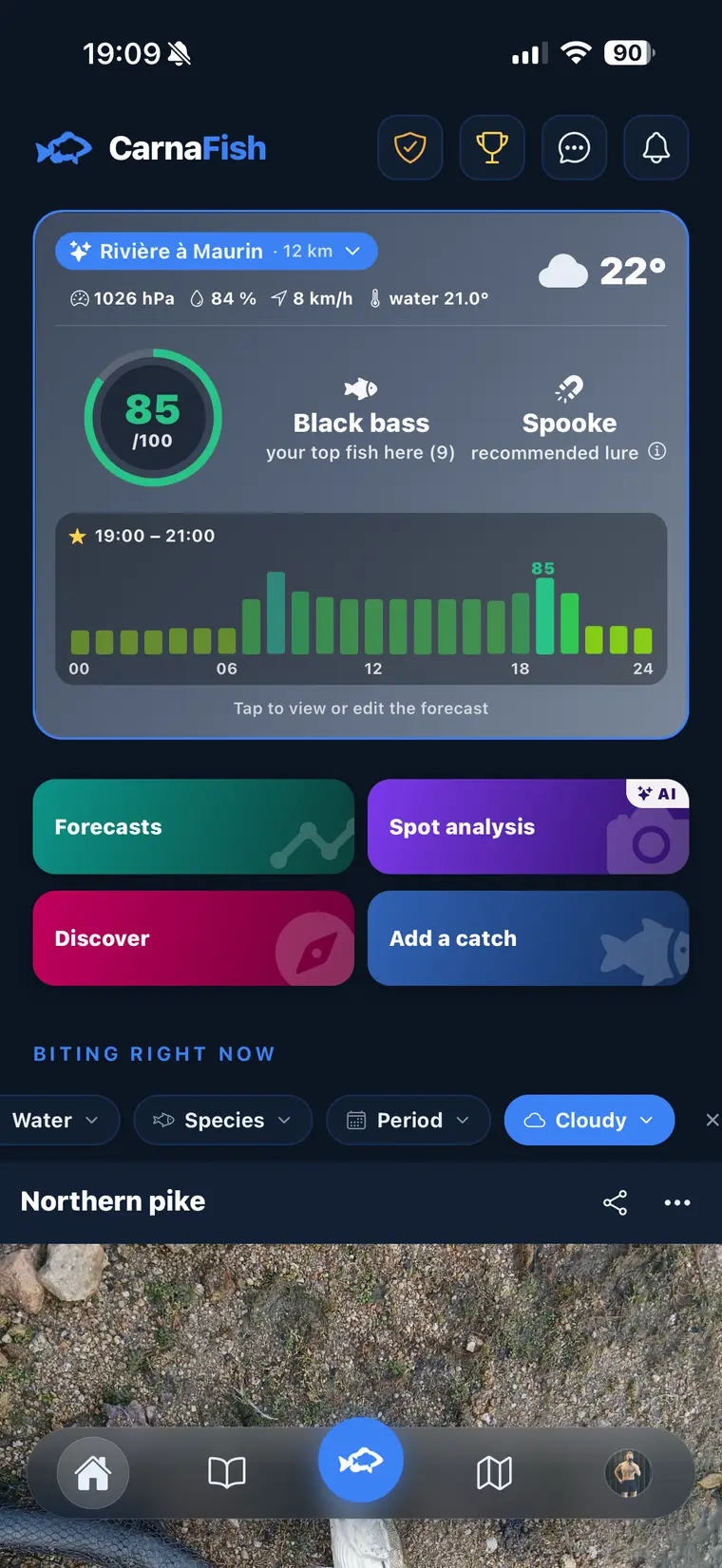
Not sure what to tie on?
Photograph your spot: CarnaFish reads the scene, cross-checks the conditions and gives you the zone, the lure and the retrieve. Free on iOS and Android.
Colors by water clarity
- Clear water, sand or light rock : Green Pumpkin. The universal tone that never startles a cautious fish and stays readable without flashing.
- Stained water, overcast or low light : Black Blue Flake, as shown in the photo on this page. The dark body cuts a clean silhouette and the blue flake grabs what little light reaches it.
- Gravel bottom, early season : Watermelon Red, which picks up the reddish cast crawfish take on when they are active.
A contact bait, so a spot-reading bait
A soft plastic craw does not forgive a bad zone: drop it where there is no rock, no wood and no break, and it is nothing more than a piece of plastic dragging along. That is precisely what CarnaFish is there to fix — one photo of the spot and the AI suggests the zone, the depth and the lure family that match what it sees. To build the groundwork on tackle and typical spots, our beginner's guide to bass fishing covers the rest.
Key takeaways
- The claws float: at rest the bait sits with them raised off the bottom, and that is when the bite comes.
- Only two sizes, 8.9 and 10.2 cm — the small one for clear water and pressured fish, the large one for spring and stained water.
- Body weight is not published by the manufacturer: your sinker is what sets the fall rate.
- The most common error is working it too fast and deleting the pause that does all the work.
FAQ
Which Paca Slim Craw size should I start with?
The 4 in for stained water or spring, the 3.5 in if the water is clear and the fishery is busy. If you only buy one bag, buy the 3.5 in: it draws more bites, even though it selects fewer big fish.
What hook and weight should I use?
A wide gap 3/0 for the 3.5 in and a 4/0 for the 4 in, with a 5 to 14 g tungsten bullet. Use the lightest weight that still lets you feel bottom: the heavier it is, the shorter the fall during which the claws are working.
Do the claws really float?
Yes, the manufacturer states buoyant claws giving a subtle floating action. Nothing suggests the whole body floats, though: rigged on a weight the bait sinks, and it is the appendages that lift.
Can it be used as a jig trailer?
That is one of its best applications. It lengthens the jig profile and slows the drop, unlike a compact trailer that falls faster. Match the choice to the depth you want and the fall speed you are after.
How many baits are in a bag?
Nine, in both sizes. Keep that separate from the length figure: the number next to the size in the manufacturer's table is a pack count, not a dimension.
Does it catch anything other than bass?
It is a bass bait and that is where it makes sense. A good perch may hit a lightly rigged 3.5 in, but do not plan around it: for perch, a much smaller profile remains the better call.
The full bass lure guideSeason-by-season strategy: which family of lure, when, and why.Go from theory to fish
CarnaFish reads your spot from a photo and gives you the game plan: zone, lure, retrieve. Free on iOS and Android.