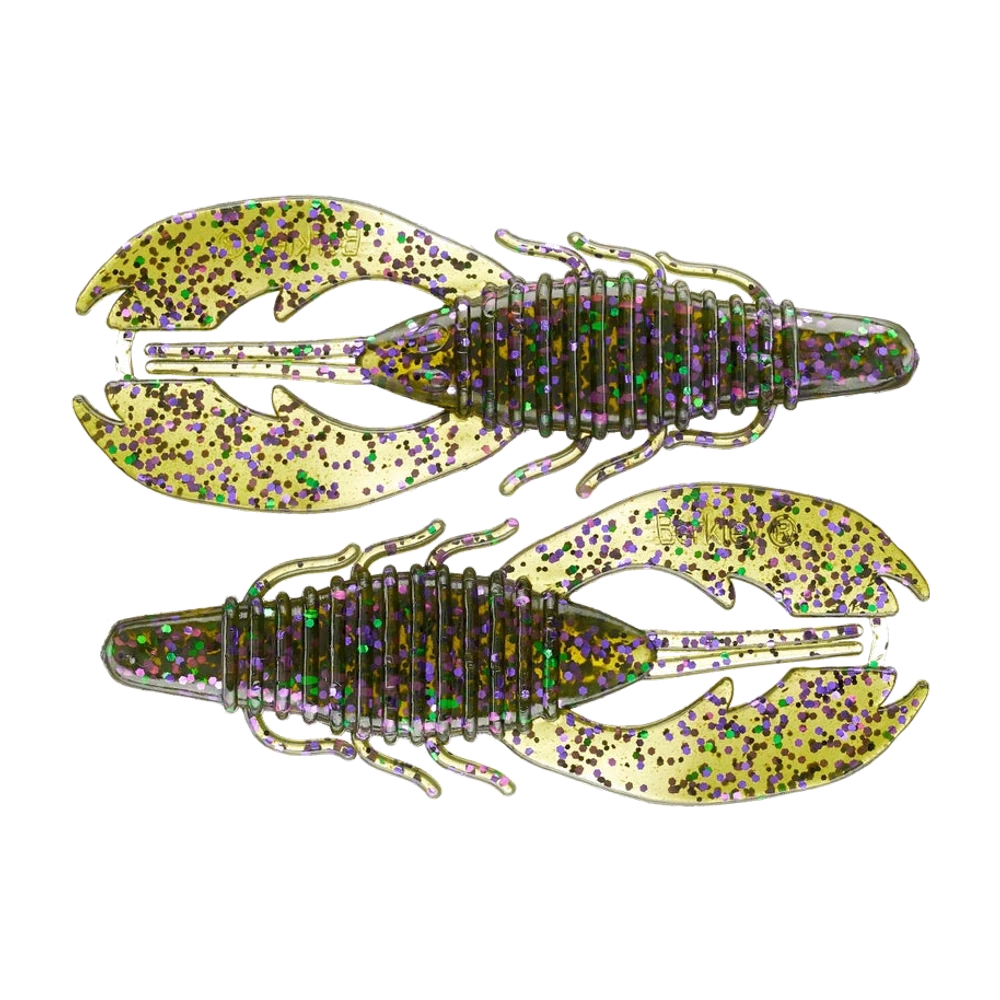
Berkley Powerbait Craw Fatty: the big craw that glides on the drop
One lure, endless conditions. CarnaFish reads your spot from a photo so you are not just guessing.
Some days you run presentation after presentation under the docks and feel nothing, and the one change that unlocks it isn't the colour or the spot: it's bulk. A bait twice the size, falling twice as slowly and pushing twice as much water, and the fish that was watching without moving finally commits. The Craw Fatty is built for that moment, and its name hides none of its intentions.
An unapologetically big profile, shaped by a flipping specialist
This craw was developed with Bobby Lane, an Elite Series veteran and a well-known flipping angler, and it carries the mark of that discipline: it's a big bait, designed to hunt bigger bites rather than more bites. Berkley publishes neither a length nor a weight for this model, only its intended use. In practice you size it up by eye and by hand at the counter and match your hook to what's actually in front of you — a 4/0 or 5/0 wide-gap is the sensible starting point for a craw of this class.
That's a clear difference from a compact craw like the Berkley Powerbait Crash Craw, whose job is to drop straight and fast between branches. The two do different work: one threads through, the other occupies the zone.
The flat body, and the gliding fall it creates
The Craw Fatty's real signature isn't its bulk but its cross-section. The body is wide and flattened, not round. On a free fall, that flat surface grabs water on either side and the bait slides sideways instead of diving vertically.
Two consequences. First, time on display: a bait that takes four seconds to cover two metres of water stays four seconds inside a fish's field of view, against a second and a half for a compact craw. Under a dock or in a hole in the grass, that's often all that separates a refusal from a bite.
Second, trajectory. The bait doesn't fall straight down, it drifts off to the side. So you can reach a spot slightly offset from your entry point — under a low branch, behind a piling — without having to drop the bait directly onto it.
To feel the gliding fall, fish it on a slightly slack line, not a tight one. A tight line pulls the bait back toward you and cancels the sideways glide. Watch the line on the drop: when it stops or moves off to one side, set.
Three levels of movement
Berkley separated the signals, and that's what makes this craw legible to work.
The claws, oversized and flattened, are the loud signal. They kick wide the moment the bait moves, and displace enough water to reach a fish's lateral line from several metres away in dirty water. That's what makes this a credible stained-water craw.
The flat body itself moves water on every sideways motion. That isn't a detail: a flat surface gliding through water pushes a mass of it ahead, where a round body simply splits it.
The antennae and side legs, finally, are thin and short. They do nothing while the bait is moving, where they vanish behind everything else. They work at rest: sitting on the bottom with a slack line, the bait keeps quivering at its extremities for several seconds. That's the pause signal, and it's often the one that triggers.
The rigs
Flipping and pitching. The technique it was built for. Tungsten bullet pegged against the nose, wide-gap hook, heavy rod and braid. You present one piece of cover at a time, let it fall on a slack line, give it two or three seconds on the bottom, lift and move on.
Standard Texas rig. Unpegged weight over clean bottom, the bait gliding behind the lead once contact is made. Drag it slowly with small sideways pulls and long pauses. This is the searching rig along a break or a weed edge.
Jig trailer. Its most interesting use for a European angler. Behind a flipping jig like the Berkley Flippin' Jig, it noticeably slows the fall and widens the silhouette. The effect is dramatic in cold water, where a bare jig drops too fast for a sluggish fish. Just don't oversize it: on a light jig, a trailer this bulky can tip the whole thing onto its side.
The most common mistake
Setting the hook too early. On a bulky bait, the fish doesn't always take the head first, and a good share of bites begin as a partial grab on the claws. If you set on first contact, you bring back a chewed craw and no fish. Wait for the weight to settle, drop the rod to take up slack, then set firmly upward.
Second mistake: trying to fish it fast. A big craw worked quickly loses everything that makes it interesting — the gliding fall never happens, the claws kick continuously instead of marking the beats, and all that's left is a large piece of plastic crossing the zone. If your fishing needs tempo, change lure families.
Not sure what to tie on?
Photograph your spot: CarnaFish reads the scene, cross-checks the conditions and gives you the zone, the lure and the retrieve. Free on iOS and Android.
Colour by water
- Clear water over gravel or sparse vegetation: the translucent finish in the photo, an olive green loaded with purple, green and gold flake. The body passes light and the flake throws scattered highlights, giving a living silhouette without being garish.
- Stained water, after rain or over mud: black and blue, the contrast combination that stays readable once visibility drops. Here the claws are the only reference the fish genuinely sees.
- Weed and dense edges: solid green pumpkin, which blends into the vegetation and lets the movement do all the work.
On a bait this size, heavy flake isn't decoration: it creates points of light that move independently of the body, breaking up the perception of one uniform lump of plastic.
Choosing the right craw bulk means nothing if you present it on empty cover, and that's exactly what CarnaFish does: a photo of the spot, and the app suggests the zone, the depth and the presentation suited to the day's conditions. To build a tackle base without an unreasonable budget, our predator fishing tackle guide covers what actually matters on a flipping rod.
Key takeaways
- An unapologetically big craw: it hunts bigger bites, not more bites.
- The wide flat body creates a sideways gliding fall that multiplies time spent in front of the fish.
- Claws for movement, antennae and legs for the pause: the two signals don't fire at the same time.
- Berkley publishes neither length nor weight: check the size on the packaging before picking your hook.
FAQ
What size is the Craw Fatty?
Berkley publishes no length for this model, only its intended use and pack count. It's a large-profile craw within the Powerbait range; check the figure on the bag before choosing a hook, with a 4/0 or 5/0 wide-gap being the usual starting point.
How does it differ from the Crash Craw?
In bulk and fall trajectory. The Berkley Powerbait Crash Craw is compact and drops straight, which makes it precise inside a tangle of branches. The Craw Fatty is wider, glides sideways and stays far longer in the fish's field of view.
Is it a good jig trailer?
That's one of its best uses. It slows a flipping jig's fall and widens its silhouette, which matters in cold water when fish won't chase a fast bait. Just avoid pairing it with too light a jig, which would tip onto its side.
Why aren't my bites converting?
Usually because you're setting too early. On a bulky bait, fish often grab the claws first. Wait for the weight to settle properly, take up the slack, then set upward in one firm motion.
Is it for clear water or dirty water?
Both, as long as you match the colour. In dirty water it's actually at its best: the claws displace enough water to be picked up by the lateral line before the bait is ever seen.
What hook and weight should I use?
A 4/0 or 5/0 wide-gap depending on the exact size of the bait in your hand, and a tungsten bullet of 7 to 14 g / 1/4 to 1/2 oz depending on cover density. Peg the weight for flipping, leave it free over clean bottom to preserve the gliding fall.
The full bass lure guideSeason-by-season strategy: which family of lure, when, and why.Go from theory to fish
CarnaFish reads your spot from a photo and gives you the game plan: zone, lure, retrieve. Free on iOS and Android.