Berkley PowerBait MaxScent Creature Hawg: the craw that stands its ground under cover
Not sure this lure fits YOUR spot today? CarnaFish tells you in 10 seconds, from a photo.
When a bass tucks under a sunken tree or into the edge of a lily pad mat, it stops chasing anything. It occupies a shelter, it waits for prey to pass within immediate reach, and it ignores anything crossing its zone more than thirty centimetres away. Lures that are fished by moving forward — cranks, spinners, shads on a straight retrieve — have no hold on that fish.
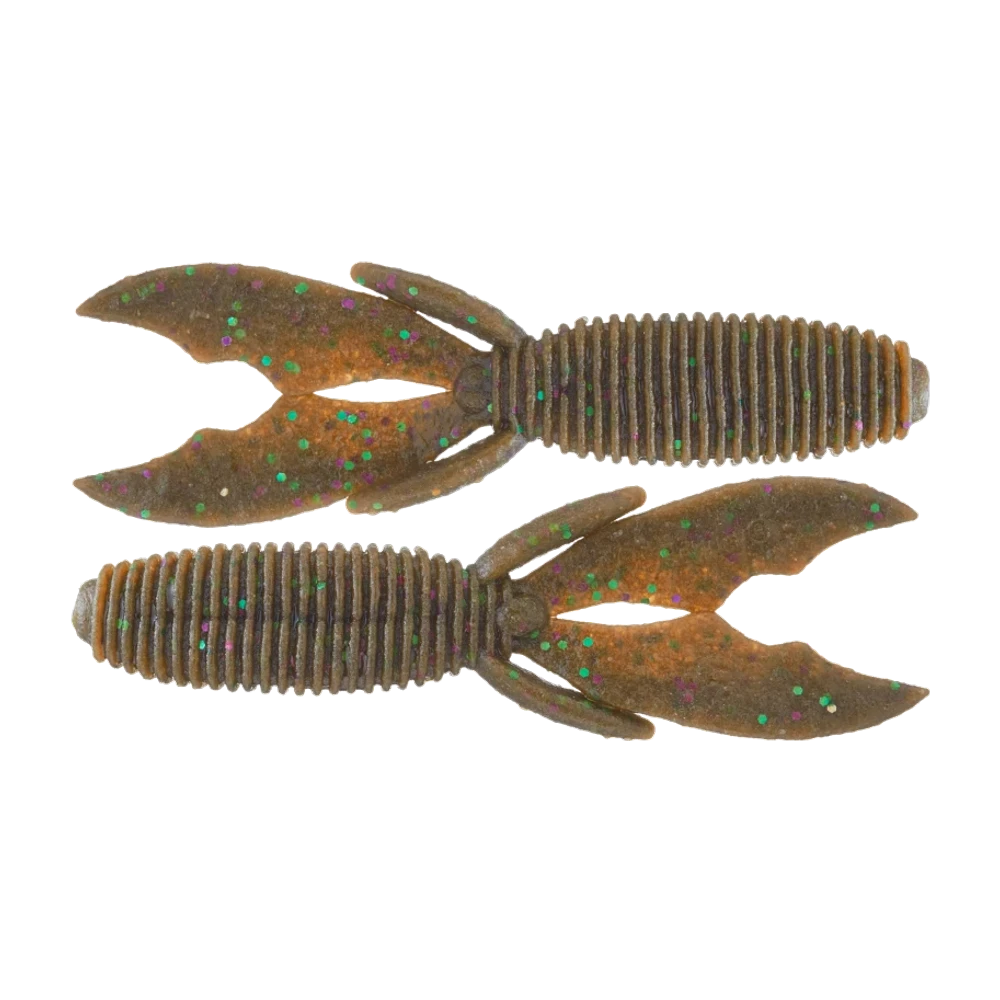
What works is a lure that gets into the shelter, stops there, and keeps living while you do nothing. That is exactly the job of a creature bait, and the Creature Hawg is cut out for it: a compact body, a set of multiple appendages, and the silhouette of a crayfish in a defensive posture.
The MaxScent technology the material is made of — how it disperses, how long the scent trail lasts, how to store the bag — is explained in detail in our page on the PowerBait MaxScent The General. We will not repeat it here. What interests us is what the creature shape adds on top.
What the appendages do, one by one
A creature bait is not a worm with decorative extras. Each appendage has a different mechanical function.
- The two flat claws catch water at the slightest movement. They flap during the fall, and above all they keep oscillating for several seconds after the lure has settled.
- The fine side appendages create a secondary, high-frequency disturbance. They are what give the lure its "alive" look during long pauses.
- The segmented body acts as the anchor point for the hook and concentrates the mass at the front, which stabilises the lure on the drop and stops it spinning on itself.
Together they produce something no straight worm does: the lure stays active at rest. That is precisely the quality you need when the right presentation is to leave the lure motionless in front of a fish for ten seconds.
The posture on the bottom, a decisive detail
Drop a Texas-rigged creature bait on hard bottom and watch it: the claws, more buoyant than the rest, lift up. The lure settles into a defensive crayfish posture, claws in the air, body flat.
That posture has two concrete consequences.
First, it is recognised by bass, which feed heavily on crayfish over hard bottom. Second, it puts the claws into the current or the residual water movement, which is enough to make them move without any input from you.
Hence a simple rule: over gravel, rock or dead wood, you can leave this lure motionless far longer than you think is necessary.
On the water: after dropping the lure at the foot of cover, count ten seconds doing nothing, then simply make it twitch on the spot by tightening the line a centimetre — without moving it. That micro-movement, which makes the claws flap without the lure advancing, triggers more bites than any pull.
Rigs and weights
| Rig | Weight | Use |
|---|---|---|
| Texas rig, free bullet | 5 to 7 g | weed edge, shallow water, slow fall |
| Texas rig, pegged bullet | 10 to 14 g | punching a dense mat or tight wood |
| Carolina | 14 to 21 g sinker | flats, hard bottom, wide searching |
| Jig trailer | to suit the jig | big fish, heavy cover |
A few rigging points that make the difference.
The hook. A wide gap model in 3/0 or 4/0. A creature body is thick: a hook with too narrow a gap does not free enough point and you lose hooksets.
Pegging the bullet. Leave the bullet free when you want a slow, separated fall that gives the claws time to work. Peg it against the lure with a stopper when you have to get through a vegetation mat: the whole thing becomes compact and punches through instead of hanging up.
As a jig trailer, cut one or two segments off the body before threading it on. You keep the bulk of the claws without ending up with an oversized package, and the hookup rate improves noticeably.
Not sure what to tie on?
Photograph your spot: CarnaFish reads the scene, cross-checks the conditions and gives you the zone, the lure and the retrieve. Free on iOS and Android.
Where to pull it out, and where to leave it in the bag
The windows where it is hard to beat:
- Hard, crayfish bottoms: gravel, riprap, scree, slabs.
- Sunken wood and stumps, where its compactness on a Texas rig lets it get in without snagging.
- Dense weed edges, on a pegged rig.
- Spring and early summer, the period when crayfish are active and bass are looking for them.
- Passive fish after a cold snap or a front, when you have to slow down to the extreme.
Where it is not the right tool:
- Fast searching. You cover very little ground per hour; to search, a straight-retrieve lure is better.
- Open water. A creature bait makes no sense off the bottom or away from cover.
- Very cold water in midwinter, where a slim worm on a drop shot rig will be accepted more readily.
- Small fish. The size of the lure and hook select, which is an advantage if you are after big fish and a drawback if you just want to get bites.
Creature Hawg or straight worm
The PowerBait MaxScent The General is its exact opposite in terms of shape: a smooth worm with no appendages, fished wacky or finesse, whose whole point is slowness and discretion. It excels on wary fish, in open water or over clean bottom.
The Creature Hawg targets the other end of the spectrum: bulk, water displacement, appendages that move, and the ability to get into places where a wacky-rigged worm would snag immediately. Choose it when the fish is under cover rather than in open water, and when you are after a committed fish rather than a high bite count.
Against a Zoom Brush Hog, the difference lies in material and density: the Creature Hawg is softer and heavier, which gives it a more decisive fall and appendages that react to less input, at the cost of lower durability per fish landed.
Our beginner's guide to bass fishing places the creature bait among the other bottom techniques. And if you are unsure which rig to choose in front of a particular piece of cover, CarnaFish analyses a photo of the spot and answers.
Key takeaways
- The appendages keep moving at rest: the lure works while you do nothing.
- The buoyant claws make it settle in an upright crayfish posture on hard bottom.
- Free bullet for a slow fall, pegged bullet to punch a dense mat.
- Wide gap hook in 3/0 to 4/0: the body is thick, you need to free the point.
- A cover and hard-bottom lure, useless in open water or for fast searching.
FAQ
What hook should you use to Texas rig a Creature Hawg?
A wide gap Texas hook in 3/0 or 4/0. The body is thick and a hook with too narrow a gap leaves too little point exposed, which causes missed hooksets on fish that inhale the lure whole.
Should you peg the bullet weight?
It depends on the aim. Free bullet for a slow, natural fall along the margins; pegged bullet with a stopper when you have to get through a vegetation mat or tight wood, because the package becomes compact and penetrates better.
How long should you leave the lure motionless?
Far longer than with a conventional lure: ten seconds at the foot of cover is nothing excessive. The claws and appendages keep oscillating during that time, and that is often when the bite comes.
Can you use it as a jig trailer?
Yes, that is one of its best uses. Cut one or two segments off the body before threading it on to keep the bulk of the claws without ending up too long, which also improves the hookup rate.
What is the difference with a straight worm like The General?
The straight worm plays discretion and slowness over clean bottom or in open water. The Creature Hawg brings bulk, water displacement and the ability to get in under cover, with a bias towards bigger fish.
Which colours should you favour?
Crayfish tones — browns, dark greens, sometimes with an orange accent on the claws — in clear to slightly stained water. In heavily coloured water, switch to a frankly dark silhouette, which reads better against the light.
The full bass lure guideSeason-by-season strategy: which family of lure, when, and why.Go from theory to fish
CarnaFish reads your spot from a photo and gives you the game plan: zone, lure, retrieve. Free on iOS and Android.