Berkley Powerbait Crash Craw: the compact craw that goes anywhere
Not sure this lure fits YOUR spot today? CarnaFish tells you in 10 seconds, from a photo.
Late September, the water starts cooling and bass pin themselves back onto the rock. You spend half an hour searching with a crankbait and see nothing, then you put a craw on a Texas rig along the same break and catch three fish in fifteen minutes. That isn't lure magic: it's that the crawfish is the dominant prey right then, and a bait crawling along the bottom with its pincers waving tells exactly the right story.
A compact profile, and why that matters
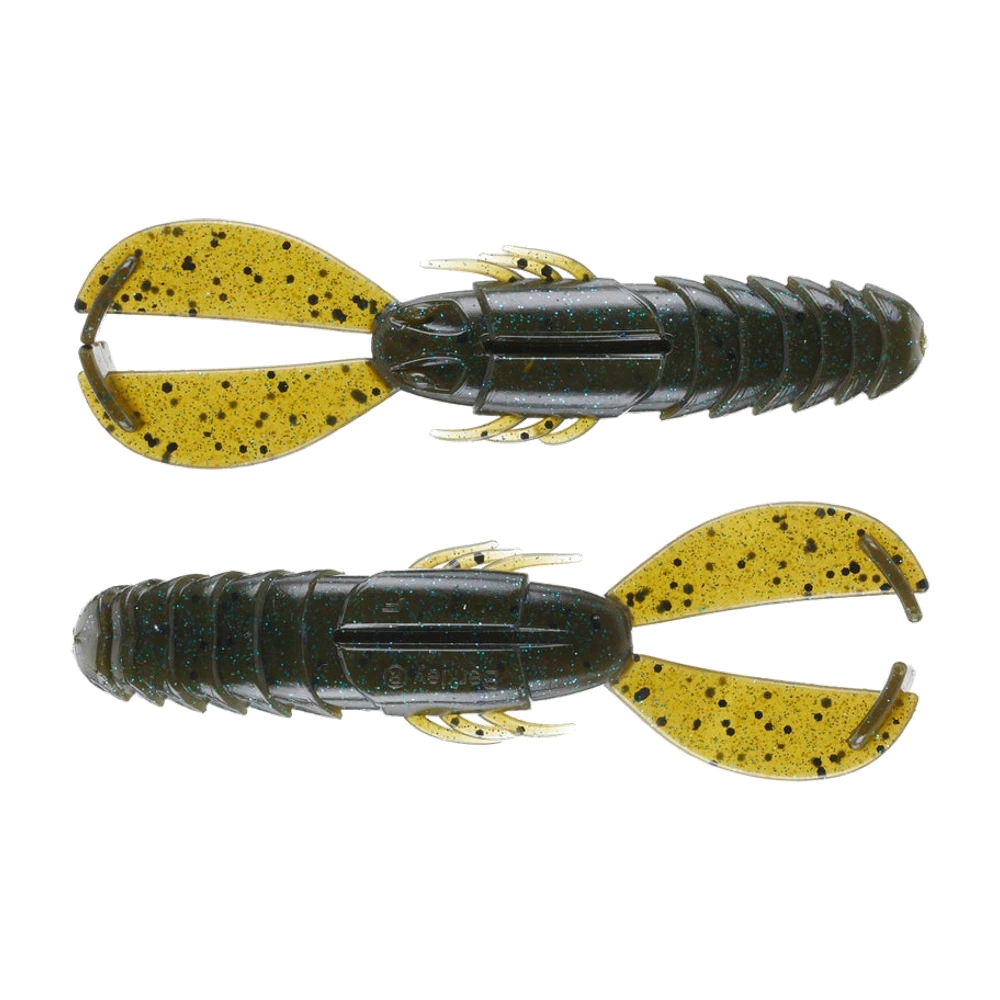
The Crash Craw was designed by Scott Suggs, a Major League Fishing pro, and his intent is obvious at a glance: this is a compact craw, not a big many-limbed creature bait. The body is short and dense, and the two available sizes stay modest — 8.9 cm / 3.5 in for the small one, 10.8 cm / 4.25 in for the large. Berkley publishes no weight for this bait, which is normal for a bare soft plastic: the finished weight comes entirely from what you rig in front of it.
That compact format has a direct consequence on the water. A short bait drops straight, doesn't glide, and lands where you put it. When you're flipping into a tangle of branches, that's exactly what you want: the bait falls in the hole you picked, not three metres away on a drift. Conversely, if you're trying to slow the fall so a fish has time to come up, a bulkier body like the Berkley Powerbait Craw Fatty does the job better.
The ribbing: hook protection before decoration
The Crash Craw's body is covered in deep, pronounced rings running from head to tail. They jump out of the photo. They are not there for looks.
First, they stiffen the body along its axis. A ribbed soft plastic compresses like an accordion on the hookset instead of tearing, which lets the hook point come through cleanly. Second — and this is what Berkley highlights — that sculpted surface shrouds the hook point on a Texas rig: the ridges stand slightly proud of the back and catch soft weed instead of the point. In sparse grass or in algae-covered wood, you feel the difference in the number of snags you don't have to clear.
Finally, all that surface area carries more Powerbait formula. On a bait a fish holds for two or three seconds before you set, that counts.
When you Texas rig a ribbed soft plastic, bring the point out in a valley between two rings, not on a ridge. On a ridge the plastic is thicker and the point takes a fraction of a second longer to clear. Over ten bites in a day, that adds up to fish.
Pincers and legs: two separate signals
The Crash Craw combines two movements that don't fire at the same moment, and that's what makes it interesting to work.
The trailing legs, thin and supple, run an alternating action: they don't beat in phase, one goes out as the other comes back. That disorder keeps working in cold water, when a stiffer plastic has stopped moving altogether. It's the background signal, the one that runs while the bait sinks or sits still.
The two flat flapping appendages up front answer to you. They're wide and flattened, and they open and wave the moment you twitch the rod tip — exactly the posture of a cornered crawfish rearing up to threaten. That's the punctual signal, the one you trigger.
In practice that dictates the cadence: two short sharp twitches to make the pincers flare, then a long pause while the legs carry on by themselves. The bite almost always comes on the pause.
The three rigs that exploit it
Texas rig with a tungsten bullet. The default. A 5 to 10 g / 3/16 to 3/8 oz weight depending on cover density and depth, with a 3/0 or 4/0 wide-gap hook depending on size. Peg the weight against the nose in heavy cover, leave it free over clean bottom so the bait glides a little behind the lead.
Wobble head. A head with a swivelling line tie that leaves the body free to rotate around the pulling axis. This rig makes the most of the compact profile: the bait stays flat on the bottom and rolls over itself when it bumps a rock instead of falling onto its side. Drag it slowly, with small sideways pulls of the rod.
Bladed jig trailer. Behind a vibrating blade, the Crash Craw adds bulk without killing the vibration, and its flat pincers add drag that knocks the blade out of its metronome rhythm. Watch the size: the 10.8 cm / 4.25 in loads a light bladed jig too much, so stick with the 8.9 cm / 3.5 in.
It also makes a fine flipping jig trailer behind a Berkley Flippin' Jig, but its compact profile sinks fast — it is not the trailer to pick when you want to slow the drop.
The mistake to avoid
Overworking it. A crawfish doesn't swim through open water: it walks the bottom and darts backwards when disturbed. Most anglers' instinct is to lift the bait off the bottom on every pull, which puts it instantly out of context. Keep the rod low, drag ten to twenty centimetres horizontally, and let it settle. You should feel the bottom at all times.
Second, subtler mistake: too light a weight. On a Texas rig, once you lose bottom contact you no longer know what your bait is doing and you miss the soft bites. A slightly heavy weight with constant contact beats a perfect weight with a line that tells you nothing.
Not sure what to tie on?
Photograph your spot: CarnaFish reads the scene, cross-checks the conditions and gives you the zone, the lure and the retrieve. Free on iOS and Android.
Colour by bottom and water
- Clear water over rock: green pumpkin with blue-green flake, the colour in the photo. The flake mimics the bluish highlights you actually see on a live crawfish's back.
- Stained water or overcast skies: black and blue, the contrast that stays readable once visibility drops below a metre.
- Gravel and clay bottoms, late summer: crawfish brown, with lighter pincers if you want a visible focal point.
One detail that matters: the Crash Craw's pincers are a markedly lighter shade than the body. That's deliberate — it's what makes the pincer movement visible from a distance in moderately clear water. Don't kill that contrast by darkening the claws with a marker.
Knowing which craw to tie on is useless if you're over the wrong kind of bottom, and that's exactly what CarnaFish makes easier: a photo of the spot, and the app suggests the zone, the depth and the presentation that suit the day's conditions. To learn how to spot breaks and rocky stretches before casting, our guide to reading a fishing spot walks through the clues to look for from the bank.
Key takeaways
- Only two sizes, 8.9 cm / 3.5 in and 10.8 cm / 4.25 in, and no published weight: the weight comes from your rig.
- The ribbing shields the hook point on a Texas rig as much as it holds the Powerbait formula.
- Pincers and legs work separately: two sharp twitches for the pincers, then a long pause for the legs.
- A compact profile that drops straight: excellent for flipping, less suited when you want to slow the fall.
FAQ
Which Crash Craw size should I pick?
The 8.9 cm / 3.5 in covers most situations and works equally well on a Texas rig or as a bladed jig trailer. The 10.8 cm / 4.25 in is for bigger fish, or for stained water where you want a larger profile. Berkley packs eight of the small size and six of the large.
What bullet weight should I rig in front?
Between 5 and 10 g / 3/16 and 3/8 oz in most cases. The right reference isn't depth, it's contact: take the lightest weight that still lets you feel the bottom constantly, then step up one size if there's wind or current.
Does the Crash Craw make a good jig trailer?
Yes, but it sinks fast because of its compact profile. Behind a flipping jig, it suits situations where you want to reach the bottom quickly inside deep cover. To slow the fall, a bigger-clawed trailer like the Berkley Crazy Legs Chigger Craw is a better fit.
Will it come through vegetation?
Through light to moderate vegetation, yes, provided you rig it Texas style with the point tucked in. The body ribbing helps push blades aside before they reach the point. In a thick mat you need a weedguard or a topwater bait instead.
How much does the Crash Craw weigh?
Berkley publishes no weight for this model, only lengths and pack counts. That's standard for a bare soft plastic, whose fishing weight depends entirely on the bullet or head you rig in front of it.
Should I work it fast or slow?
Slow, and in contact with the bottom. A crawfish doesn't cross the water column: it walks and darts backwards in bursts. Two short horizontal drags, then a three-to-five-second pause, is the cadence that catches the most fish.
The full bass lure guideSeason-by-season strategy: which family of lure, when, and why.Go from theory to fish
CarnaFish reads your spot from a photo and gives you the game plan: zone, lure, retrieve. Free on iOS and Android.