Berkley Chop Block 10 in: the 119 g soft glide bait, in CA Hitch
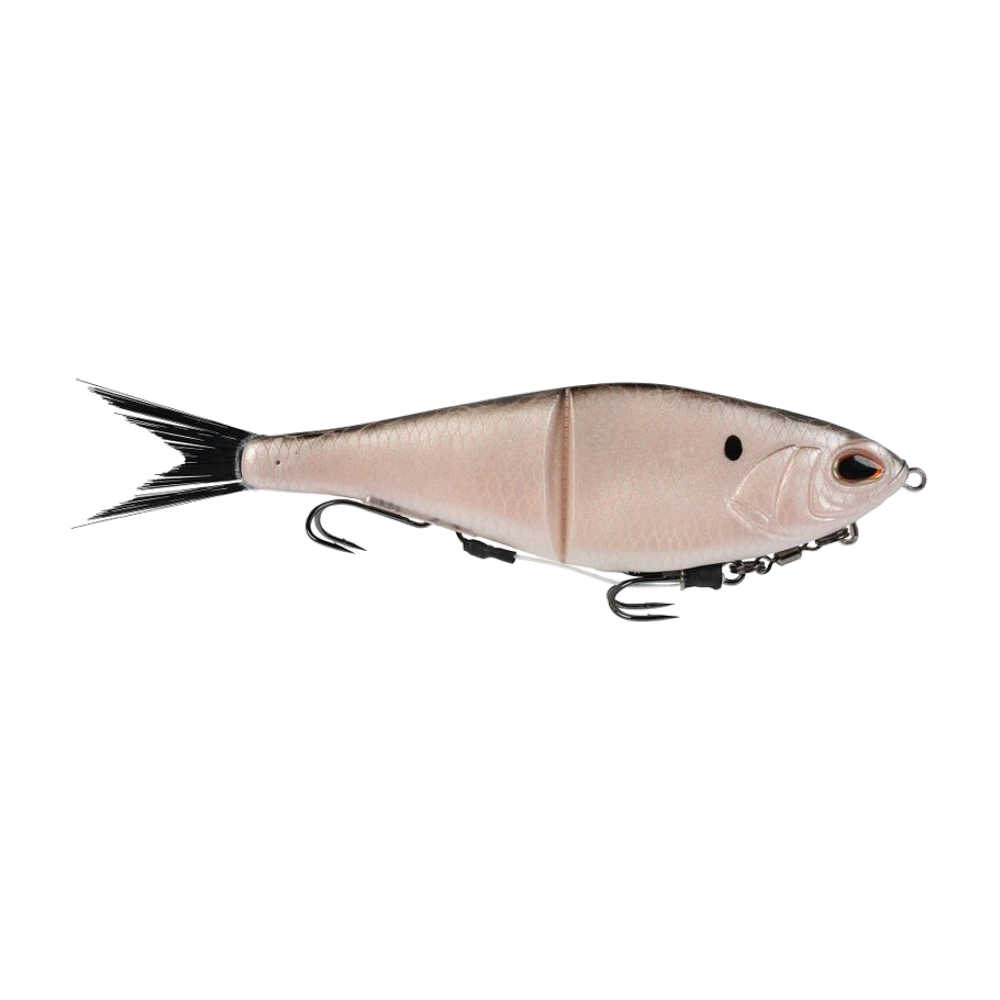
This lure shines under specific conditions. CarnaFish tells you in 10 seconds if today is one of them.
A big hard glide bait sets its own tempo: you give it one input, the bait travels a metre, you wait for it to come back. That is deadly on a fish that wants a long move, and useless on a fish that wants tight, continuous movement. The Chop Block is built for the other half of the problem: a 25 cm soft body that chops on the spot instead of gliding away.
What chopping actually means
Berkley uses the word, and it is the right one. The reference retrieve here is not the wide sweep of a classic glide bait: it is short, closely spaced twitches of the rod tip, or quick turns of the handle, that swing the bait ten or fifteen centimetres each way without ever letting it settle. The tall, broad body moves a lot of water for a tiny sweep, and it is that water displacement, more than the distance covered, that pulls fish in from a distance.
The fact that the body is soft changes everything compared with a resin glide bait. The central joint is reinforced with an internal mesh - a detail Berkley highlights, and not decoration: that joint is the first thing to fail on this kind of bait. And because rubber compresses under teeth, a fish holds the lure in its mouth a fraction of a second longer than it would a hard body. On a bait this size, that fraction is exactly what separates a solid hookset from a lost fish.
The tail is made of fibres rather than a moulded paddle. It creates no swimming action of its own; it follows the body a beat behind and waves during the pauses. It is what keeps a motionless lure looking alive while you let it sink.
The best moment to hook a fish on this bait is the stop right after a burst of tight twitches. Chop four or five times, kill it dead and count two seconds. That slow drop with the tail quivering is what decides the fish that was following.
Three sizes, and why this page covers the 10 in
Berkley's chart lists three formats: 6 in at 1 oz, 8 in at 2.2 oz and 10 in at 4.2 oz, all three in the slow-sinking class. Converted, that is 15.2 cm for 28 g, 20.3 cm for 62 g and 25.4 cm for 119 g.
This page covers the 10 in version, and it pays to be blunt: 119 g does not go on an ordinary predator rod. You need a swimbait rod rated to at least 150 g, a solid casting reel and 50 to 65 lb braid. If you do not own that outfit, take the 8 in version, which does the same job in a size most heavy setups can handle.
The hooks scale with the body. For the 10 in, Berkley lists a 4/0 treble and a 6/0 stinger; the 6 in drops to a size 2 treble with a 1/0 stinger. Those are very large hooks, and that is consistent with the amount of rubber they have to clear.
The stinger that detaches, and why that is clever
This is the real feature of the Fusion19 harness fitted here. The second hook, the stinger, is attached so that it releases from the body once the fish is hooked - it stays on your leader, but the swimbait no longer hangs off the hook.
The reasoning is mechanical. A 119 g lure dangling from the jaw of a head-shaking fish is an enormous lever, and leverage is the number one cause of lost fish on big swimbaits. Freeing the body takes that weight off the hook hold and cuts the risk sharply. In exchange, remember to put the stinger back in place after every fish: if it stays loose, the bait swims with a hook trailing behind it and the action suffers for it.
Where this bait belongs
Berkley describes an imitation of gizzard shad and panfish, that is, deep-bodied forage. The direct European reading is bream and good-sized roach, and therefore the big waters that hold pike - that is where the 10 in makes the most sense, not on a bank-edge bass.
Two situations stand out. The first is slow work along a drop-off or the edge of deep weed, where you cover little ground but every metre counts. The second is the following fish: a big pike that escorts a lure to the boat without striking will sometimes crack on a burst of tight twitches followed by a dead stop, where a steady swim gives nothing.
And because the body is rubber, there is a limit worth stating: pike teeth mark the Chop Block on the very first fish. That is not a manufacturing fault, it is the nature of the material. On water that holds plenty of pike, the cost per session is not the same as with a hard glide bait like the Megabass I-Slide.
The classic mistake
Working it in long sweeps like a hard glide bait. A soft body of this length does not really glide: at wide amplitude it goes off axis, folds at the joint and comes back in a mess. The action the manufacturer describes only appears on short, closely spaced inputs. If the lure feels mushy or chaotic, it is almost always because you are pulling too hard and too far.
Not sure what to tie on?
Photograph your spot: CarnaFish reads the scene, cross-checks the conditions and gives you the zone, the lure and the retrieve. Free on iOS and Android.
Colours by water
- Clear water on a big lake: the pearly CA Hitch from the photo, a pale pink tone that is very subdued and reproduces the flank of a baitfish under strong light.
- Stained water: a high-contrast pale-bellied pattern, which stays readable when light only penetrates a metre.
- Low light, late in the day, dark bottom: a dark back, which cuts a silhouette seen from below rather than trying to imitate a scale.
Where it sits among other big baits
The Chop Block fills a precise slot: the big soft volume that works tight. A Berkley Nessie uses the same material but on a wider glide, and a Savage Gear 3D Bleak Glide Swimmer brings the broad S-track of a hard body. Three lures, three registers - and it is often by moving between them on the same spot that you get a reaction from a fish that has seen everything.
Pulling out a 119 g lure only makes sense if you know where to throw it, and that is exactly what CarnaFish makes easier: one photo of the spot, and the AI suggests the zone to work, the depth and the lure type that suit the day's conditions. For the rest, our guide to choosing a pike lure covers the families worth carrying and the situations that go with them.
What to remember
- The 10 in measures 25.4 cm for 119 g in a slow-sinking class: a swimbait rod and heavy braid are not optional.
- The retrieve is made of short tight twitches, not long sweeps - the action only appears at short amplitude.
- The stinger releases from the body after the hookset to kill the leverage; put it back after every fish.
- Soft body: better hold in the mouth, but it wears out fast on water full of pike.
FAQ
What sizes does the Chop Block come in?
Three: 6 in at 1 oz, 8 in at 2.2 oz and 10 in at 4.2 oz, which is roughly 15.2 cm / 28 g, 20.3 cm / 62 g and 25.4 cm / 119 g. All three are listed as slow-sinking.
Do you need a special rod for the 10 in model?
Yes. 119 g is far beyond an ordinary predator rod. You want a swimbait rod rated to at least 150 g, a robust casting reel and 50 to 65 lb braid.
Does the Chop Block float?
No, all three sizes are listed as slow-sinking. You can let it drop while counting seconds before starting the retrieve, and work well below the surface layer.
What is the detaching stinger for?
It removes the leverage of the body once the fish is hooked. The lure frees itself from the hook, which stays on the leader, so the fish no longer has 119 g hanging off its jaw to work the hook loose.
Is it suitable for pike?
Yes, and on the 10 in version that is the most logical use in Europe. Plan on a wire or titanium leader, and accept that the rubber will be marked by the first fish.
Why does my Chop Block swim off to one side?
Almost always because the retrieve is too wide. This lure is built for short tight twitches; at large amplitude the soft body folds at the joint and spins out. Halve the amplitude before you look for anything else.
The full bass lure guideSeason-by-season strategy: which family of lure, when, and why.Go from theory to fish
CarnaFish reads your spot from a photo and gives you the game plan: zone, lure, retrieve. Free on iOS and Android.