6th Sense Hogwalla: the creature bait that swims instead of crawling
Not sure this lure fits YOUR spot today? CarnaFish tells you in 10 seconds, from a photo.
A lake bank cluttered with deadfall, a metre and a half of water, and bass that refuse anything moving fast. You have already burned through the crankbait and the spinnerbait. What is left is to pitch something bulky to the base of every piece of wood and make it work on the spot until a holding fish commits. That is exactly a creature bait's job, and the Hogwalla is built for it.
A hybrid between a lizard and a creature
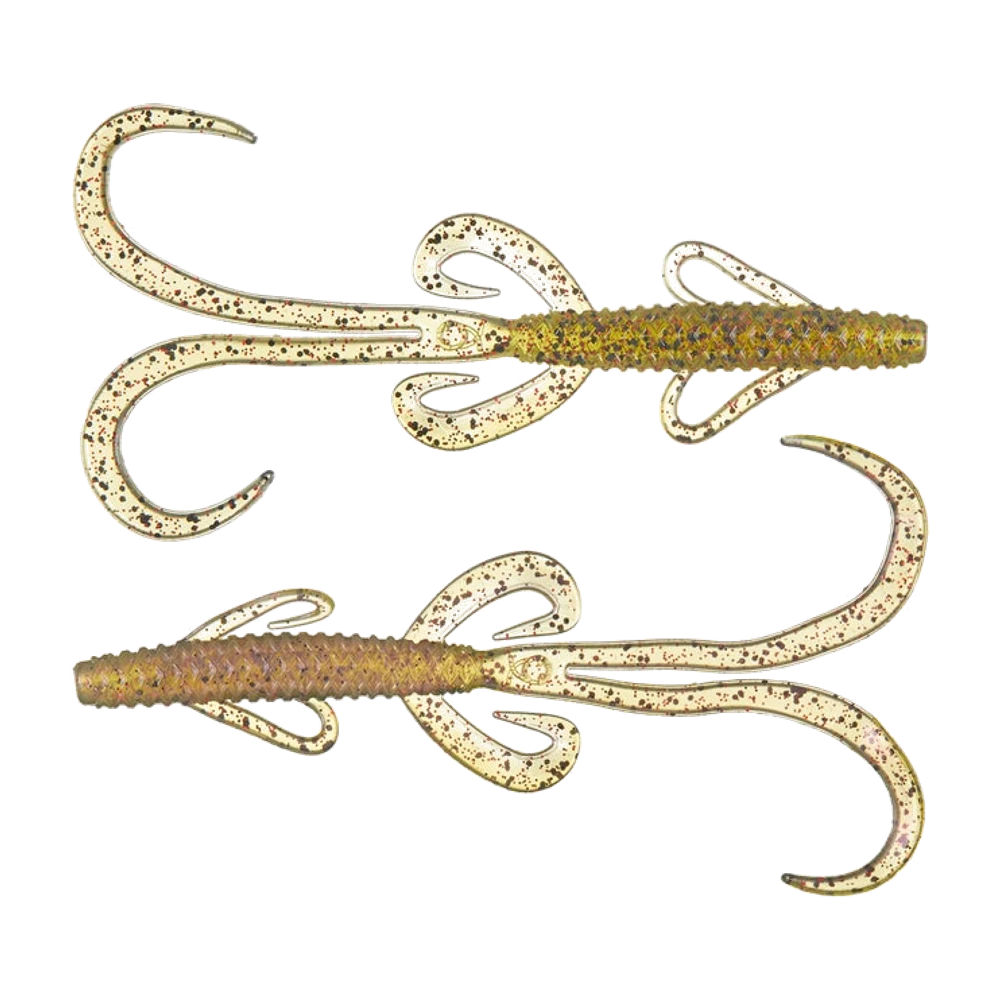
The Hogwalla measures 14.7 cm, a genuinely big profile for freshwater plastic. Its character comes from that profile: 6th Sense built it between two families, the lizard and the creature bait. From the lizard it keeps the length and the trailing ribbons that undulate at the slightest movement; from the creature it takes the pincers and the side arms. Six appendages in total. It also shares its base body with the brand's own Stroker Craw, but with a ribbed central section that changes everything.
Those ribs are not decoration. They grab water, create turbulence along the body and stop the bait from sliding cleanly: instead of crawling over the bottom like a worm, the Hogwalla churns. The result is a bait that swims even when you do nothing.
The fall is where it happens
The sequence that works is short and repetitive. Pitch tight to the cover, let the bait sink to the bottom with the line visible, give one or two sharp 20 to 30 cm hops, then give slack and wait. Two to five seconds. During that pause the Hogwalla settles back down, opening up as it goes, its six appendages spreading and quivering each at its own rhythm.
Almost every bite comes at that moment, and most are subtle: a line sliding sideways, tension appearing for no reason, a weight that goes soft when you take up contact again.
Before you set the hook, drop the rod toward the fish and gently take up contact until you feel the weight. On a bait this size, bass rarely inhale it in one go — swinging too early pulls the plastic straight out of the fish's mouth half the time.
Three rigs, three distinct jobs
Texas rig with a sliding bullet
The default setup. A 4/0 to 5/0 wide-gap hook — no smaller, with a 14.7 cm body — and a 5 to 10 g tungsten bullet for general work. Left free to slide on the line, the weight lets the bait sink a little slower and more naturally than when it is pegged. This is the version for covering a bank.
Heavy flipping
Same rig, but the bullet goes up to 14-18 g and gets pegged against the nose of the bait with a bobber stop or bead. The package becomes compact and punches through grass or branches without hanging up, to land at the base of one precise target. The bite is read on the line, usually within a second of the bait hitting bottom.
Carolina rig
The long-range search version, over hard, clean bottom. A 10 to 20 g egg sinker, a swivel, then 50 to 80 cm of fluorocarbon leader to the bait. The weight ploughs the bottom and raises a cloud while the unweighted Hogwalla trails behind at fish level. If that rig is new to you, our Carolina rig page walks through the details.
The classic mistake
Overworking it. A creature bait this size does not need to travel metres: its appendages work on ten centimetres of movement. Anglers who drag it back in long steady pulls clear the productive zone in three moves and miss the fish sitting under the cover. Slow down until you feel like you are doing nothing — that is roughly the right pace.
The other error is undersizing the hook. A 3/0 in a body this thick leaves too little point exposed and shows up as repeated pulled hooks.
Where and when
The Hogwalla is a cover bait and a warm-season bait. It shines when bass are holding: pad edges, stumps, laydowns, docks, reed lines. In spring, over hard crawfish bottom, the pincer silhouette reads particularly well. In summer it is the bait you pitch into dense shade when the sun is high.
Its limits deserve honesty: in cold water a body this bulky is hard to sell, and a finesse worm or a ned rig will produce more bites. It is not a perch bait either — the size is simply out of scale. In European waters it can occasionally interest a pike holding in weed, but you would be better armed with a shad of the same length on a stinger rig than with a plain Texas rig.
Not sure what to tie on?
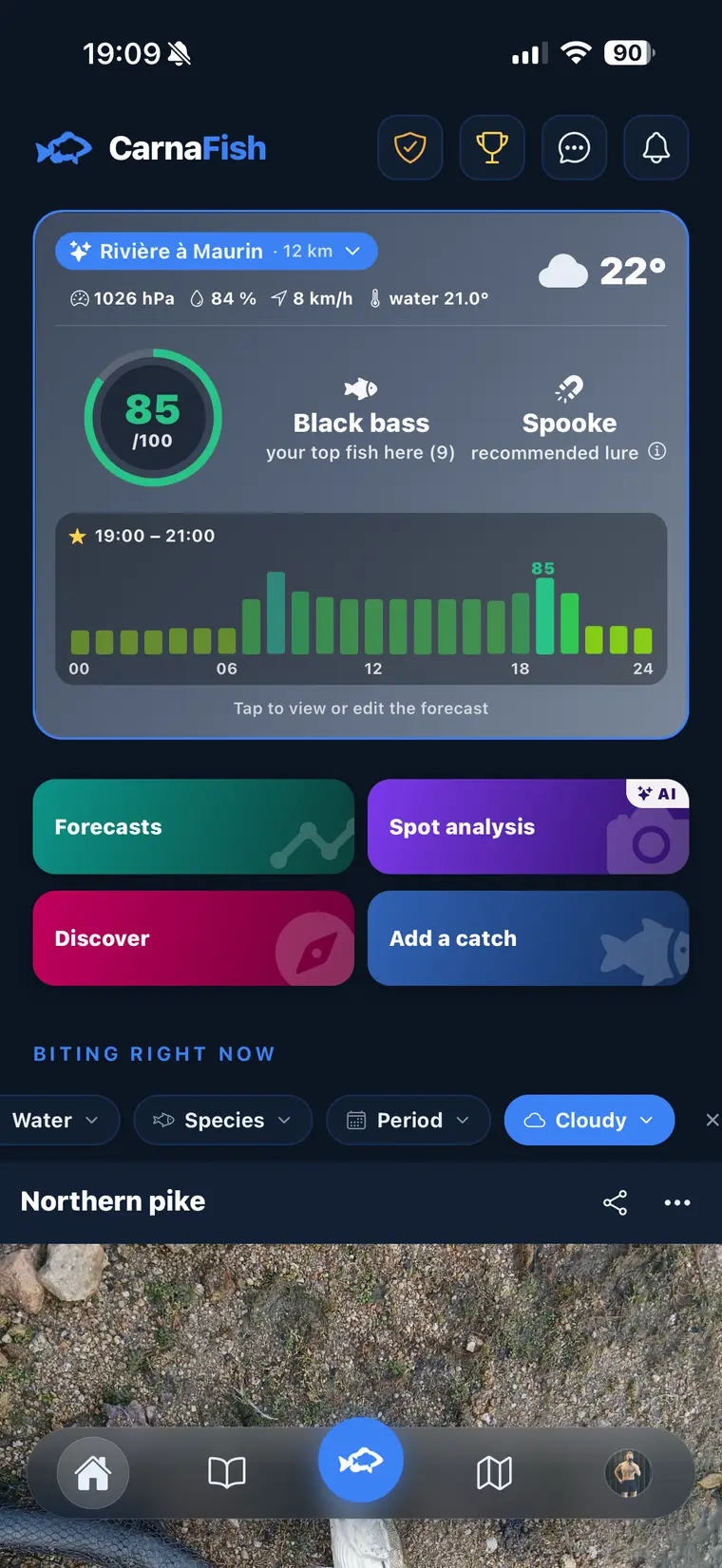
Photograph your spot: CarnaFish reads the scene, cross-checks the conditions and gives you the zone, the lure and the retrieve. Free on iOS and Android.
Colors by water clarity
- Clear water: green pumpkin, the reference color on creature baits. It reads as both a crawfish and a small baitfish silhouette without standing out against the bottom.
- Stained water or heavy cover: black and blue, the combination that keeps a clean silhouette once light stops reaching under the branches.
- Spring, hard bottom: an orange or red-brown tone that matches the real color of crawfish at that time of year. This is one of the few situations where a bright color genuinely earns its place on this kind of bait.
Where it sits among other creature baits
The Hogwalla plays on volume and swimming action. A Reaction Innovations Sweet Beaver is more compact and punches tight cover better, a Missile Baits D-Bomb holds a more gathered profile, and a Zoom Lizard remains the pure lizard reference, slimmer and more discreet. The Hogwalla sits between the two families, with a clear edge whenever you need visual noise in very little space.
Picking the right bait means nothing if you send it to the wrong place, and that is exactly what CarnaFish handles: a photo of the spot, and the app suggests the zone to attack, the depth and a presentation suited to the day's conditions. To build tackle and spot fundamentals for bass, our beginner's guide to bass fishing is the right place to start.
Key takeaways
- The ribbed body section makes the bait swim on the fall, with no input from the angler.
- A 4/0 to 5/0 wide-gap hook minimum: on a 14.7 cm body, an undersized hook costs you fish.
- One rig per situation: free bullet to cover a bank, pegged bullet to flip cover, Carolina over clean hard bottom.
- A cover bait for warm water. In cold water, drop both size and volume.
FAQ
What hook size should I use on the Hogwalla?
A straight-eye wide-gap hook in 4/0 or 5/0. The body is 14.7 cm long and stays thick through the ribbed section: below 4/0 the point does not clear properly on the hookset and pulled hooks multiply.
Should I peg the bullet weight or leave it free?
Both, depending on the job. Free, it slows and naturalises the fall, which is ideal when covering a bank. Pegged against the nose, it compacts the package so it can punch through vegetation on a flip.
How long should I pause after a hop?
Two to five seconds, long enough for the bait to settle and the six appendages to spread. Most bites arrive during that pause, not during the hop.
Does the Hogwalla work in cold water?
Less well. A 14.7 cm body asks a fish for an effort it is not willing to make below ten degrees. In those conditions a finesse worm or a ned rig will be more productive.
Can it be fished with no weight at all?
Yes, Texas rigged bare over submerged vegetation, or on a Carolina rig behind the sinker. The fall becomes very slow and gliding, which is deadly on wary fish, but casting distance drops a lot.
How is it different from a classic lizard like the Zoom Lizard?
The Zoom Lizard is slimmer and works mainly through the undulation of its flat tail. The Hogwalla adds pincers, side arms and a ribbed body, which moves far more water — an advantage in stained water, a drawback on heavily pressured fish in clear water.
The full bass lure guideSeason-by-season strategy: which family of lure, when, and why.Go from theory to fish
CarnaFish reads your spot from a photo and gives you the game plan: zone, lure, retrieve. Free on iOS and Android.