Berkley PowerBait Pit Boss: the compact creature that works on the fall
Not sure this lure fits YOUR spot today? CarnaFish tells you in 10 seconds, from a photo.
A bass sitting in a tangle of branches chases nothing. It occupies a square metre of shade, it looks upwards, and it grabs whatever falls within reach. If your lure passes fifty centimetres away sideways, it will not move. If it drops right in front of its head, it decides in a second.
That is the whole logic of pitching: the presentation is not horizontal, it is vertical. And the best lure is not the one that swims best, it is the one that gets cleanly through the cover and lives during its descent.
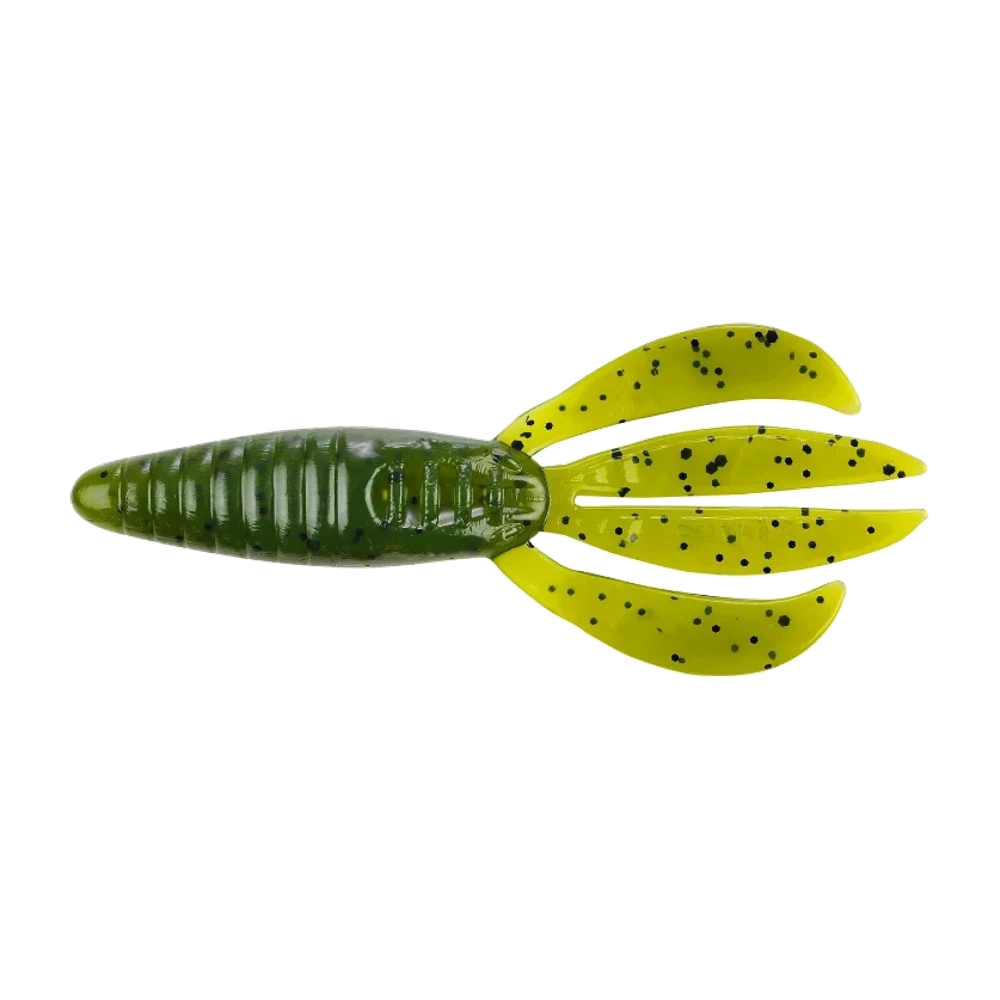
The Pit Boss is cut out for that: a short, thick body, appendages concentrated at the back, and a silhouette that slips between two branches without hanging up. This is not a searching lure. It is a spot lure.
Compact and stubby: a shape built for getting through
Most creature baits are long and covered in appendages. That is excellent for signal, but every appendage is a branch-catcher and a brake that slows the fall.
The Pit Boss does the opposite:
- A short, solid body that concentrates the mass. Paired with a tungsten bullet, the package drives straight through a layer of debris or vegetation instead of settling on it.
- Short, flat appendages, set at the back. They pulse during the fall without slowing the whole thing down.
- An overall profile close to a folded crayfish, which is exactly what a bass rooting around a stump eats.
The body is also thick enough to hold the hook. On a slim creature, the eye pulls out through the back after three pitches; here the Texas rig stays put much longer, which matters when you are stacking up fifty short casts along one bank.
The weight does all the fishing
It is the only setting that really counts. Too light, your lure sits on top of the vegetation. Too heavy, it drops like a stone and the appendages have no time to work.
| Situation | Tungsten bullet | What you are after |
|---|---|---|
| Clear margins, sparse weed, 1-2 m | 5 to 7 g | Slow drop, long presentation |
| Sunken wood, stumps, 2-4 m | 9 to 11 g | Trade-off between getting through and fall time |
| Dense vegetation, thick lily pads | 14 to 18 g | Punching the mat and reaching underneath |
| Vertical flipping in 4 m and more | 18 to 21 g | Fast contact, total control |
Two rigging points that change the result:
- Peg the bullet with a line stop or a rubber pin as soon as you are fishing heavy cover. A free bullet slides up the line on impact and the lure lands flat, separated from the weight.
- Use tungsten rather than lead. At the same weight the volume is smaller, so it gets through better and transmits bottom feel more clearly.
The hook: a wide gap in 3/0 for a standard rig, 4/0 if you are fishing big fish and heavy cover. Texas rigged, point just tucked under the skin of the back, never buried deep. The Texas rig page covers the technique.
The retrieve: there is barely any
This is the point most anglers refuse to accept. In this fishing, you work the lure almost not at all.
- Pitch under the cover, aiming for the deepest point of the shade. The cast should be low and skimming, so the lure enters the water without a splash.
- Follow the fall with the rod tip, line semi-tight, watching the braid with your eyes. This phase lasts two to six seconds. This is the fishing.
- On contact with the bottom, leave three full seconds doing nothing.
- One single lift of the rod tip, 20 to 30 cm, then follow it back down.
- Two or three repeats maximum, then reel in and pitch the next spot. You do not drag a creature ten metres.
On the water: when your braid jumps sideways during the fall, do not set the hook within the second. Drop the rod tip towards the lure to give slack, count a beat, then set with a big sweeping sideways move. A bass that engulfs a creature on the drop turns it round in its mouth before swallowing: set too early and you pull it straight back out.
The scent changes the delay, not the number of bites
PowerBait soft plastics are impregnated with an attractant. What that actually does, and what it does not:
It does not bring a fish in from a distance. A bass attacks by sight and by vibration, not by smell, over any useful distance.
It extends how long the lure is held in the mouth. A fish that would have spat it out in half a second often holds it for two or three. In a fishing where the bite is visual and the hookset is delayed, that extra delay is exactly what you need. It is a gain on the conversion rate, not on the number of contacts.
Practical consequence: keep the lures in their original bag with their juice, and do not mix them with other brands in a compartment box.

Not sure what to tie on?
Photograph your spot: CarnaFish reads the scene, cross-checks the conditions and gives you the zone, the lure and the retrieve. Free on iOS and Android.
Where it excels, and where it is pointless
Its ground:
- Sunken wood, stumps, log jams: the core of its job.
- Lily pad edges and dense vegetation, punching the mat with a heavy weight.
- Jetties and man-made structure, skipped under the platforms.
- Settled, inactive fish, in summer as well as after a cold snap.
Its limits:
- Searching large areas: it is too slow. A spinnerbait or a chatterbait covers ten times the ground.
- Open water with no structure: nothing justifies tying it on.
- Actively feeding fish: you waste time fishing slowly for what a fast lure would take quicker.
Pit Boss or long-appendage creature
A Zoom Brush Hog is longer, with developed appendages that move more water. It puts out a stronger signal, it sinks more slowly, and it is excellent on a Carolina rig dragged over a flat — a horizontal fishing.
The Pit Boss plays on compactness: it gets through, where the Brush Hog sits on top. As soon as the cover gets genuinely dense, or you want a controlled fall time under a specific branch, the stubby format takes the advantage.
For an approach even more focused on crayfish and defence, a Strike King Rage Craw on a jig trailer covers different ground. Our beginner's guide to bass fishing explains how to read cover before choosing your weight. And if you are unsure what bullet weight to rig facing a wooded bank, CarnaFish analyses a photo of the spot and answers.
Key takeaways
- Short body and tucked-in appendages: it gets through the cover instead of sitting on top.
- The fall is the retrieve. Two to six seconds of followed descent is the real fishing phase.
- Peg the tungsten bullet as soon as you fish heavy cover, or the lure separates from the weight.
- Visual bite on the braid, then a delayed hookset after giving slack.
- A spot lure, not a searching lure: three presentations per spot, then move.
FAQ
What weight should you use with the Pit Boss?
From 5 to 7 g on clear margins, 9 to 11 g in sunken wood, and up to 14 to 21 g to punch dense vegetation or fish vertically in 4 m and more. Favour tungsten, more compact for the same weight.
Should you peg the bullet on the line?
Yes as soon as you fish cover. A free bullet slides on impact and the lure falls separately from the weight, which breaks the presentation and increases snags. A line stop is enough.
How do you detect a bite on the drop?
By watching the braid rather than the rod tip. A bite shows as a sideways jump or as a descent that stops early. It is visual: you often will not feel anything in the rod.
When should you set the hook?
Not immediately. Give slack by dropping the rod tip, count a short beat, then set with a wide sideways sweep. A bass turns the lure round in its mouth before swallowing, and an instant hookset rips it straight back out.
What hook size should you rig?
A wide gap in 3/0 for general use, 4/0 for big fish and dense cover. The point should be just tucked under the skin of the back, not buried in the body of the lure.
Does the attractant really make a difference?
It does not draw a fish in from a distance, but it extends how long the bass holds the lure in its mouth. In a fishing with a delayed hookset, that extra delay clearly improves the hookup rate.
The full bass lure guideSeason-by-season strategy: which family of lure, when, and why.Go from theory to fish
CarnaFish reads your spot from a photo and gives you the game plan: zone, lure, retrieve. Free on iOS and Android.