Berkley Spin Bomb: the short propbait that sprays at crawling speed
Rather not fish it blind? Photograph your spot — CarnaFish cross-checks the conditions and points you the right way.
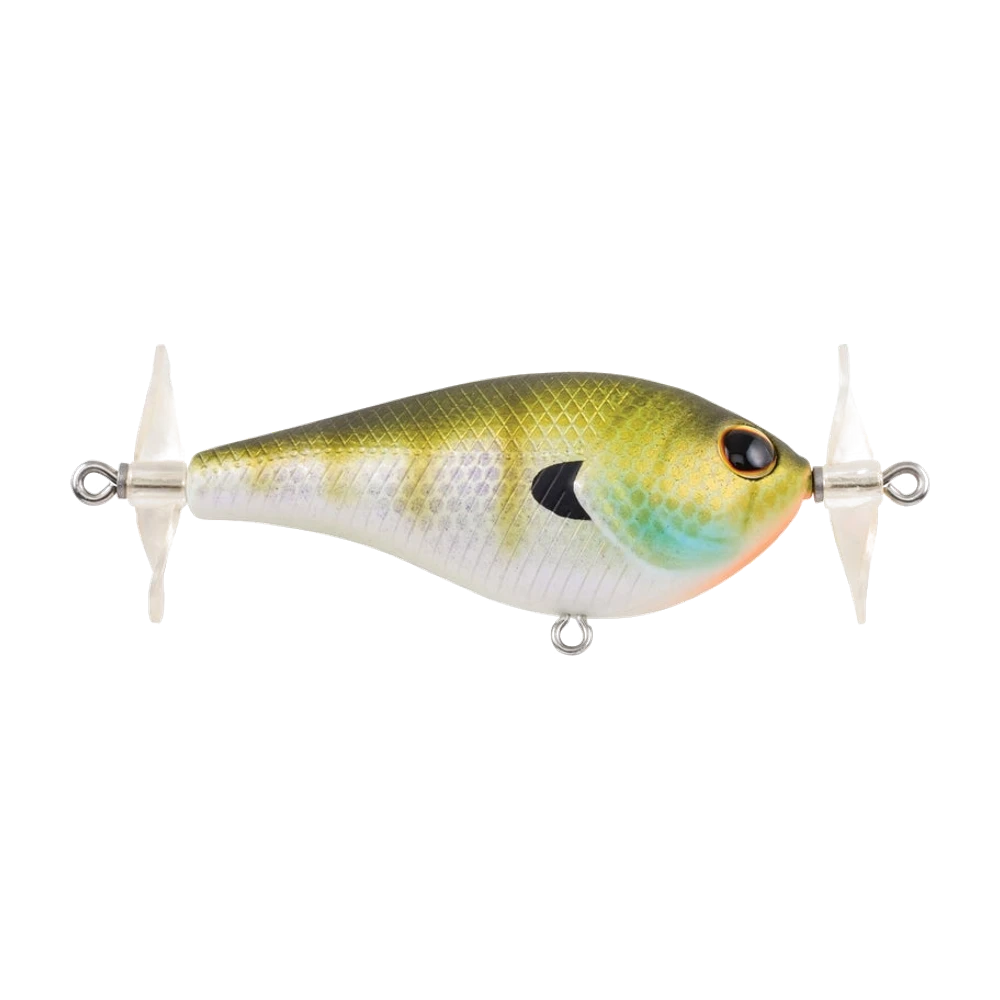
Late spring, the water has picked up a few degrees and the bass have moved shallow. They aren't hunting open water: they're patrolling between emerging weed and stumps, waiting on the fry and small sunfish hiding in there. It's a situation where a big topwater bait spooks more fish than it triggers, and where a bait that's too subtle never gets noticed. The Spin Bomb aims squarely at that gap: 6.1 cm / 2.4 in of body, with two oversized props that make a noise out of all proportion to its size.
A short body, and what that changes
The Spin Bomb was built to the specs of Justin Lucas, an American pro known for his topwater game. He asked for a compact body shaped after a small baitfish rather than a long minnow. That choice has a direct consequence on the water: a short bait pivots on itself instead of travelling forward when you pull it sharply. You can keep it working in place, over a hole in the weed, for several seconds without dragging it out of the zone.
That's the main difference from a slim propbait like the Berkley Spin Rocket, which covers more ground on every pull and suits searching better. The Spin Bomb is a spot bait, not a search bait. On a bank you already know well, that's exactly what you want.
Two cupped props that need no tuning
The two plastic props mounted front and rear are deliberately wide and dished. Berkley makes two claims about them: they need no tuning out of the box, and their enhanced surface area throws the maximum amount of water at any speed.
The second claim is the one that matters on the water. Most propbaits have a threshold: below a certain speed the props turn lazily and the bait goes mute. With a bigger blade area that threshold drops very low — the Spin Bomb sprays from the first turn of the handle, which is what makes it usable on the very slow presentations that work on pressured fish.
The first claim deserves an honest caveat: "no tuning" means the props come correctly set from the factory, not that they can't go out of true. After a season of knocks in timber, check that a blade hasn't folded over — a bent prop unbalances the bait and makes it track off line.
Two retrieves doing two different jobs
Twitch-and-pause
This is the reference presentation. Two short downward taps of the rod tip, then a two- to three-second pause. On the twitch the props throw a double plume; on the pause the bait sits still on the surface while the blades keep turning for a fraction of a second, producing a sound that fades out. The strike very often comes on that fading sound. Keep the rod low and leave a little slack during the pause: a tight line pulls the bait back towards you and kills the stillness.
Steady retrieve
Less subtle, but deadly when fish are active or the surface is rippled. A slow, even retrieve and the two props lay down a double V-wake. It's also the best way to cover a whole bank when you don't yet know where the fish are, before coming back with twitch-and-pause over the spots that showed a sign.
Tackle and rigging
A 1.95-2.10 m medium casting rod, no stiffer: an 11 g bait with fine trebles needs a bit of give in the tip so fish don't pull off on the hookset. Thin braid and a 25-30 lb fluorocarbon leader about 80 cm long. The bait ships with sharp Fusion19 trebles that are fine as they come.
Watch out for line twist: any twin-prop bait rotates slightly on a fast retrieve. A small rolling swivel between braid and fluorocarbon fixes it without costing anything in action.
The mistake to avoid
Working it too hard. The reflex with a prop bait is to rip it to "make noise". On a short body a violent pull launches the bait clear of the water and kills the blades, which need to stay submerged to throw anything. Two crisp but short taps, ten centimetres of travel at most: that's all it takes.
If you're getting blow-ups but not hooking up, lengthen the pause rather than setting faster. A bass that comes up on a motionless propbait almost always returns for a second go, and that's the pass where it actually eats it.
Not sure what to tie on?
Photograph your spot: CarnaFish reads the scene, cross-checks the conditions and gives you the zone, the lure and the retrieve. Free on iOS and Android.
Colour by the bank you're fishing
- Vegetated banks with sunfish present: the bluegill pattern on the photographed bait, with its barred olive back, pearl flanks and gill-plate spot. It's a direct copy of the main forage in that kind of spot.
- Open clear water over baitfish: a pearl silver finish, more neutral, throwing light without drawing a specific pattern.
- Overcast skies or lightly stained water: opaque white. From below, silhouette matters more than finish detail, and an opaque body reads better under flat light.
Where it sits among other topwater baits
The Spin Bomb doesn't have the casting range of a Berkley Choppo, nor a popper's ability to scoop and spit water like a Megabass Pop-X. What it brings is a continuous spray on the spot, at very low speed, in a compact package. That's an unusual profile, and exactly why it earns a slot alongside a plopper and a popper rather than instead of them.
Choosing the right topwater family starts with reading the spot and the light, which is exactly the job CarnaFish does: a photo of the spot, and the app suggests the zone, the depth and the lure type that fit the moment. To build the fundamentals of shallow fishing, our beginner's guide to bass fishing covers the water worth reading first.
Key takeaways
- A 6.1 cm / 2.4 in body at 11.3 g / 0.4 oz: it pivots in place under a twitch instead of moving forward, so it stays in the zone.
- The large cupped props throw water even at crawling speed, which extends the usable retrieve range downwards.
- Twitch-and-pause to work a precise target, slow steady retrieve to cover a whole bank.
- A rolling swivel prevents the line twist that any twin-prop bait creates.
FAQ
What size and weight exactly?
Berkley lists a single format: 6.1 cm / 2.4 in for 11.3 g / 0.4 oz, classed as a topwater bait. There is no larger or smaller version in the range.
Twitch-and-pause or steady retrieve?
Twitch-and-pause when you know where the fish are and want to work a precise target; a slow steady retrieve while you're still searching, to cover a full bank. In practice you alternate the two within a session.
Do the props need tuning before the first trip?
No, they arrive correctly set and spin without any help. Do check them after several sessions around timber or rock, though: a folded blade makes the bait track off line.
Does it catch perch?
Yes, a package this compact gets attacked by perch without hesitation, especially during late-summer surface feeding. The stock trebles are a little large for small fish, but decent-sized perch hook up fine.
Why does my leader twist?
That's a structural trait of every twin-prop bait, especially on a fast retrieve. Add a small rolling swivel between the braid and the fluorocarbon: it removes the problem without changing the action.
How is it different from the Spin Rocket in the same range?
Body shape. The Berkley Spin Rocket is long and slender, gliding tens of centimetres on every pull, which suits searching. The Spin Bomb, short and deep, works in place and is there to grind on one target.
The full bass lure guideSeason-by-season strategy: which family of lure, when, and why.Go from theory to fish
CarnaFish reads your spot from a photo and gives you the game plan: zone, lure, retrieve. Free on iOS and Android.