Big Bite Baits Double Tail Finesse Grub: two tails, three jobs
One lure, endless conditions. CarnaFish reads your spot from a photo so you are not just guessing.
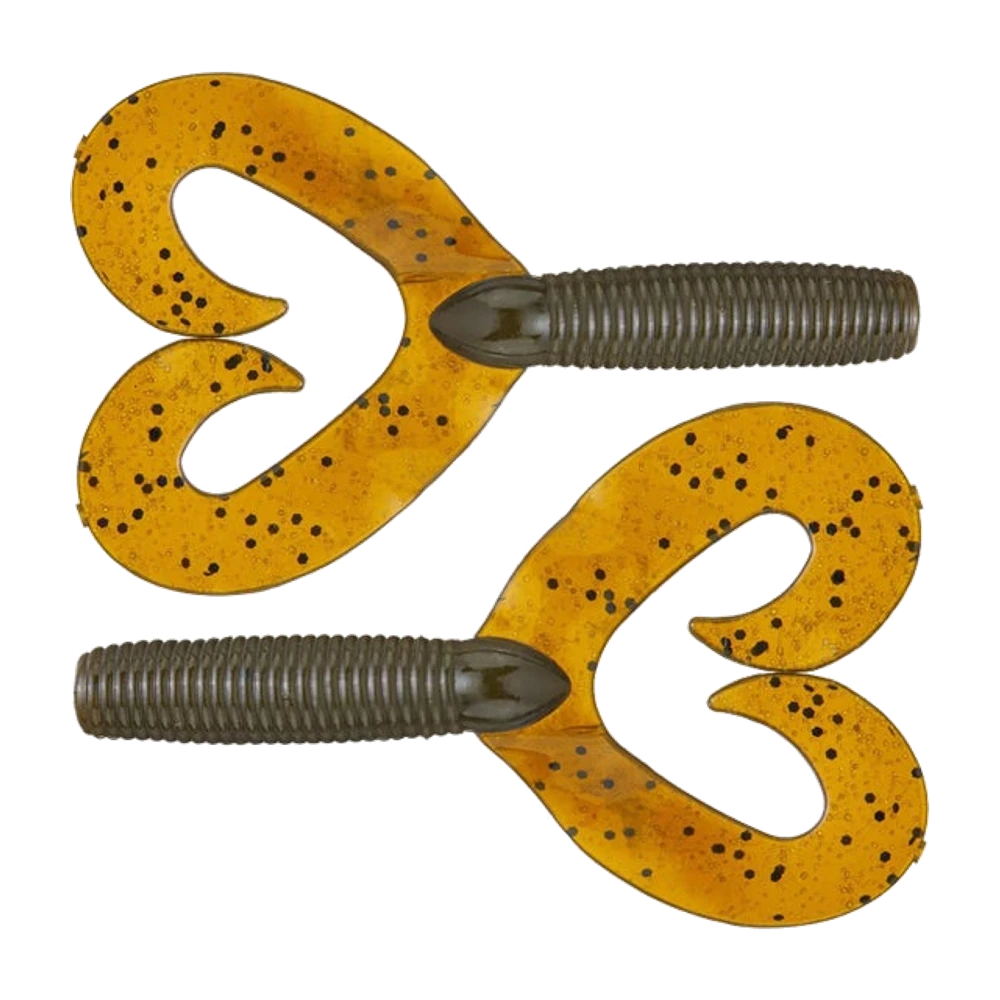
A fleeing crawfish does not walk, it reverses in bursts, slapping its tail hard. It is a very particular movement, and most soft plastics imitate it badly: a paddle tail swims like a baitfish, a craw pincer just quivers in place. The Big Bite Baits Double Tail Finesse Grub is one of the few profiles that genuinely reproduces that beat, because it has two tails instead of one.
Why two tails rather than one
A single-tail grub has one tail that rotates, which spins the body and creates a continuous vibration. Two tails, mounted symmetrically, beat in opposition. They cancel out in rotation but add up in water displacement. The result: the body stays straight and stable while the back end sends out a strong signal.
That is exactly what happens when a crawfish bolts. And it is why the manufacturer presents this grub as a crawfish imitator rather than a baitfish bait, despite its worm-like shape. The silhouette is generic; the movement is very specific.
The body itself is ribbed along its whole length, with a rounded nose. Those ribs do two jobs. They increase the surface that grabs water, which slightly slows the fall. And they give a jighead collar or a jig keeper something to bite into, so the bait does not slide back on the first cast.
Three ways to fish it
Big Bite Baits lists three animations: dragging, hopping and swimming. These are not three variations on one thing, they are three different kinds of fishing.
Dragging, on a darter head or a football jig, means pulling the bait across the bottom while keeping constant contact. The tails undulate behind without ever racing. It is the presentation closest to a crawfish moving calmly along, and by far the most productive over gravel or rock.
Hopping, on a round head, lifts the bait twenty to thirty centimetres and drops it back. The tails open on the way up and fold on the way down: that gives two signals per stroke, which is what you want when fish are grouped on a precise target.
Swimming, on a 5 to 10 g head, turns the grub into a full search bait to be reeled just above the weed. It is the least obvious use but the most interesting one for perch, which responds well to that kind of steady vibration.
If you are dragging and the tails do not quiver when you stop, your grub is too big for your jighead or your braid is too tight. The tails should keep moving for a second or two after the bait itself has stopped. That residual quiver is what draws the bite, not the drag itself.
The jig trailer, its most reliable use
This is the use the manufacturer lists first, and for good reason: a double tail is the historic football jig trailer. It adds a mass of movement behind a jig without widening the profile, unlike a big-clawed craw.
On a Strike King Tungsten Football Jig dragged slowly over hard bottom, the double tail grub does exactly what is asked of it: it fills out the back of the jig, it waves at the slightest pull, and it adds no drag that would cost you bottom contact. For a bulkier, noisier profile, a Yamamoto Double Tail Hula Grub with its built-in skirt plays in another category.
The same logic applies behind a vibrating jig or a spinnerbait, with one important caveat: at those speeds the two tails rotate instead of beating, and their drag pulls on the back of the lure. On a spinnerbait that is already marginal in balance, that is enough to lay it over on its side. Always check the swim over the first few metres before casting long, and trim one or two body ribs if the lure leans.
A word on durability, since that is the usual weak point of trailers. The ribbed body holds well on a barbed collar, but it is the tail joints that fail first: two or three bass and a tail is gone. Keep a full pack in the box rather than three mismatched baits, and swap the grub as soon as one tail is torn, because an amputated double tail spirals instead of beating straight.
The classic mistake
Rigging the grub crooked on the jig. Both tails must sit in the same plane as the jig body, parallel to the bottom. Rig them vertically and they no longer beat in opposition but one above the other, and the bait spirals. You often see this on a jig that climbs in a corkscrew as you drag it — the jig is not at fault, the trailer rigging is.
What the manufacturer does not state
Big Bite Baits does not publish an official length for this grub, nor a per-piece weight. The name contains "finesse", which sets the order of magnitude, but nothing more precise. If you are ordering online for a specific jig, compare the bait to the jig in the seller's photo before buying, or order one test pack.
The colour range is stated though: ten shades. Enough to cover the three useful cases, not enough to get lost in.
Not sure what to tie on?
Photograph your spot: CarnaFish reads the scene, cross-checks the conditions and gives you the zone, the lure and the retrieve. Free on iOS and Android.
Colour by water and bottom
- Clear water, hard bottom: Green Pumpkin body with translucent amber tails, exactly the version in the photo. The two separate tones help a fish pick out the moving rear of the bait.
- Dark water or low light: Black Blue, for a clean silhouette when colour nuance no longer registers.
- Weed and lightly green water: Watermelon, which visually disappears into the vegetation and leaves only the tail movement.
A simple design that still earns its place
The double tail grub is an old design, and that is a good sign: shapes that survive thirty years do not survive by accident. It replaces neither a finesse worm nor a detailed craw like the Big Bite Baits Craw Worm, but it does one thing neither does as well — produce a lot of movement at very low speed.
Knowing which bottom type to pull it over counts as much as the bait itself, and that is exactly what CarnaFish makes easier: a photo of the spot, and the app suggests the zone and the presentation suited to current conditions. To sharpen your soft plastic work for perch, our guide to lure fishing for perch details the rigs worth knowing.
Key takeaways
- Two tails in opposition: plenty of water moved without spinning the body, even at the lowest speeds.
- The manufacturer publishes neither a length nor a weight for this model; check the size before pairing it with a specific jig.
- Three genuinely different animations: dragging in contact, hopping on a round head, swimming above the weed.
- Always rig the tails in the jig's plane, or the whole thing spirals on the drag.
FAQ
How long is the Double Tail Finesse Grub?
Big Bite Baits does not publish an official length for this model. The word "finesse" in the name points to a compact size, but it is worth checking the measurement with the retailer before pairing it with a specific jig.
What jighead should I use?
A 3 to 7 g round head for hopping, a 5 to 10 g darter head for dragging, or straight onto a football or flipping jig if you use it as a trailer. The ribbed body holds well on a barbed collar.
Does the Double Tail Finesse Grub work for perch?
Yes, it is one of its best uses in Europe. On a light head, reeled slowly above the weed, it produces a steady vibration that perch respond to very well.
Why does my jig spiral when I drag it?
Almost always because the trailer's tails are rigged vertically instead of in the jig's plane. Pull the grub off and rig it again so both tails sit parallel to the bottom.
How is it different from a single-tail grub?
A single tail spins the body and produces a continuous vibration. Two tails beat in opposition, cancel the rotation and send a stronger signal at the same speed. The double tail is also more convincing as a crawfish imitation.
Can it be fished on a straight retrieve?
Yes, that is its third intended animation. On a 5 to 10 g head reeled just above the vegetation it becomes a genuine search bait, especially at first and last light when fish hunt the margins.
The full bass lure guideSeason-by-season strategy: which family of lure, when, and why.Go from theory to fish
CarnaFish reads your spot from a photo and gives you the game plan: zone, lure, retrieve. Free on iOS and Android.