Big Bite Baits Finesse Worm: the straight worm for tough days
One lure, endless conditions. CarnaFish reads your spot from a photo so you are not just guessing.
There comes a point where everything noisy has been tried. The crankbait came back with weed on it, the spinnerbait drew three follows and no bites, the chatterbait spooked two fish you watched swim off. The bass are there — the sonar shows them — but they want nothing fast. That is exactly the situation the Big Bite Baits Finesse Worm exists for: a plain straight worm, ribbed, extremely soft, that does almost nothing in the water and catches fish when nothing else will.
A straight worm, and why it is so hard to beat
The straight-tail worm is the oldest and most stripped-down shape in soft plastic bass fishing. No claws, no flappers, no paddle tail: a tapered cylinder that simply trembles. That bareness is precisely what makes it lethal on educated fish. A bait that moves a lot gives a fish something to think about; a bait that barely moves gives it no reason to be suspicious.
The Finesse Worm takes the principle quite far, with ribbing along its entire length and plastic Big Bite describes as super soft. The ribbing does two things: it catches a little water on every micro-movement of the rod tip, turning a shiver of the hand into visible undulation, and it increases surface area without increasing apparent bulk. On a shaky head sitting on the bottom, the worm stands up and the ribs keep it quivering even when you touch nothing.
Salt and scent: what it actually changes
Big Bite loads this worm with salt and soaks it in its house attractant, Bite Juice. Salt is not just a selling point: it adds density, which helps an unweighted bait sink straight, and it changes how the bait feels in a fish's mouth. A bass that inhales a salted worm statistically holds it longer before spitting it — not seconds, but a fraction of a second more, and in finesse fishing that is often the gap between a good hookset and a chewed bait coming back.
The trade-off is worth knowing before you buy: the softer and more heavily loaded a plastic is, the less durable it is. Count on one to two fish per bait, sometimes fewer if you set hard. It is a consumable, and that is accepted — this kind of worm comes in packs of 10 or 7 precisely because you go through them.
If the worm slides down the shank after every bite, lock it in place with a small piece of heat-shrink tubing or a spring bait keeper on your jighead. You will double your fish-per-bait count without changing anything else.
Four rigs, four situations
Shaky head
The benchmark rig. A 3 to 7 g head with a spring keeper, worm nose-hooked and sitting straight. Cast, let it sink, then shake the rod in place without moving the weight. The worm stands vertically and undulates. This is the presentation for docks, riprap and clean breaks, where fish are parked in one spot and refuse to chase.
Drop shot
Nose-hooked on a fine-wire hook, 30 to 60 cm above a 5 to 10 g cylinder weight. The worm stays at the fish's level and the smallest rod tip movement brings it alive. This is also where the 15.2 cm version catches perch, provided you drop to a size 1 or 2 hook. On a well-identified vertical target, it is the most forgiving rig of the four.
Wacky
A round hook through the middle of the body, no weight. The worm folds in half and sinks with both ends fluttering, a very slow fall that exasperates fish holding under a laydown. The soft plastic makes this rig especially expressive, but it is also where the bait dies fastest: an o-ring is close to mandatory.
Split shot
The most forgotten of the four and the most effective on big sandy flats. A plain split shot pinched 50 to 80 cm above a light Texas hook, dragged very slowly. The worm follows the bottom without ever really touching it. It is slow, it is unspectacular, and it catches fish in the heat of midsummer.
6 or 8 in: two different baits
The 15.2 cm version is the all-rounder. It covers shaky head, drop shot and split shot, interests bass of every size and can also convince a good perch on a drop shot. It is the one to buy if you buy only one.
The 20.3 cm version is a different bait. At that size the worm stops being a finesse tool and becomes a selective one: it filters out small fish and draws bass that have seen plenty go by. Rig it on a plain Texas hook, with or without a light bullet weight, along cluttered banks. It gets bitten less often but better, exactly like a big ribbon tail.
The classic mistake
Using too large a hook. That is the number one error with this kind of worm: a 4/0 on a body that thin chokes the undulation and kills the effect you are after. Stay with a 1/0 to 2/0 on the 15.2 cm and accept losing a few fish rather than killing the action. Second mistake: working it too much. A finesse worm that moves a lot is no longer a finesse worm. If you feel the urge to work it hard, it is the wrong bait for the day.
Not sure what to tie on?
Photograph your spot: CarnaFish reads the scene, cross-checks the conditions and gives you the zone, the lure and the retrieve. Free on iOS and Android.
Colour by water clarity
- Clear water: Green Pumpkin, the translucent olive that disappears over any natural bottom and never alarms a wary fish.
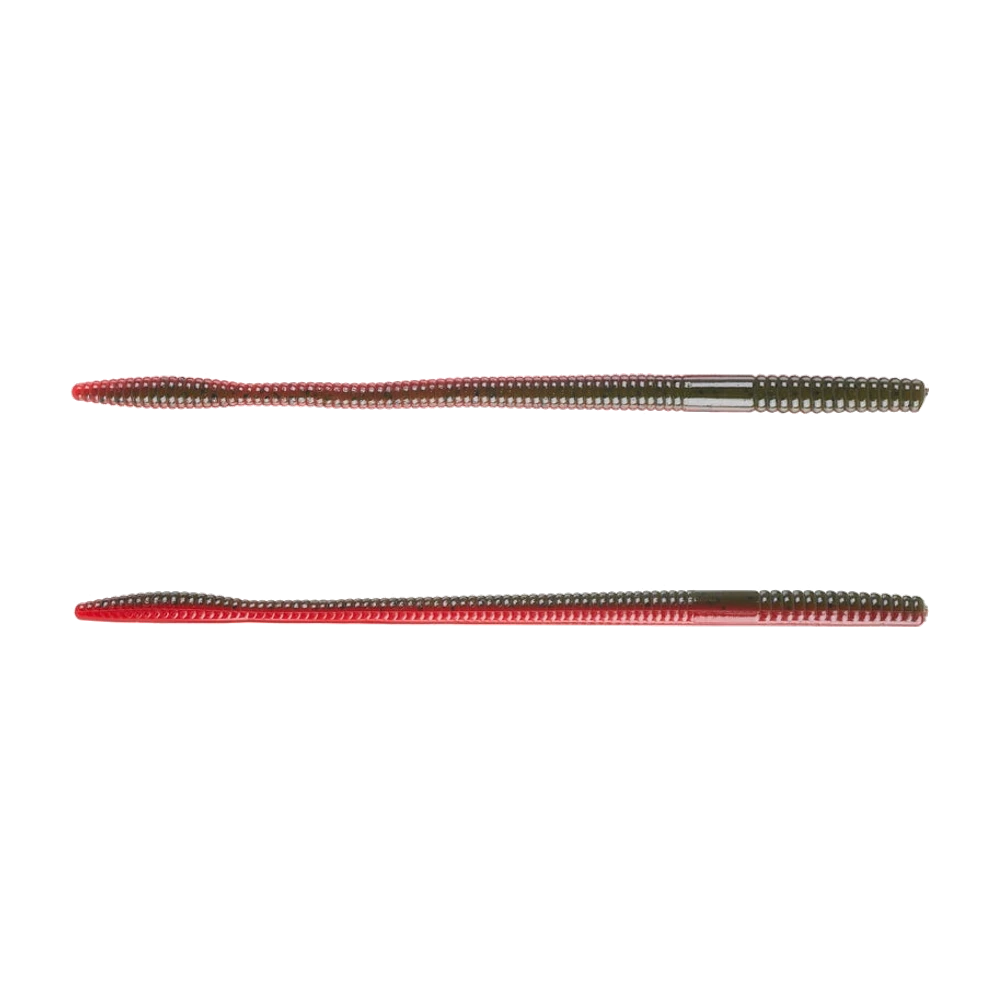
- Lightly stained water or gravel bottom: an olive and red laminate such as Red Bug, like the one in the photo. The red belly only shows at certain angles, which creates a subtle flash as the worm twists.
- Dark water or low light: Junebug, a deep purple with green reflections that keeps a readable silhouette when visibility drops below a metre.
A back-up bait everyone ends up keeping
The Finesse Worm is not what you tie on when you arrive at the water. It is what you reach for after two hours without a bite, when you have to stop searching and start persuading. In that role it sits very close to a Zoom Finesse Worm or a Roboworm Straight Tail: choosing between the three comes down to colour availability and plastic softness more than any real difference in fishing. For heavier duty, Texas-rigged in cover, the Big Bite Baits B2 Worm from the same range is better armed.
You still have to know where to put the worm. Slow presentations do not forgive a mistake in zone: at that pace you will not cover the same spot twice. That is exactly what CarnaFish makes easier — a photo of the spot, and the app suggests the zone and the presentation suited to the conditions. And if you are putting a setup together without wanting to spend a salary on it, our guide to predator fishing gear on a budget explains what actually matters on a finesse rod.
Key takeaways
- A ribbed straight worm, very soft and salt-loaded: built for pressured fish that refuse anything fast.
- Two sizes with different jobs: 15.2 cm as the all-rounder, 20.3 cm as the selective option.
- Four rigs worth knowing — shaky head, drop shot, wacky, split shot — none of which calls for a wide action.
- A fine, modest hook, 1/0 to 2/0 on the 15.2 cm: too big a hook kills the undulation.
FAQ
Which size if I only buy one?
The 15.2 cm. It covers shaky head, drop shot, wacky and split shot, and interests average bass as much as good ones. The 20.3 cm is a selective complement, not a first purchase.
How many fish does one bait last?
One to two as a rule, sometimes fewer on a wacky rig. The plastic is deliberately very soft, which is what provides the action but shortens its life. An o-ring for wacky and a spring keeper on a shaky head improve things noticeably.
Does the Finesse Worm catch perch?
Yes, mainly on a drop shot with the 15.2 cm version and a size 1 or 2 hook. Perch readily attack a slim worm quivering in place. The 20.3 cm, on the other hand, stays out of reach for most perch.
How is it different from a firmer standard worm?
Softness. A firmer plastic survives teeth better but needs more energy to come alive. On apathetic fish, it is precisely the softest worm that starts living on a simple shiver of the rod tip.
Do I need a fluorocarbon leader?
Yes, and this is one of the rare situations where it genuinely matters. On a slow presentation the fish has all the time it needs to examine the rig. A 20 to 25 lb fluorocarbon is a good starting point for bass, lighter for perch.
Can it be fished in weed?
Texas-rigged with the point tucked in, yes, in light vegetation. But that is not its ground: a thin, soft worm folds and snags as soon as the weed thickens. In heavy cover, a beaver like the Big Bite Baits FAFO will get through far better.
The full bass lure guideSeason-by-season strategy: which family of lure, when, and why.Go from theory to fish
CarnaFish reads your spot from a photo and gives you the game plan: zone, lure, retrieve. Free on iOS and Android.