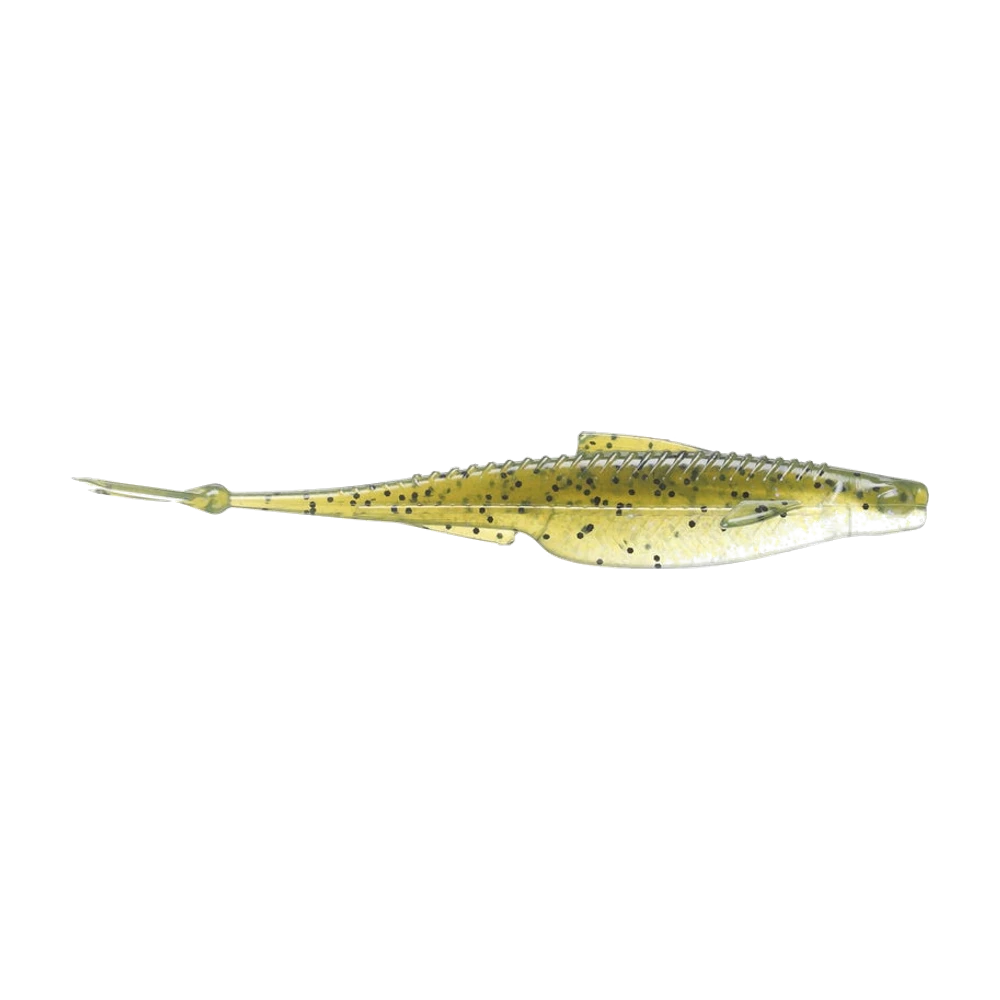
6th Sense Flush 5.2: the fluke whose split dorsal hides the point
This lure shines under specific conditions. CarnaFish tells you in 10 seconds if today is one of them.
October, the first cool mornings, a school of fry being pushed up against a reed line. The surface breaks here and there without you ever quite seeing what is doing it. In that situation a hard bait is often one noise too many: the fish are already locked onto one specific prey item, and they refuse anything that doesn't look like it. A thirteen-centimetre soft jerkbait, worked in sharp pulls a few centimetres under the surface, is one of the few answers that works. The 6th Sense Flush is a heavily worked-over take on that American classic.
A fluke, but with a keel
The fluke concept has been around for decades: a soft, fusiform body, a slit belly to house the hook, a forked tail, and above all no appendages creating resistance. You work it in sharp pulls and it breaks off into disordered lateral darts, exactly like a panicked baitfish.
The historical flaw of the family is rolling over. Pulled too hard or too fast, a standard fluke lies on its flank, then on its back, and ends up spinning on its own axis — the action turns ridiculous and the fish is not fooled. 6th Sense added a belly keel, a longitudinal ridge under the body that does exactly what a keel does on a boat hull: it brings the bait back level after every dart. Combined with sculpted pectorals and a sculpted dorsal, those fins stabilise the trajectory without choking the darting.
Next to a Zoom Super Fluke, which is rougher and cheaper, the Flush is betting on trajectory control. The trade-off is that it is a little less unpredictable: if you are after total chaos, the original fluke stays the more disorderly of the two.
The tail ball, a detail that isn't one
At the base of the forked tail, the mould includes a small ball of material. It looks incidental and it changes two measurable things.
First it adds a little mass at the back: the tail no longer trails passively behind the body, it has its own inertia and carries on moving when the body stops. In practice, at the end of a pull, the bait makes one extra little tail kick — a flutter you can see clearly on a sighted fish in clear water, and one that often triggers hesitant followers.
Second, that mass placed behind the fin helps the tail find its neutral position again instead of staying bent. A fluke with a floppy tail always ends up fishing with the caudal folded to one side, which throws the whole bait out of balance.
The split dorsal, and the bait's name
This is where the name comes from. The dorsal fin is not a solid piece: it is separated into two halves with a central groove running its full length. When you Texas-rig the bait, you bring the hook point out through the back and seat it in that groove, level with the back, point sitting flush.
The result is a rare compromise. The point is not buried in the plastic, so the hookset is near-immediate, without the usual delay of a standard Texas rig where the hook has to drive through the bait first. But it is not bare either: the two halves of the dorsal flank it and act as a weed guard. So you can fish a reed line or the edge of a light weed mat with a far better hookup rate than a fully buried rig gives you.
Before the first cast, check that the bait sits straight on the shank, looking at it head-on. A fluke threaded a millimetre off-centre swims on its flank from the very first pull, and you will spend the next half-hour wondering why nothing is biting. It is the most common error in the whole family, and it takes three seconds to fix.
Working a soft jerkbait
The basic motion is a double or triple sharp pull with the rod tip, short, rod low, followed by a one to three second pause during which the bait glides down. You only reel in the slack the pulls created, never during the pull itself. The rhythm should not be regular: alternate two pulls and a long pause, then three fast pulls and a short pause.
Three rigs by depth
- Weightless, on a 4/0 or 5/0 wide gap hook: the most natural version. The bait works in the top metre and glides very slowly. This is the rig for surface feeding activity and shallow banks.
- With a small stick-on weight, a piece of self-adhesive lead under the belly or a weighted hook of 1.5 to 3.5 g: the bait sinks faster and swims lower, around one to two metres, while keeping its lateral action.
- With a free 5 to 7 g bullet weight: you are leaving soft jerkbait territory for deeper work, down to three metres. The action loses amplitude, but it becomes usable along a drop-off or in a strong wind.
The classic mistake
Reeling during the pull. If you pull with the rod and wind at the same time, the bait travels in a straight line and never breaks sideways, and the whole action disappears. The lateral darts only happen when the bait has a little slack in front of it. Pull, then pick up the slack. In that order, always.
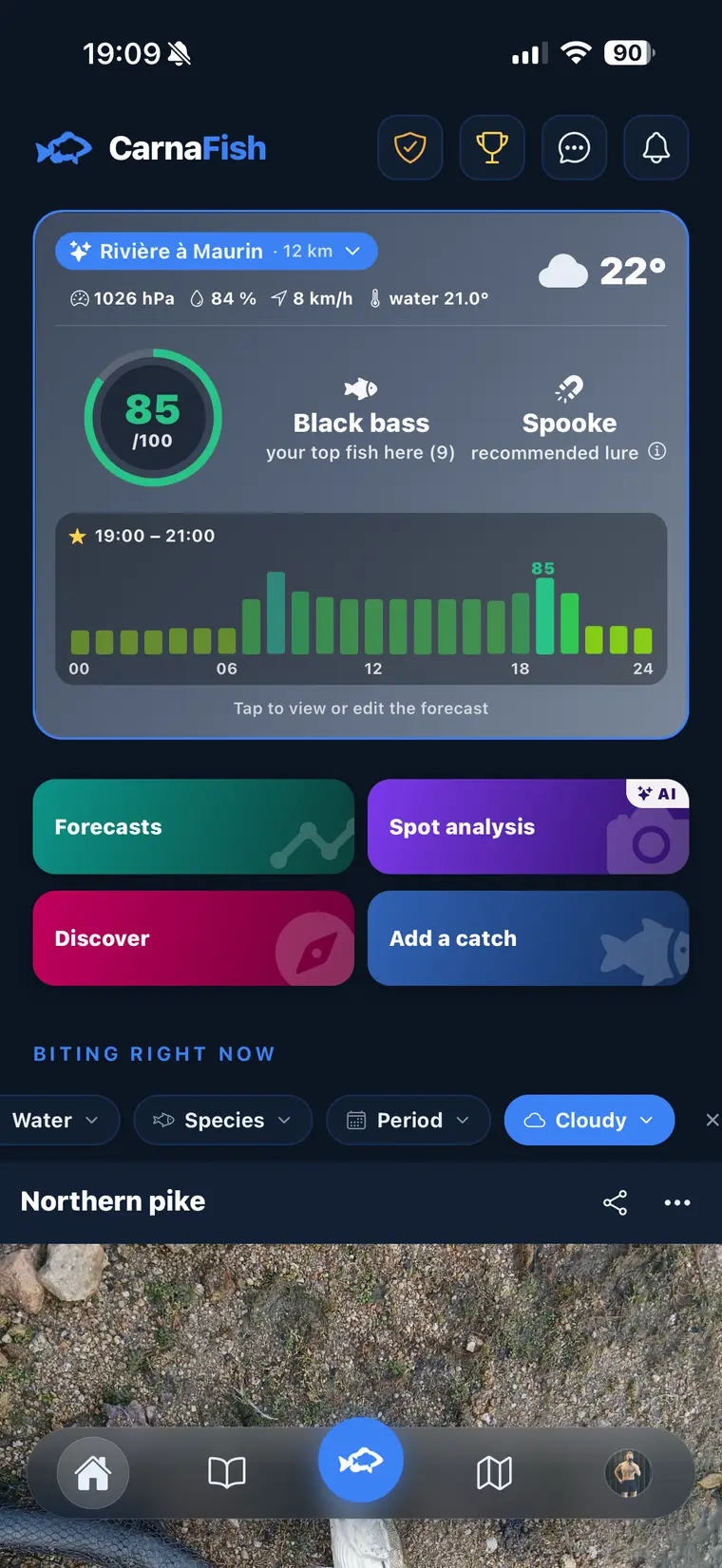
Not sure what to tie on?
Photograph your spot: CarnaFish reads the scene, cross-checks the conditions and gives you the zone, the lure and the retrieve. Free on iOS and Android.
Sea bass, a use not to overlook
A thirteen-centimetre fluke rigged weightless is also a serious weapon on sea bass, along the shoreline, over current seams and above rocky plateaus in a moderate sea. The slim silhouette matches a sand eel or a small mullet well, and the absence of weight lets you fish very high in the water column when fish are feeding at the surface. That is the same playing field as a Z-Man Scented Jerk ShadZ, with a more conventional plastic but more worked-out fin detail.
Do carry spares, though. A soft plastic without reinforced elastomer does not last long against sea bass teeth or repeated hooksets. Eight baits per pack is one active session.
Colours by water
- Clear water: a translucent silver, the closest thing to a fry seen side-on. On visible feeding activity in clear water, that is the first choice.
- Choppy water or a broken surface: an opaque pearl white, more readable from below when the surface is rippled and reflects light poorly.
- Stained water: a chartreuse with a green back, which keeps an identifiable silhouette in reduced visibility without tipping over into a loud colour.
What it does less well
This is not a fast search bait: every cast demands active rod work, and covering two hundred metres of bank takes time. It is not a deep-water bait either, even weighted. And if you want a continuous swim with no animation at all, take a paddle-tail shad — a Zoom Swimmin Super Fluke fills that role with the same silhouette.
That leaves the question of whether the day actually calls for a soft jerkbait, and that is exactly what CarnaFish lets you settle in a minute: photograph the spot and the AI suggests the zone, the depth and the lure family that fit the conditions. For the saltwater side, our guide to lure fishing for sea bass goes into the spots and the tide windows worth prioritising.
Key takeaways
- The belly keel and sculpted fins bring the bait back level after every dart, which fixes the rolling problem flukes are known for.
- The ball at the tail base adds a tail kick at the end of the pull and helps the fin return to neutral.
- The split dorsal seats the point flush with the back, giving a fast hookset while keeping a weed guard effect.
- You pull, then you pick up the slack. Reeling during the pull removes all the lateral action.
FAQ
What hook suits the 5.2 inch size?
A Texas-style wide gap hook in 4/0 or 5/0 depending on body thickness and the size of fish you are after. What matters is bringing the point out through the back and seating it in the dorsal groove, not pushing it back into the plastic.
What does Flush mean in the name?
The dorsal is split into two halves with a groove down the centre, which lets you lay the hook point flush with the back. That flush positioning is what gives the bait its name, and what earns it the weed guard effect.
Do I need to weight this soft jerkbait?
Not necessarily. Rigged weightless it works in the top metre and glides very slowly, which is often the best presentation on surface feeding activity. A 1.5 to 3.5 g weight is there to get down to one or two metres in wind or on deeper fish.
Is the Flush any good for sea bass?
Yes, rigged weightless on a Texas hook, along the shoreline and over rocky plateaus in a moderate sea. Its slim silhouette matches a sand eel well, but plan on several packs because the plastic wears out fast against sea bass teeth.
Why is my fluke spinning on its own axis?
Nine times out of ten because it is threaded crooked on the hook shank. Check the alignment head-on before you cast. If the bait is straight and still rolls, you are pulling too hard or winding during the pull.
How many baits per pack and how long do they last?
Eight per pack. On an active session with repeated hooksets, count on one bait for a few fish: the body tears first where the hook point exits, up on the back.
The full bass lure guideSeason-by-season strategy: which family of lure, when, and why.Go from theory to fish
CarnaFish reads your spot from a photo and gives you the game plan: zone, lure, retrieve. Free on iOS and Android.