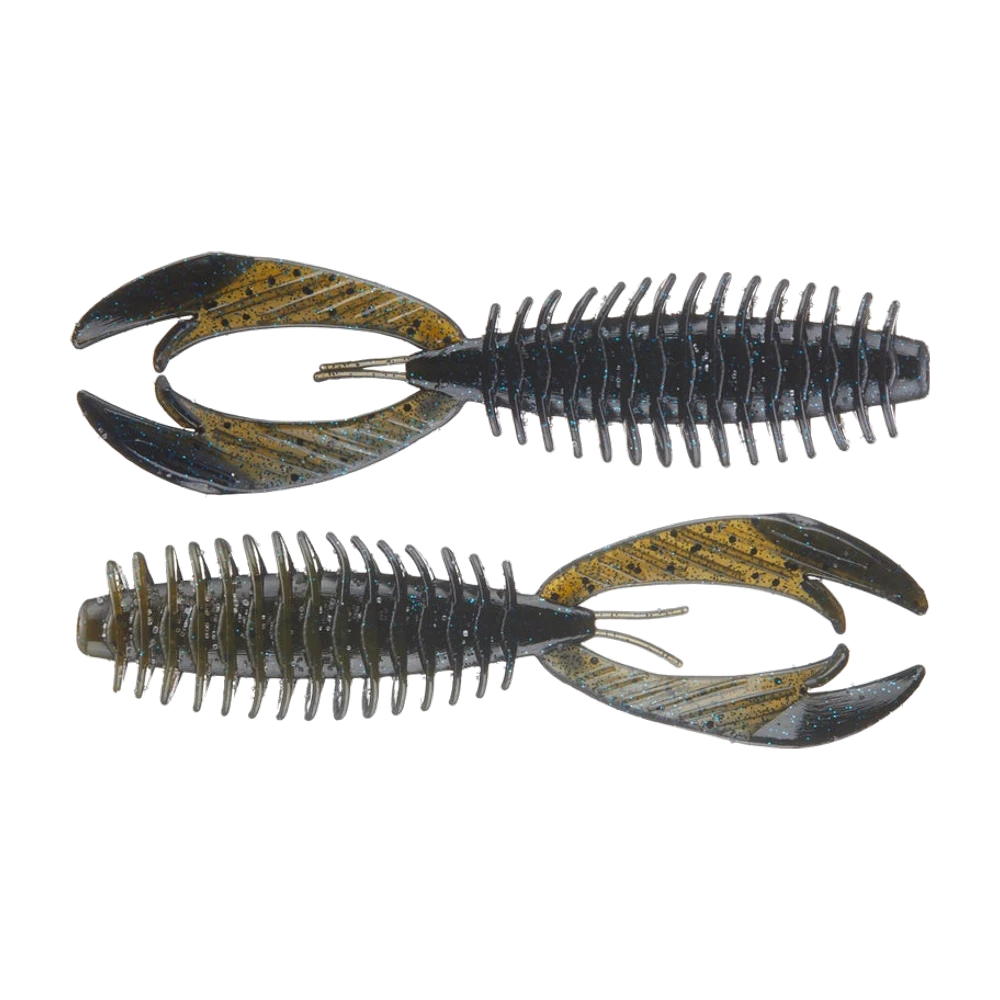
Big Bite Baits Fighting Craw: the craw that swims instead of thrashing
Rather not fish it blind? Photograph your spot — CarnaFish cross-checks the conditions and points you the right way.
A crawfish that feels threatened does not thrash about: it backs up in short jerks, claws raised, keeping contact with the bottom. Most soft plastic craws do exactly the opposite — huge claws beating constantly, a loud signal, sometimes far too loud for a fish that has already watched ten boats go by that day. The Big Bite Baits Fighting Craw starts from the other end of the problem: it borrows the counter-flapping claws from the Fighting Frog and grafts them onto a beaver body, which gives you a craw that swims gently instead of flailing.
Claws that flap against each other
That is the detail that drives everything. The Fighting Craw's two claws are not symmetrical in their movement: they are moulded to open in opposite directions, so on the fall or on a hop, one pushes water up while the other pushes it down. The result is not a spectacular beat but a soft twist running through the whole bait, an undulation that travels from head to tail.
In the water that reads very differently from a big-clawed craw like the Strike King Rage Craw. Where that one sends vibration you can feel in the rod, the Fighting Craw works quietly, with small sideways displacements. On a heavily pressured lake in midsummer, when bass refuse anything noisy, that is exactly the register that still produces.
Reverse-facing ribs, two jobs for the price of one
The body bristles with heavy ribs that are not perpendicular but leaning forward, against the direction of travel. They do two things. The first is hydraulic: on every lift they grab water and slow the rise, which increases the time the bait spends in the strike zone. On the fall the same effect works the other way and slows the descent without having to lighten the weight.
The second effect is purely practical, and it is the one people underestimate. The gap between two ribs forms a natural channel to bury the point of a Texas hook. You do not need to stab into the bait's back or leave the point sitting proud: it drops into the groove, the rig stays genuinely weedless, and because the plastic is thin there, the point breaks through on the hookset without having to drive through a thick section. That difference shows up in landed fish over a day.
Rig the Fighting Craw with the hook point in the groove about two thirds down the body, not in the middle. The bait sits straighter on the shank and spins far less on the cast, which saves you from twisting your fluorocarbon into a mess in three hours.
Three rigs, three uses
Weighted Texas
The main use. A 3/0 wide gap hook, a 5 to 14 g / 3/16 to 1/2 oz tungsten bullet depending on cover density and depth. At 9.5 cm the Fighting Craw stays a moderate profile: it slips in where a 4 in beaver starts to feel bulky, and it suits average-sized bass better than a heavier bait like the Big Bite Baits FAFO. Work it in short 20 to 40 cm hops, never in long sweeps: the claws have no time to open if you move it too fast.
Jig trailer
Probably its best role. On a 10 to 14 g / 3/8 to 1/2 oz flipping jig or a football jig, the Fighting Craw adds a credible craw profile without adding the drag of a big-clawed trailer. The skirt already supplies the bulk; the trailer should supply movement, not volume. Thread it nose-first up to the skirt collar and let the claws hang free behind.
Carolina rig
Over a gravel flat or a clean break, behind a 14 to 21 g / 1/2 to 3/4 oz weight and a 60 to 100 cm leader, the Fighting Craw cashes in on its ribs: dragged slowly, it stays slightly off the bottom and undulates continuously. It is a rig people forget about and it stays deadly in late spring over post-spawn areas.
Where and when
In Europe, the Fighting Craw's window opens once the water passes 14-15 °C and crawfish become active again — in practice from mid-April to October. Look for hard bottom: gravel, cobble, rock piles, dam and canal riprap, deadfall. A crawfish does not live in soft silt, and a bass hunting crawfish is not looking there either.
Reed edges and sparse weed are good ground too, as long as you slow down further: in vegetation the bait has to drop, land, wait, and only then be lifted a few centimetres. The bite very often comes as the bait settles back down after that small lift.
The classic mistake
Working it too fast and too hard. A craw that flies a metre on every pull no longer looks like a crawfish, or like anything else. The other, sneakier mistake is keeping the same bait after two or three fish: the plastic tears at the hook collar, the bait slides on the shank and loses its posture. The moment it stops sitting straight, change it — a crooked bait turns a weedless rig into a snag magnet.

Not sure what to tie on?
Photograph your spot: CarnaFish reads the scene, cross-checks the conditions and gives you the zone, the lure and the retrieve. Free on iOS and Android.
Colour by water clarity
- Clear water over gravel: Green Pumpkin, the universal crawfish tone, impossible to fault.
- Stained water or weedy bottom: a black and gold finish such as Okeechobee Craw, like the one in the photo, where the gold catches what little light there is while the black keeps a clean silhouette.
- Dark water, heavy turbidity or late-evening sessions: Black Blue, a classic that stands out backlit and that bass pick up by silhouette rather than colour.
A size that fits between two extremes
The Fighting Craw replaces neither a big flipping beaver nor a small finesse craw on a ned head. It occupies the middle ground, the one for days when the fish are neither really active nor completely shut down. In that register it does as well as, if not better than, a Zoom Z Craw, with a clear edge in how well the rig holds thanks to the ribs.
That said, the best craw in the world will not tell you where the hard bottom is. Reading a bank, spotting the break, guessing where the gravel runs under murky water: that is exactly what CarnaFish makes easier — a photo of the spot, and the app suggests the zone and the presentation suited to the day. To get better at that specific skill, our guide to reading a fishing spot walks through the clues to look for before you even tie on a bait.
Key takeaways
- Counter-flapping claws that twist the whole body instead of producing a loud beat: a craw for wary fish.
- The forward-leaning ribs slow both the fall and the lift, and they house the hook point for a genuinely weedless Texas rig.
- A versatile 9.5 cm size, excellent as a jig trailer, good on a Texas rig, underrated on a Carolina.
- Slow, short presentation: 20 to 40 cm hops, never long sweeps.
FAQ
What is the difference from the Fighting Frog in the same range?
The claws are the same counter-flapping design, but they sit on a more compact beaver body instead of a frog body. The result is that the Fighting Craw slides through dense vegetation better and lends itself more to flipping.
What hook should I use on a Texas rig?
A 3/0 wide gap hook suits the 9.5 cm size. What matters is tucking the point into the groove between two ribs rather than stabbing it into the back: the rig stays weedless and the hookset takes less force.
Does the Fighting Craw work as a chatterbait trailer?
It works, but it is not its best use. Counter-flapping claws are designed to work on the fall and on short hops, not under constant pull. For a chatterbait, a paddle- or twin-tail trailer gives a signal more consistent with the blade.
How long does one bait last?
Two to four fish as a rule, before the plastic tears at the hook collar. A pack of eight covers half a day on a cluttered stretch. Any bait that no longer sits straight on the shank should be swapped immediately.
Can it be fished in cold water?
Yes, but that is not when it shines. Below 12 °C crawfish are barely active and bass switch to baitfish. A finesse shad or a soft jerkbait makes more sense at that time of year.
Does it suit species other than bass?
On mixed water a good-sized perch can hit it, especially as a trailer on a small jig. But the bait was drawn for bass and 9.5 cm stays large for most perch; do not count on it as an all-rounder.
The full bass lure guideSeason-by-season strategy: which family of lure, when, and why.Go from theory to fish
CarnaFish reads your spot from a photo and gives you the game plan: zone, lure, retrieve. Free on iOS and Android.