Big Bite Baits Suicide Shad: the thin-necked shad that starts slow
The right lure in the wrong spot still catches nothing. CarnaFish spots the zone that works, from a single photo.
You rig a shad behind a swim jig, cast, start reeling — and nothing comes back through the rod. The bait is swimming, but so softly that you cannot tell whether it is working at all. That is the classic flaw of shads built with a thick body and a chunky tail stem: they need speed to come alive, and at speed the jig in front starts rolling over. Big Bite Baits designed the Suicide Shad from the opposite end, with a slender body and a deliberately thin connection to the tail.
A thin stem, and everything that follows from it
On a paddle tail shad, the part that decides everything is neither the body nor the paddle: it is the small piece of plastic joining the two. The thicker it is, the more moving water you need to make it flex, and the more speed the bait demands. The thinner it is, the earlier the tail starts — at the cost of durability.
The Suicide Shad accepts that trade. The stem is visibly thinned just ahead of the paddle, which gets the tail kicking from the very first turns of the handle, at a near-crawling retrieve. In practice that changes two things. First, you can fish slowly without the bait going dead, which matters enormously in cold water or on apathetic fish. Second, behind a swim jig or a chatterbait, you are no longer forced to burn the retrieve to feel something: the trailer works even while the head is running at its comfortable speed.
The downside is real and worth stating: a thin joint means a tail that eventually tears. Big Bite ships these shads in a flat clamshell precisely so the paddles do not end up folded in the bag. Rig the bait straight on the hook and a tear will come after several fish; rig it crooked and the first set of teeth will finish the stem.
Three sizes, three real jobs
The Suicide Shad comes in 3.5 in (8.9 cm, five per pack), 5 in (12.7 cm, four per pack) and 7 in (17.8 cm, two per pack). Big Bite does not publish a weight, which is normal for a bare shad meant to be loaded by whatever you rig it on.
The 8.9 cm is the trailer size par excellence: behind a light swim jig, a compact chatterbait or a 5-10 g jighead, it keeps a discreet profile that fits almost anywhere. It is also the most believable size in Europe for zander, where an oversized shad produces more refusals than bites.
The 12.7 cm is the all-rounder, the size that covers the most situations. On a 10-20 g jighead it becomes a standalone bait for pike along a bank, and it stays slim enough to serve as a trailer behind a big chatterbait.
The 17.8 cm steps outside the trailer role altogether. At that size it is a search bait for a better class of fish, retrieved slowly along a break or a weed edge, or hung on one arm of an umbrella rig where that rig is legal. Check that first: several European regulations tightly limit the number of baits per line.
Before deciding a shad does not work, change the speed before you change the colour. A Suicide Shad retrieved too fast loses its signature: the tail beats continuously but the body stops rolling, and you end up with an ordinary bait.
The rigs that work
As a swim jig or chatterbait trailer
This is what it was drawn for. Thread the shad dead centre on the jig hook, body aligned on the axis. The mistake to avoid is pushing it too far up, which shortens the profile and, worse, brings the paddle into contact with the skirt: it locks up and stops beating. Leave a millimetre or two of clearance.
On a bare jighead
On a plain round or football jighead, the Suicide Shad becomes a straightforward swimming bait. The solid body, with no internal cavity, holds on the hook better than a hollow shad and survives long casts without sliding. Slow retrieve, two or three stops per cast: bites very often come on the restart, when the tail kicks back into life.
Behind an underspin
The underspin is probably the most underused rig in Europe. A small blade below the jighead adds flash and a low-frequency vibration, and the shad does the rest. It is deadly in lightly stained water on fish holding in mid-column, where neither the bottom nor the surface gives you anything.
Weedless Texas
With a wide-gap Texas hook through the back and the point tucked in, the solid body of the Suicide Shad handles fishing over and through scattered vegetation well. You lose a little swimming amplitude compared with a jighead, but you earn the right to fish where the fish actually hide.
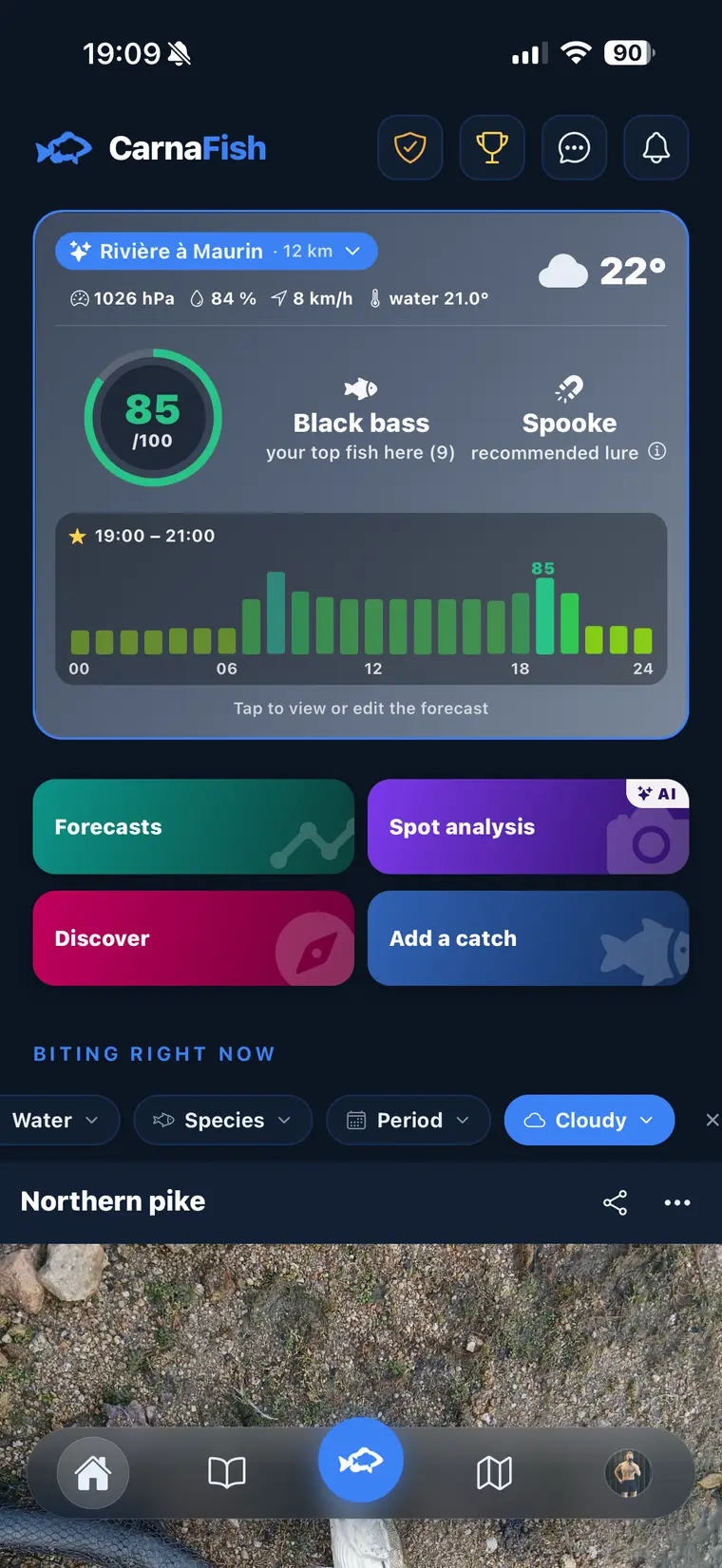
Not sure what to tie on?
Photograph your spot: CarnaFish reads the scene, cross-checks the conditions and gives you the zone, the lure and the retrieve. Free on iOS and Android.
The finish, and what it genuinely adds
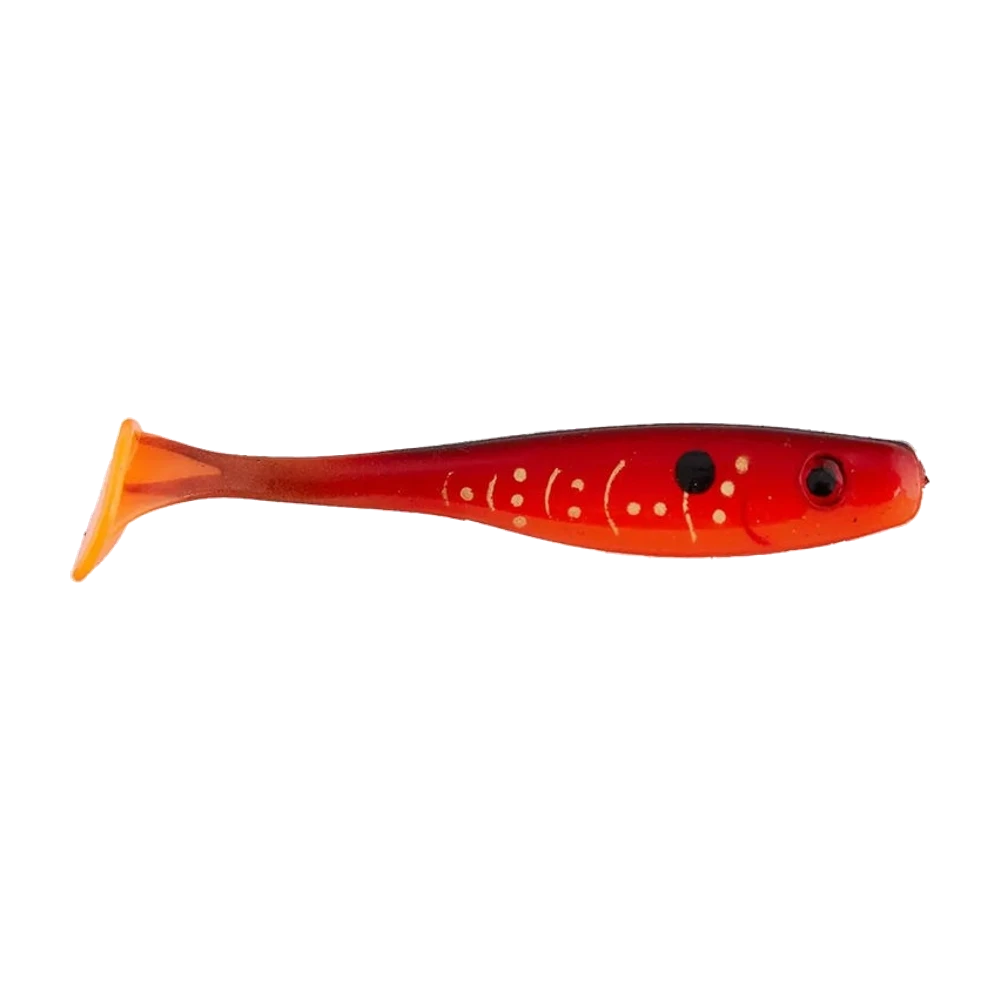
The Suicide Shad is moulded with a solid body, a multi-layer finish and 3-D eyes set into the material. In the photo on this page, the translucent red-orange colour lets the darker back show through, along with the cream dashes and dots on the flank and a crisp moulded eye. It looks good, but let us be honest about what it changes: a 3-D eye and a careful finish mainly matter in clear water and on a fish that has time to study the bait — slow presentations, wary fish, high visibility. In stained water and on a fast retrieve, silhouette and vibration decide, not details.
The classic mistake
Rigging the shad crooked. A paddle tail threaded two millimetres off centre does not swim straight: it spirals on its axis, spins your leader, and ten casts later you have a corkscrewed line with no idea why. Watch the bait in the water a metre from your feet before you start fishing seriously — thirty seconds that save a session.
Colour by water clarity
- Clear water: Pearl or a translucent silver, imitating a small baitfish without excess flash.
- Stained water: the translucent red-orange shown here, readable up close without shouting.
- Muddy water or a flood: Chartreuse Shad, dark back and bright belly, the only register that really works once visibility drops below thirty centimetres.
The right shad is useless in the wrong layer of water. That is exactly where CarnaFish helps: a photo of the spot, and the app suggests a zone, a depth and a style of presentation suited to the day. For the method behind reading a spot, our guide to reading a fishing spot lays out the markers to look for before you cast.
In the same register, the Keitech Swing Impact 4 remains the benchmark thin-tailed trailer, the Zman Diezel Minnowz leans on ElaZtech durability, and the Strike King Rage Swimmer offers a far more aggressive paddle when you need signal. Behind a Zman Chatterbait Jackhammer, the Suicide Shad finds its most obvious home.
Key takeaways
- Very thin tail stem: the paddle kicks from the first rotations, which allows a genuinely slow retrieve.
- Three sizes with distinct jobs: 8.9 cm for trailers and finesse, 12.7 cm as the all-rounder, 17.8 cm for hunting bigger fish.
- Solid body and moulded 3-D eyes: good hook retention, with a finish that mostly pays off in clear water.
- Rig it dead straight or the bait spirals and ruins your leader before it ruins your confidence.
FAQ
Which Suicide Shad size should I start with?
The 12.7 cm (5 in) is the best compromise: big enough to interest a bank-cruising pike, slim enough to serve as a chatterbait trailer. If you mostly fish zander or bass in finesse mode, drop down to the 8.9 cm.
Does Big Bite Baits publish a weight?
No. The manufacturer only gives lengths and the number of baits per pack. That makes sense for a bare shad, whose total weight depends entirely on the jighead or jig you rig it on.
Is it a good chatterbait trailer?
Yes, that is one of its main uses. Because the tail starts so early, you can run the chatterbait at its comfortable speed without the trailer hanging dead behind the head.
Does the Suicide Shad work for pike?
In 12.7 and 17.8 cm, yes, on a jighead and with a suitable leader. The solid body holds up reasonably well against teeth, but budget for refills: no soft shad survives a run of pike bites for long.
Why does my shad spin?
Almost always because it is rigged off centre on the hook. A couple of millimetres of offset is enough to unbalance the swim. Check the alignment before you cast and re-rig rather than fishing with a bait that spirals.
Is the thin tail fragile?
More fragile than a thick stem, yes, that is the price of responsiveness. The flat clamshell packaging exists precisely to stop the paddles deforming before use, and a well-centred rig clearly reduces tearing.
The full bass lure guideSeason-by-season strategy: which family of lure, when, and why.Go from theory to fish
CarnaFish reads your spot from a photo and gives you the game plan: zone, lure, retrieve. Free on iOS and Android.