Gambler Komodo 4: the ribbed fork-tail trailer built for dirty water
Before tying this one on, it helps to know if the spot actually calls for it. CarnaFish reads the scene from a photo.
When the water colours up after rain and visibility drops to less than half a metre, fish stop seeing your lure and start feeling it. Everything that improves the mechanical signal — vibration, turbulence, displaced water — then matters more than colour or realism of profile. The Gambler Komodo is built on exactly that principle, with two elements that do different jobs: a reverse-ribbed body and a fork tail.
Reverse ribbing, and what it changes
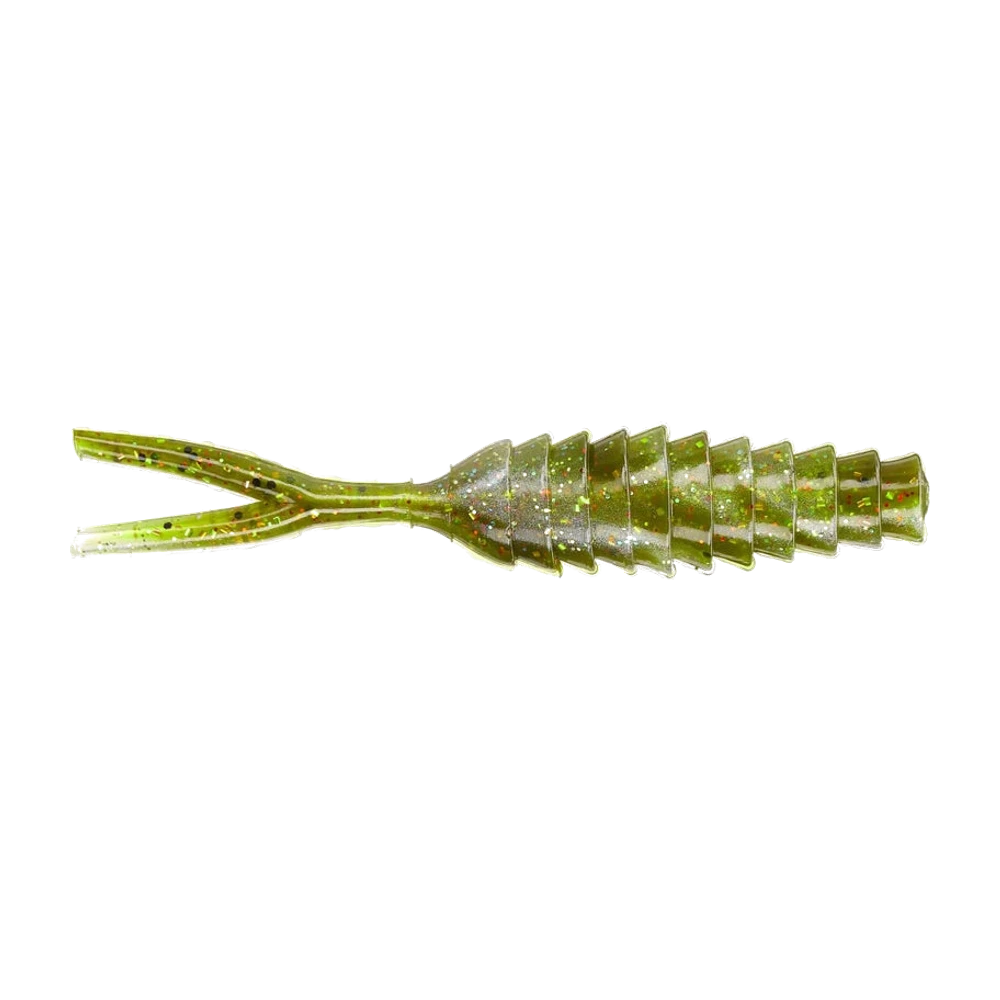
Look closely at the photo. The ribs are not simple grooves: their edges are pronounced, raised, and angled against the direction the bait travels. That is what the maker calls reverse ribbing, and it is not a moulding detail.
A conventional rib goes along with the water flow. A reversed rib fights it: at every edge the flow separates and spins off. The result is a volume of displaced water well beyond what a 10.2 cm bait suggests, and a turbulence signature a fish picks up through its lateral line from a useful distance. Gambler presents it as a way of helping bass key in on the bait, and that is exactly the right vocabulary: the aim is not to imitate, it is to be found. The maker explicitly targets two situations: stained water and vegetation that disrupts vision.
There is a flip side, and it is fair to flag it: a body this textured drags more than a smooth one. Behind a light bladed jig or on a 7 g swim jig, the Komodo forces you to slow down. That is not a fault if you know it in advance — it is often exactly what you want in cold or dirty water — but it becomes one if you wanted to cover water fast.
The fork tail, the second engine
The profile ends in a fork tail with rounded tips: two flat ribbons, clearly visible in the photo. The maker credits it with a realistic kicking motion as the bait swims through the water column.
In practice those two ribbons do not beat in phase. Each flexes according to the pressure it takes, and because they are flat, the slightest change of speed makes them clap together or spread apart. That produces a less mechanical swim than a single paddle: messier, more convincing on a fish that is taking its time. On the fall, under a bullet weight, both ribbons plane and slow the descent — what Gambler calls glide-style behaviour, and the reason it stands up well as a lure in its own right when flipping, not just as a trailer.
The three intended jobs
Behind a bladed jig
The maker lists this first. A bladed jig puts out a low, regular vibration; the Komodo layers the turbulence of its ribbing and the disorderly beat of its fork on top. Along a weed edge in green water, that is a rig a fish picks up from a distance. Run it on a 10 to 18 g model and accept slowing down a notch compared with a smooth paddle trailer. A Strike King Thunder Cricket or a Z-Man ChatterBait JackHammer are two reliable bases to try it on.
Behind a swim jig
Same idea, but with a silicone skirt and a weed guard. The Komodo extends the skirt, adds volume at the back and gives a continuous swim to a rig that otherwise just follows the pull. This is the rig to favour over a sparse weed carpet.
On its own, weighted Texas rig
Gambler also presents it as a standalone creature bait for flipping and pitching. A 7 to 14 g bullet weight, a wide-gap hook rigged Texas, and you can drop it into holes in the vegetation or tight against submerged branches. The volume of displaced water compensates for poor visibility, and the two ribbons are already working on the way down. In Europe, the same rig along pad edges also takes pike, provided the terminal tackle is up to it.
With this bait, the flipping bite almost always comes on the fall, not on the pull. Keep the line just taut and watch it going down. If it stops before the depth you expected, that is a fish, not a snag: set the hook.
The classic mistake
Rigging it like a plain paddle trailer and keeping the same retrieve speed. The Komodo does not have the same hydrodynamic efficiency: it drags, it churns, it needs a firmer pull for the same travel. Keep your usual rhythm and the rig will feel dead, and you will conclude too quickly that the trailer is no good. Slow down, let the bait rise in the column, and judge afterwards.
The garlic scent
The maker announces a garlic scent built into the plastic, a classic on baits aimed at flipping. Garlic does not pull a fish across the lake: what it changes is how long a fish holds the bait before spitting it. On a style of fishing where you deliberately wait a second or two before setting, that second is worth having. It is a convenience, not a reason to buy.
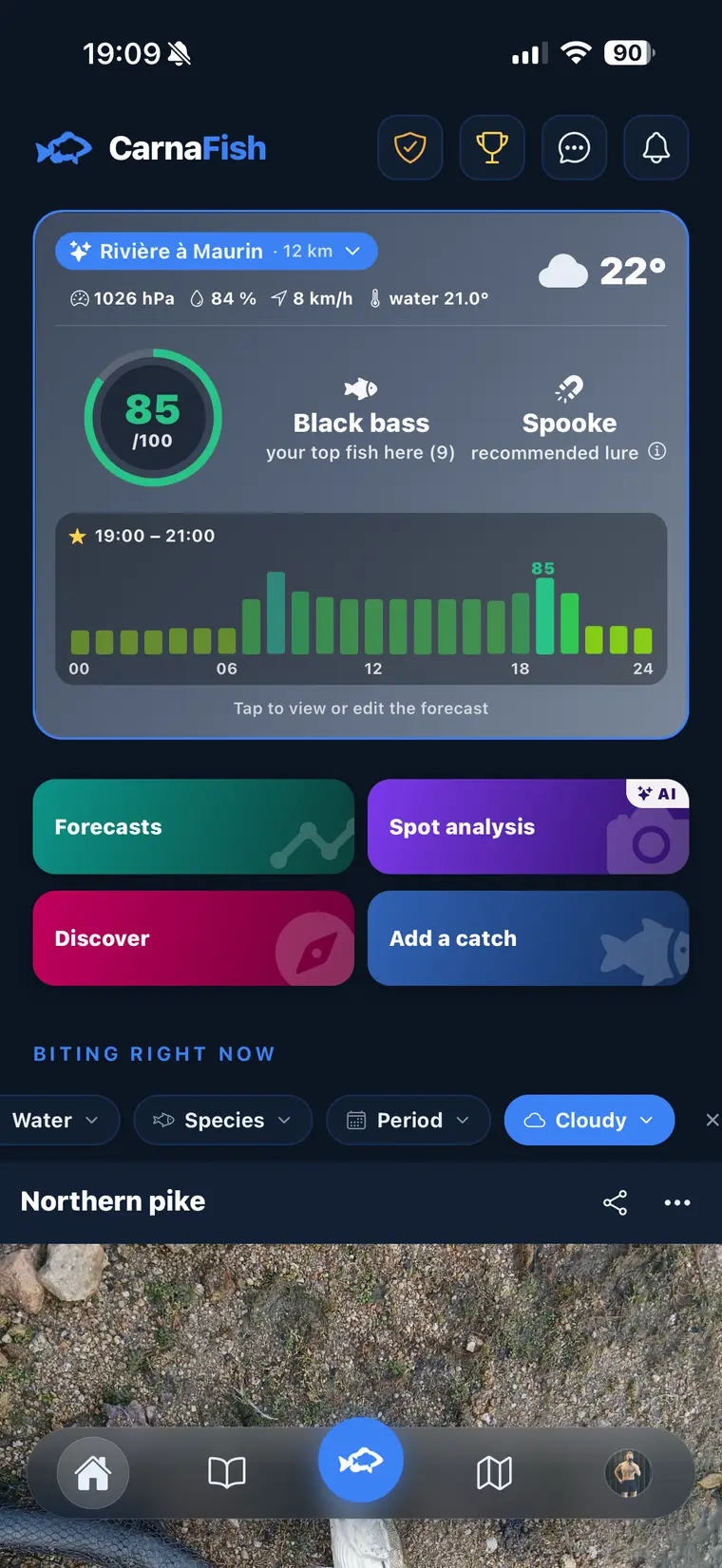
Not sure what to tie on?
Photograph your spot: CarnaFish reads the scene, cross-checks the conditions and gives you the zone, the lure and the retrieve. Free on iOS and Android.
Colours by water
- Stained water after rain: the chartreuse green with flake from the photo, a tone that stays readable in green water without going fluorescent.
- Weed, clear to slightly green water: green pumpkin, the safe bet in bass plastics, which melts into the vegetation.
- Heavily coloured water or low light: a dark tone with flake, playing silhouette rather than colour.
Where it sits in the box
The Komodo works in a different register from the Gambler EZ Vibez: the Vibez is still a shad with a genuine paddle and a clean thump, the Komodo is a creature bait that churns. Against a compact flipping creature such as the Reaction Innovations Sweet Beaver, it offers more displaced water but less compactness for punching through very thick vegetation. Choose according to what is limiting your day: visibility or penetration into cover.
A bait that gets noticed from far off is useless if you send it to the wrong place, which is exactly what CarnaFish is for: a photo of the spot, and the AI suggests the water, the depth and the type of presentation that fit the conditions. To learn to spot the cover worth a serious flipping session, our guide on how to read a fishing spot lays out the method.
Key takeaways
- The reverse ribbing exists to be detected by the lateral line, not to imitate a baitfish: this is a dirty-water and thick-weed bait.
- The rounded fork tail is already working on the fall, which makes it usable on its own when flipping rather than only as a trailer.
- One catalogue size: 10.2 cm, six per pack. Neither individual weight nor buoyancy class is published.
- It drags more than a smooth trailer: slow down a notch instead of deciding it does not swim.
FAQ
Is the Komodo only a trailer?
No. The maker presents it as a bladed jig or swim jig trailer, but also as a standalone creature bait for flipping and pitching on a weighted Texas rig.
How much does a Gambler Komodo 4 weigh?
The maker publishes no individual weight: the table gives only length, 4 in or 10.2 cm, and quantity, six per pack. The weight that matters is that of the jig or bullet weight you pair it with.
Why is the ribbing called reversed?
Because the rib edges face against the direction the bait travels. Instead of going along with the flow they make it separate, which multiplies the vortices and sharply increases water displacement.
What bladed jig weight should I use with it?
A 10 to 18 g model covers most situations. Lighter and the ribbed body drags too much and the blade loses frequency; heavier and you move into deeper fishing where a slimmer trailer is usually cleaner.
Does it work for pike?
Yes. In Europe, a weighted Texas rig worked along pads and weed edges takes pike, provided you use a leader that can handle teeth. It was not designed for that, but the volume and turbulence suit the fish very well.
Does the garlic scent genuinely change anything?
It will not attract a fish that is not there. What it increases is how long a fish holds onto the bait, which is useful in flipping where you deliberately wait before setting the hook.
The full bass lure guideSeason-by-season strategy: which family of lure, when, and why.Go from theory to fish
CarnaFish reads your spot from a photo and gives you the game plan: zone, lure, retrieve. Free on iOS and Android.