Big Bite Baits McMoney Jig: one jig from shoreline wood to deep breaks
Before tying this one on, it helps to know if the spot actually calls for it. CarnaFish reads the scene from a photo.
There is a point in a day of bass fishing when you stop covering water and start picking it apart. Laydowns along the bank, stumps, dock pilings: they stop being stretches to sweep with a hard bait and become individual pieces of cover to visit one at a time, within a foot of accuracy. A skirted jig is the tool for that moment. The McMoney Jig, designed with tournament angler Mike McClelland, is built around one claim: you should not have to retie a different jig when you leave shoreline wood for a deep break.
A hybrid head, and what it actually changes underwater
The word hybrid covers all sorts of things in catalogues. Here it means something specific: a head that is neither a true wedge-shaped flipping head nor a round swim jig head, but an in-between shape meant to handle both jobs. A classic flipping head is cut to split a branch and slide along a trunk, but it noses down the moment you retrieve it straight and the skirt collapses against the body. A swim jig head tracks cleanly through mid-water but jams in the first fork of deadwood it meets.
The shape used on the McMoney Jig threads through wood properly while keeping a stable attitude when you swim it back. In practice you can pitch along a laydown, follow the fall, and if nothing happens, go straight into a swimming retrieve to the next piece of cover without the bait rolling over. That is exactly the use Big Bite Baits claims for it: flipping, pitching, swimming, skipping and bottom-dragging with one jig.
Do not expect a miracle, though. A jig built to do everything does each individual job slightly less well than a specialist. In a really dense vertical wood pile, a dedicated flipping jig with a pronounced wedge head still slips through better. The McMoney is the jig of an angler moving along a bank, not of an angler camped on one tree.
Two weights, two different ways of fishing
The McMoney comes in 1/2 oz (about 14.2 g) and 5/8 oz (about 17.7 g), both armed with a black-nickel finish Mustad hook in size 4/0. The gap looks trivial — around 3.5 g — and yet it separates two fisheries.
The 1/2 oz is the shallow-bank and skipping weight. It falls slowly enough to give a bass time to rise and look at it, it skips better across the surface when you slide it under a dock, and it stays comfortable on a medium-heavy rod. That is the weight to pick if most of your fishing happens between zero and three metres.
The 5/8 oz is the weight for breaks, wind and current. Past four metres, or as soon as a crosswind bellies your line, the 1/2 oz takes too long to get down and you lose contact with the bait. The 5/8 oz falls straighter, telegraphs bottom composition far better through the rod, and stays workable on a drag at six or seven metres.
If you are only buying one, buy the 5/8 oz. You can always compensate for a slightly heavy jig by slowing the cadence and keeping a little slack on the fall; you can never compensate for a jig that is too light once the wind picks up.
Four presentations with one bait
Flipping and pitching
This is the core use. You spot a target — a stump, a low branch, a hole in the vegetation — place the jig in it at arm's length without a real cast, and follow the fall on a semi-tight line. Most bites come during that fall, and they are subtle: a line that jumps, a bow that drifts sideways. If you wait to feel a thump in the rod, you miss half the fish.
Swimming retrieve
The hybrid head allows a straight mid-column retrieve with the skirt flared, like a swim jig. It works well over emerging weed in spring or along a reed edge. Reel slowly and snap the rod tip every five or six handle turns: that stumble lets the skirt breathe and very often triggers the bite within the next second.
Skipping under cover
With the 1/2 oz and a rod that is not too stiff, the jig skips across the surface and tucks under a dock or beneath the low branches of a willow, where no conventional cast will reach. The fish living under that kind of cover rarely see a lure go by.
Dragging the bottom
On a break, a rock pile or an old river channel, let it reach full depth then drag the jig along the substrate with the rod, not the reel. You feel every change in bottom hardness. When the head hangs on a rock, release for a second before picking it back up: the bass very often commits on that release.
Not sure what to tie on?
Photograph your spot: CarnaFish reads the scene, cross-checks the conditions and gives you the zone, the lure and the retrieve. Free on iOS and Android.
Skirt, hook and trailer
The skirt is silicone and wire-tied rather than held by a simple rubber collar. The difference is invisible in a shop and obvious after a season: a collar eventually loosens and strands escape one by one, while a wire-tied skirt holds. That is a durability detail, not a fish-catching one, but on a bait you deliberately drive into wood, durability is the real subject.
The hook is a 4/0 Mustad on both weights, black-nickel finish, with a point advertised as razor-sharp for fast penetration. It is a generous size, consistent with a power presentation: you do not set a jig with your wrist, you set it by standing into the fish with a stiff rod and low-stretch line. Braid in the 30-40 lb range, with or without a 0.35 mm fluorocarbon leader when the water is clear, is the baseline.
The classic mistake
Rigging an oversized trailer to "make it bigger". A craw with big flat claws slows the fall, keeps the skirt permanently flared and ruins pitching accuracy. If you want a jig that drops straight into a ten-centimetre window, use a compact trailer with slim appendages. Save bulky craws for the swimming retrieve and for stained water, where volume and vibration genuinely earn their keep. And remember to even the skirt up roughly level with the hook point: a new jig has strands running well past the hook bend, which multiplies missed bites.
Colour by water clarity
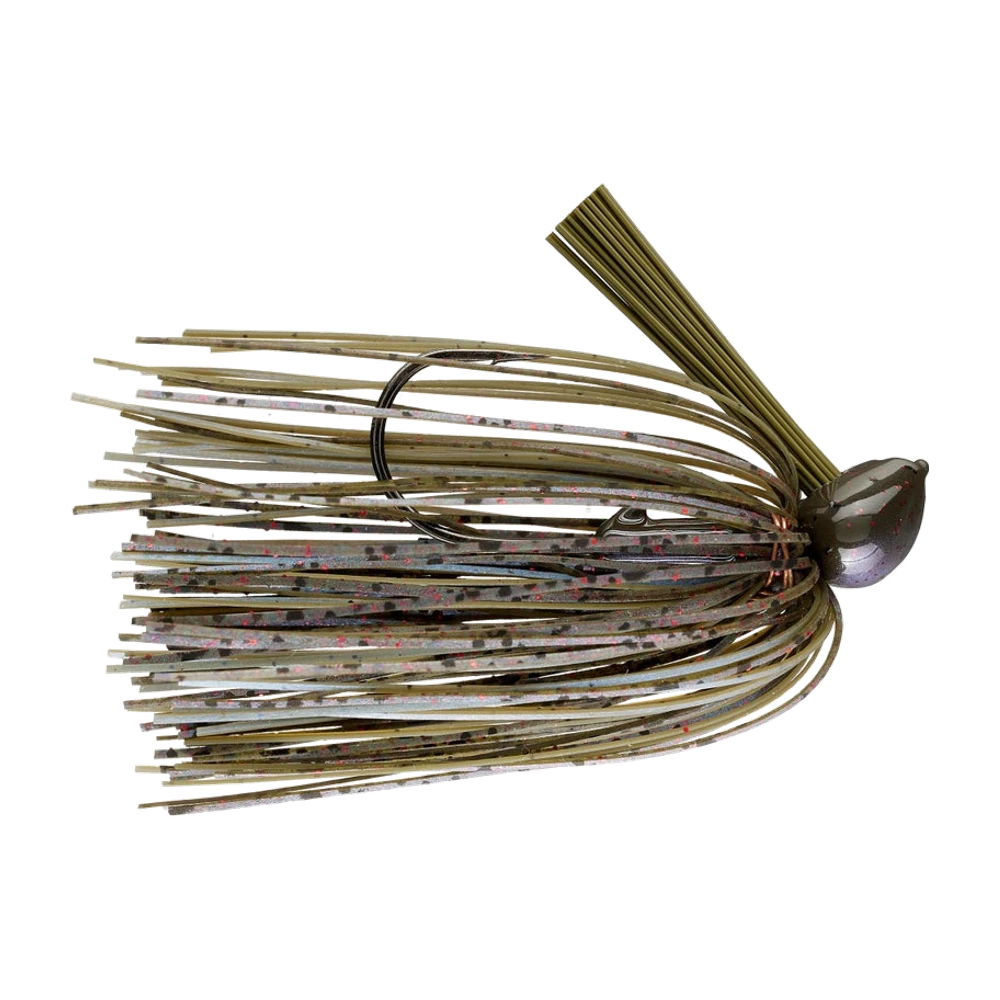
- Clear to lightly stained water: flaked Green Pumpkin, the crawfish tone that works in nine situations out of ten. It is the colour shown in the photo.
- Dark water, back of a creek or heavy overcast: Black and Blue, a hard silhouette the fish picks up by contrast rather than by colour.
- Rock bottom and slightly coloured water: Texas Craw, brown-orange dominant, close to a moulting crawfish.
A well-chosen jig never replaces reading the spot properly: knowing which bank is working, where the break runs, how high in the column the fish are sitting. That is exactly what CarnaFish makes easier — a photo of the spot, and the app suggests a zone and a presentation matched to the day's conditions. To build the tackle and spot-reading fundamentals, our beginner's guide to bass fishing is a solid starting point.
On trailers, the Missile Baits D-Bomb and the Strike King Rage Craw cover the two extremes, a slim profile for a straight fall and very active claws for bulk. And if you want a more specialised tool for pure swimming, the 6th Sense Divine Swim Jig handles that single role better.
Key takeaways
- Hybrid head: one jig for flipping, swimming, skipping and dragging, at the cost of a small step back from any single specialist.
- 1/2 oz for shallow banks and skipping, 5/8 oz for breaks, wind and current; 4/0 Mustad hook on both.
- The bite almost always comes on the fall, and shows on the line before you feel it in the rod.
- Compact trailer for a straight fall, bulky craw reserved for swimming and stained water.
FAQ
Should I pick the 1/2 or the 5/8 oz?
The 1/2 oz (about 14.2 g) suits shoreline work down to three metres and skipping under docks. The 5/8 oz (about 17.7 g) becomes necessary as soon as there is wind, current or more than four metres of water. If you only buy one, the 5/8 oz covers more situations.
How long is the McMoney Jig?
Big Bite Baits does not publish a length for this jig, only weight and hook size. That is normal on a skirted jig, where the real profile depends mostly on skirt length and on the trailer you rig behind it.
What trailer should I rig behind it?
A compact craw or chunk for vertical presentations in wood, a trailer with more active appendages for the swimming retrieve. Avoid very bulky trailers if you want a fast, straight fall into a tight window between two branches.
Does the McMoney Jig really come through wood?
Through moderate wood, yes, and that is what it is designed for. In a very dense vertical pile, a dedicated flipping jig with a pronounced wedge head still slips through better. The McMoney is a deliberate compromise between several uses, not a pure penetration tool.
Is it any good for pike or perch?
That is not what it is for. It is a bass jig, with a 4/0 hook and a skirt built to suggest a crawfish. A pike may well hit it, but without a suitable leader you will lose the bait, and for perch the profile is far too bulky.
The full bass lure guideSeason-by-season strategy: which family of lure, when, and why.Go from theory to fish
CarnaFish reads your spot from a photo and gives you the game plan: zone, lure, retrieve. Free on iOS and Android.