Missile Baits Ike's Mini Flip: the compact jig that falls fast in current
One lure, endless conditions. CarnaFish reads your spot from a photo so you are not just guessing.
A river after two days of rain, a solid current, and drowned trees along the inside bank. You drop your 14 g jig against a trunk: before it has even touched bottom it is two metres downstream, line tight, and you felt nothing. The jig did not fish the spot, it flew over it. That is exactly the problem Mike Iaconelli and John Crews set out to fix.
A prototype, a win, then a production model
The Mini Flip has a documented origin: Iaconelli fished a prototype during his win on the Delaware River in 2014, an Elite Series event held in very tough conditions. The production model came out of that two-man job, Iaconelli for the use and Crews for the design.
That guarantees nothing in itself — plenty of pro-signature lures are no better than the rest. But it explains the coherence of the brief: a jig for a cluttered river, built to fall fast and stay put, not to look good on a peg.
One point to set down straight away: Missile Baits publishes neither weight nor length for this model. The description talks about compactness and balance without a single dimension. If you want an exact gram figure for a given depth or current, the retailer's grid is your only reliable source.
Weight centred on the shank: what that actually changes
The maker stresses one construction point: the jig is balanced with the weight centred around the hook shank, rather than pushed forward as on many heads.
The immediate consequence is a straight, nose-down fall with no pitching. A jig whose lead sits too far forward dives nose first and then rights itself, which makes it drift sideways on the way down — precisely what takes you away from the trunk you meant to drop against.
Add compactness to that. At the same weight, a compact jig presents less surface to the water than a bulky one: it falls faster. Missile Baits says so explicitly, and you can verify it on the line. In current that fall speed buys you something simple: the jig reaches bottom before it has drifted off the spot, and it stays there instead of lifting at the first pull on the line.
That is the exact opposite of the logic behind the Micro Football Jig from the same Iaconelli, which is trying to slow down and present at length. The two carry the same angler's name and answer two opposite problems: one for clear cold water over hard bottom, the other for cover and current.
The angled weedguard and getting through the nasty stuff
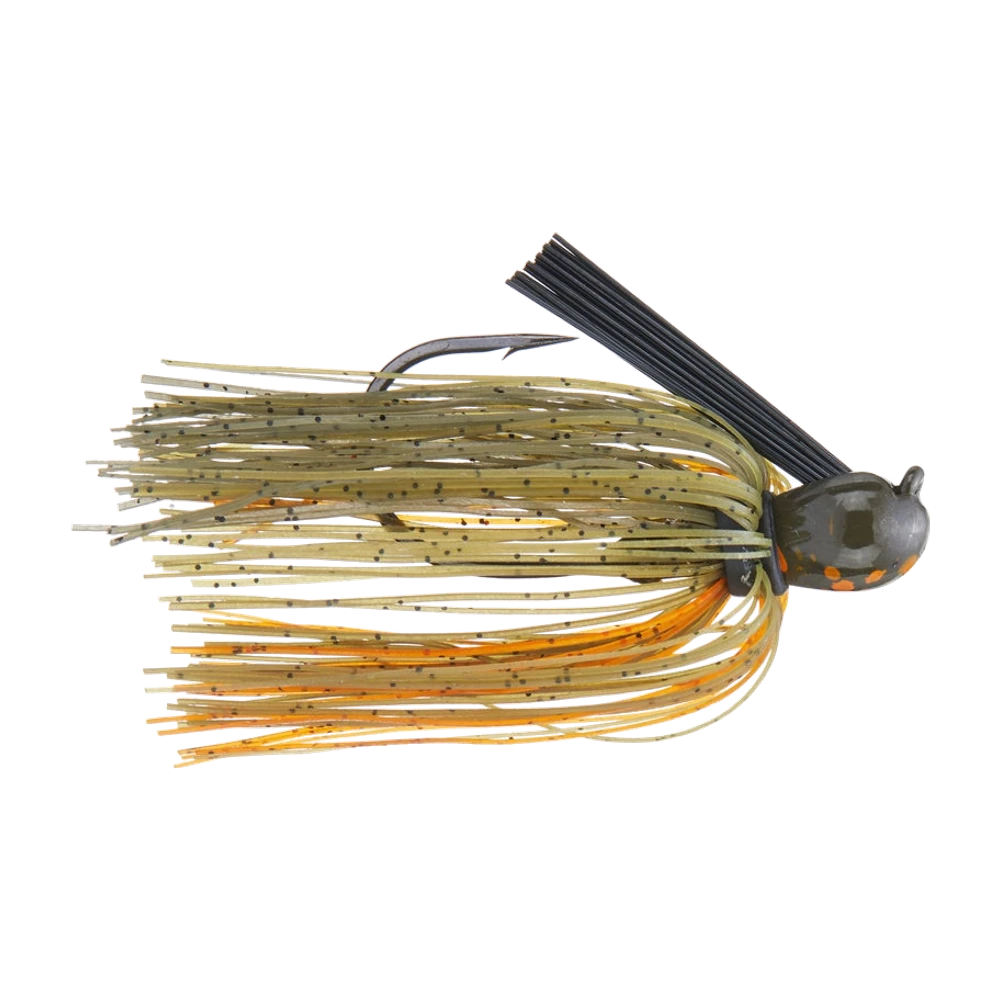
The fibre weedguard is fitted as standard and, more importantly, angled — in the photo on this page the bristles lean clearly backwards instead of standing vertical. That angle has a precise job: it lays the fibres down against the point as the jig enters a fork of branches, then lets them stand back up as it comes out.
Missile Baits states that this combination of compactness and angle lets it go in and out of the nastiest cover in nearly every case. That is manufacturer's phrasing and should be read as such, but the logic holds: most flipping hang-ups come from a weedguard that stands too vertical and catches on a branch on the way out, not on the way in.
How to set it
Do not trim the weedguard flush in the hope of better hook sets. You can, on the other hand, fan the fibres out slightly with a thumbnail: the jig becomes a little less efficient on the set but noticeably cleaner in wood. Conversely, pinch the bristles together between two fingers for more open cover, where you want maximum hook-setting bite.
Not sure what to tie on?
Photograph your spot: CarnaFish reads the scene, cross-checks the conditions and gives you the zone, the lure and the retrieve. Free on iOS and Android.
The fine-cut skirt and choosing a trailer
The skirt is cut into fine strands, which lets it pulse at the slightest movement. In practice it breathes through the pauses: even with the jig sitting still on the bottom, the strands open and close with micro-currents and with the tension of the line.
That has a direct consequence for the trailer. Since the skirt already works on its own, you do not need a big paddle trailer to create action. A compact trailer — a short chunk, a small craw, or a Missile Baits Chunky D if you want to keep some volume in dirty water — lets the skirt speak and preserves the fall speed that makes the model interesting.
A big flat trailer cancels both: it brakes the descent and pins the skirt against the body.
On the water, in a river: never fish a flipping jig downstream of your position if you can help it. Set up below the spot and cast upstream, then let the jig drop while taking in just enough line to keep contact. The current then presses the lure against the obstacle instead of tearing it away, and you feel the bite instead of guessing at it.
The classic mistake
Fishing this jig too light. The finesse reflex belongs to the Micro Football, not to this one: an underweighted Mini Flip loses exactly what sets it apart, the fast fall and the ability to stay put in current. If you are torn between two weights in moving water, take the heavier one.
The second mistake is fishing light line by imitation. A flipping jig in nasty cover calls for heavy braid and no leader: you have to be able to pull free without breaking everything, and to get a fish out of a fork before it has time to wrap you.
Colours by water and forage
- Clear to lightly stained water over hard bottom: green pumpkin flecked with orange, exactly the finish visible in the photo on this page, which reads as a crayfish in a defensive stance.
- Dark water, dense wood or low light: black and blue, the silhouette that stays readable when the fish sees the lure backlit from below.
- Gravel bottom in summer: plain craw brown, more discreet, the pick when the fish have already watched a lot of jigs go past.
Against a standard-size flipping jig, the Mini Flip gives up volume and calling power and gains fall speed and passage. Choose by the water: dirty and still, take the volume; clear or moving, take the compact one.
Knowing which drowned tree is worth three casts and which is worth none remains the decisive skill. That is exactly what CarnaFish makes easier: a photo of the spot, and the AI suggests the zone, the depth and the kind of presentation that suit the day's conditions. To line those choices up with the calendar, our season-by-season predator fishing guide sets out the markers.
Key takeaways
- Weight centred on the shank and a compact profile: a straight fall, faster than a standard jig, which is a real advantage in current.
- Angled fibre weedguard fitted as standard, designed to come back out of a fork of branches without catching.
- Fine-cut skirt that pulses on its own: keep the trailer compact so you do not crush it.
- Neither weight nor length published by the maker: check the retailer's grid before buying.
FAQ
What weight should I pick for the Mini Flip?
Missile Baits publishes no weight for this model, so you have to go by the retailer's grid. The working rule is unchanged: in current or in dense wood, take the heavier of the two weights you are torn between.
Why does this jig fall faster than another?
Because it is compact and its weight is centred around the hook shank. At the same weight, a reduced profile presents less surface to the water and goes down straighter, without the pitching that makes a forward-weighted jig drift.
What trailer should I rig on it?
A compact one: a short chunk, a small craw, or a moderately sized creature bait if the water is dirty. A big flat trailer brakes the fall and pins down the fine-cut skirt, which is to say both of the model's strengths.
Braid or fluorocarbon?
Braid, 0.35 to 0.40 mm, with no leader, as soon as you are fishing wood or dense vegetation. Keep fluorocarbon for open margins in very clear water, where discretion matters more than the ability to haul a fish out.
Can the weedguard be removed?
That is not the spirit of the model: the angled weedguard is part of what lets it come back out of branches. You can, though, fan the fibres out for more protection, or pinch them together for a cleaner hook set.
Does this jig suit river fishing?
It is one of its best grounds. Its fast fall and compactness let it reach bottom before it has drifted off the spot, and stay there when the current pulls on the line, where a bulky jig lifts off.
The full bass lure guideSeason-by-season strategy: which family of lure, when, and why.Go from theory to fish
CarnaFish reads your spot from a photo and gives you the game plan: zone, lure, retrieve. Free on iOS and Android.