Bill Lewis Big Gizz: a big gizzard shad you fish like a blade bait
The right lure in the wrong spot still catches nothing. CarnaFish spots the zone that works, from a single photo.
There's a moment in late autumn when baitfish stack into tight balls between 4 and 8 m and nothing above them produces anything at all. The sonar screen turns into an unreadable smear, the predators sit underneath or along the edges of the ball, and a 6 cm crankbait simply disappears into that mass. That's the situation a lure like the Big Gizz is built for: a big profile you drop into the middle of it and work on the spot, never leaving the layer the fish are actually holding in.
Big forage, not a search bait
The Big Gizz measures 6 in, or 15.2 cm, and the stated weight is 2-3/16 oz, roughly 62 g. Those two numbers tell you almost everything about how it should be used. At 62 g you're not casting this on an all-round rod and you're not grinding it for twenty minutes without thinking: it comes out once you've identified a zone, a depth and a specific forage type.
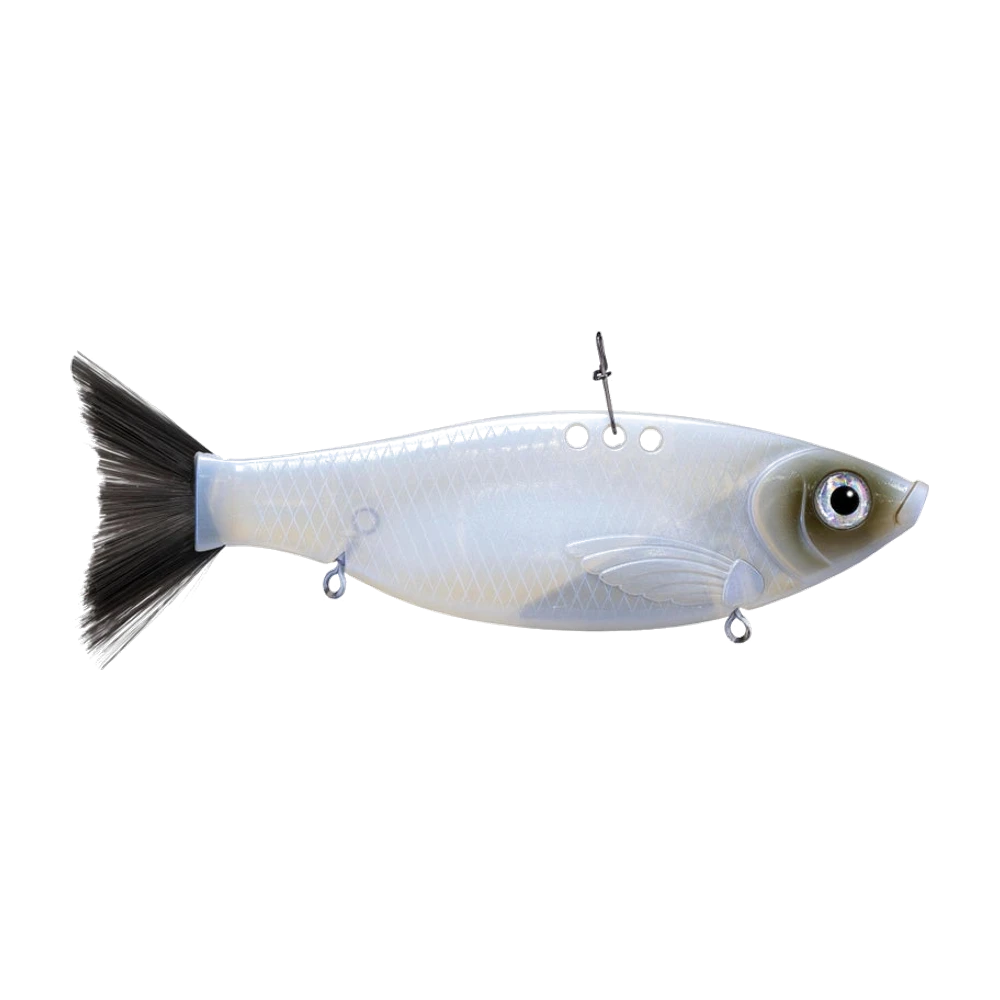
The body copies the silhouette of an adult gizzard shad — tall, flat-sided, with a pronounced shoulder and a tail that looks tiny next to the bulk of the body. Bill Lewis state it imitates gizzard shad and bluegill alike, and that isn't empty copy: head-on, a gizzard shad and a bluegill share the same tall, compressed outline, the one big predators look for when they want one meal instead of ten.
The tail isn't a soft plastic paddle but a tuft of fibers. That choice changes how the lure behaves at rest: the fibers keep opening and closing in the current or on residual water movement long after the body has stopped dead. On a fish that follows without committing, that leftover micro-movement during the pause is often what tips the balance.
The snap and the three holes are the real story
Bill Lewis built a snap and three aligned line holes into the back of the Big Gizz. That detail is what makes it more than another oversized lipless. Moving the snap from one hole to the next changes the lure's attitude in the water and therefore how it reacts to a pull — exactly like the two or three holes on a conventional blade bait, which effectively give you three different lures.
The forward hole pulls the bait by the nose: the attitude tips down, the action tightens, the lure rises less on the retrieve and vibrates more sharply. That's the closest setting to a lipless. The rear hole lets the nose drop freely as soon as you release tension, so the bait rolls further onto its side and flutters like a casting spoon. The middle hole is the compromise, and it's the logical starting point on water you don't know.
Mark the hole you used before you put the lure away. After two trips and three fish, nobody remembers which setting was working — and since all three attitudes look identical in the box, you usually start the next session on the wrong one.
Three ways to fish it
Vertically, like a blade bait
This is the most direct use and the one that actually earns those 62 g. Find the bait layer on the sonar, drop on a tight braid, and work it with short 20-40 cm lifts followed by a controlled descent on a semi-slack line. The bite almost always comes on the drop, never on the lift: if you let the line go completely slack you won't feel it, and you'll wind up a lure with the trebles already pulled free. Keep light contact at all times.
As a lipless, on a straight retrieve
With the snap on the forward hole, the Big Gizz retrieves like an oversized lipless crankbait, counting the lure down to control depth. Keep the pace slow to medium — this is not a bait you make run. Over low-angle flats, a wide yo-yo (three cranks, drop, three cranks) usually out-produces a steady retrieve by a clear margin.
As a flutter spoon, on a tight vertical spot
On a bridge piling, a sunken tree or a sharp break, the third approach is to let it fall on a controlled line from the surface and do nothing but follow it down. The flat body rolls onto its side and flutters sideways, while the fiber tail slightly brakes the descent. It's slow, it looks like nothing much, and it's often what triggers the biggest fish on a spot that's already been cast over.
Rigging, hooks and leader
The Big Gizz comes armed with two Mustad Triple Grip trebles mounted on rotating hook hangers. That's worth a moment: on a lure this heavy, a fixed treble hands the fish serious leverage to throw the bait during head shakes. A rotating hanger lets the treble follow the fish's movement rather than fight it, which cuts that leverage down. It's the same reasoning behind the hardware on big jointed swimbaits.
For line, run 30-40 lb braid and a 40-60 lb fluorocarbon leader. The braid is non-negotiable if you want to feel a bite on the drop in 6 or 8 m of water; the fluorocarbon handles abrasion against deadwood and shell beds. In Europe, if you fish this kind of structure and there is pike around, add a steel or titanium leader: a 15 cm bait fluttering slowly is precisely what a pike grabs across the body.
The rod should be a heavy-power casting stick, 2.10-2.30 m, with a tip that handles 62 g on the cast without folding in half. A rod that's too soft won't transmit the lift to the lure and won't let you set the hook properly at depth.
The classic mistake
Trying to use it as a search bait. Plenty of anglers tie on a Big Gizz, make twenty casts along a random bank, catch nothing and put it back in the box. This lure isn't built to find fish: it's built to drop on fish you've already located, on sonar or by reading the spot. If you haven't identified forage or a precise piece of structure, a 6th Sense Quake or a Rapala Rippin' Rap will cover far more water for far less effort.
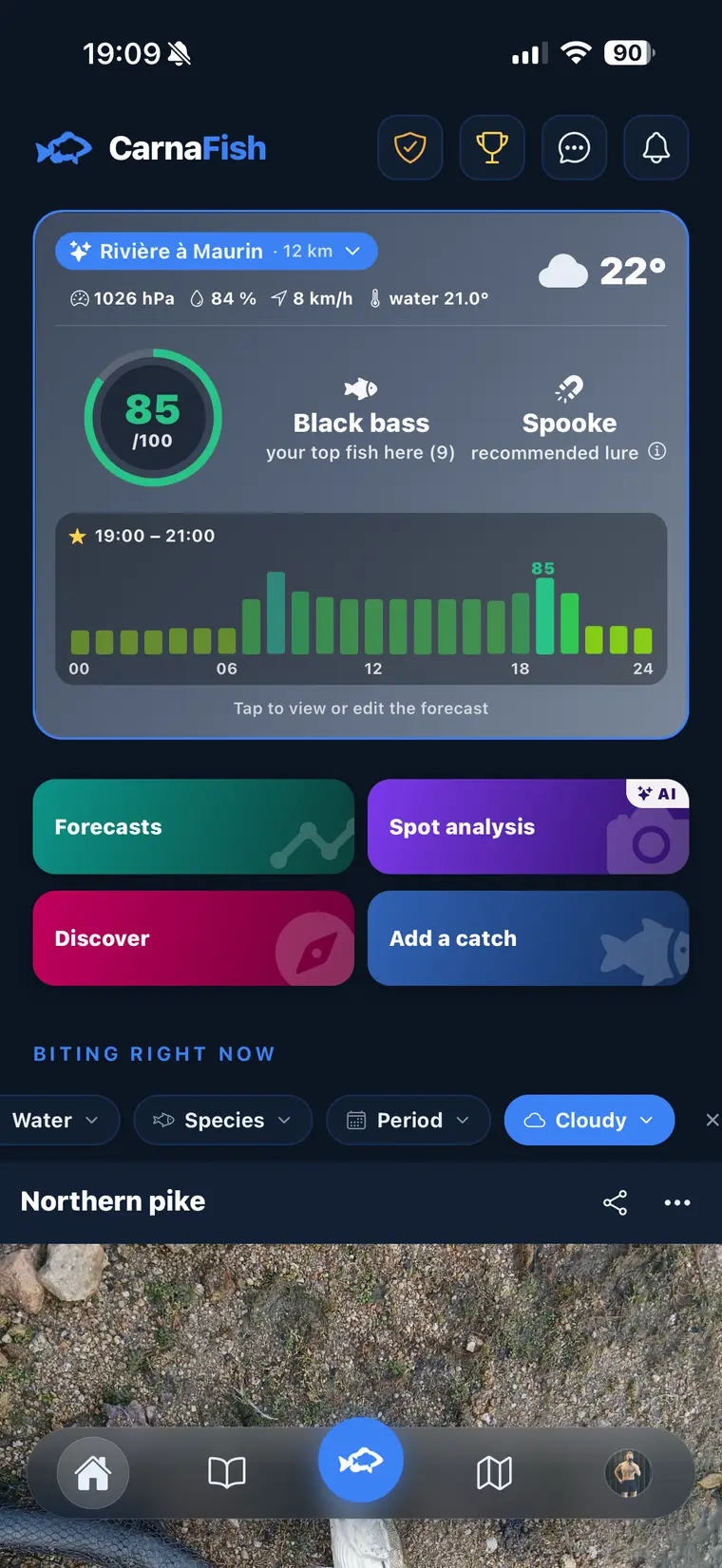
Not sure what to tie on?
Photograph your spot: CarnaFish reads the scene, cross-checks the conditions and gives you the zone, the lure and the retrieve. Free on iOS and Android.
Colors by water clarity
- Clear water: pearl white, exactly the finish in the photo, which reproduces the very pale silver flank of a gizzard shad without aggressive glare.
- Lightly stained: an olive-backed gizzard shad finish, which keeps a readable top-to-bottom contrast when light struggles to get through.
- Dirty water: a chartreuse flank, worth saving for visibility under 50 cm, where vibration does more work than sight.
A specialist's lure, and best treated as one
The Big Gizz only makes sense when you know where the fish are and how deep. That's its limitation as much as its purpose. It replaces neither a slim blade like the 6th Sense Slice, far easier to handle day to day, nor a compact lipless like the Bill Lewis Hammer Trap that covers ten times the water. It does one thing neither of those can: present a large volume, slowly, at exactly the right height.
Knowing which depth and which structure to drop on is exactly what CarnaFish is built to simplify: photograph the spot and the AI hands you the zone, the depth and the lure family that match today's conditions. To place this kind of vertical fishing in the wider year, our seasonal guide to predator fishing explains when forage drops deep and why everything else follows it down.
The short version
- 15.2 cm and around 62 g: a lure for located fish, not for searching, and it demands a heavy rod and braid.
- The dorsal snap and three holes change the attitude and give three distinct behaviours, from sharp lipless to fluttering spoon.
- The bite almost always comes on the drop, so keep the line semi-tight and never fully slack.
- Rotating hook hangers cut the leverage a fish gets during head shakes, a genuine advantage on a bait this heavy.
FAQ
Is the Big Gizz a sinking lure?
Yes, decisively so. At 62 g for 15.2 cm it drops fast and straight as long as you keep tension on the line. That's what lets you fish it vertically down to 8 or 10 m without losing contact, and equally what makes it a poor choice in shallow, cluttered water.
What are the three holes on the back for?
They shift the pulling point and therefore the lure's attitude. The forward hole tightens the action and makes it sharper, the rear hole lets the nose drop and exaggerates the flutter on the fall, the middle hole is the intermediate setting. It's the same principle as a conventional blade bait.
What leader should I use in Europe?
A 40-60 lb fluorocarbon leader on a bass spot. If there is pike on the zone — common on large European reservoirs — switch to steel or titanium: a big bait fluttering slowly is exactly the presentation a pike takes sideways.
Should I replace the stock hooks?
Not on quality grounds: the factory Mustad Triple Grips are serious hooks. Do check the points regularly though, because a treble that has knocked bottom repeatedly on the vertical goes dull fast. On this kind of fishing, sharpness matters far more than the brand name.
Can you fish it in a river?
Yes, but vertically only, on deep spots with moderate flow. In strong current 62 g isn't enough to hold the lure under the rod tip, and you end up fishing at an angle, which destroys any control over the descent.
Does the Big Gizz work for pike?
On paper everything lines up: big profile, slow action, sideways flutter. In practice it's a lure designed for big American bass sitting on gizzard shad balls, and pike use is a transposition. It works, especially vertically over deep wintering areas, but don't build a pike session around it.
The full bass lure guideSeason-by-season strategy: which family of lure, when, and why.Go from theory to fish
CarnaFish reads your spot from a photo and gives you the game plan: zone, lure, retrieve. Free on iOS and Android.