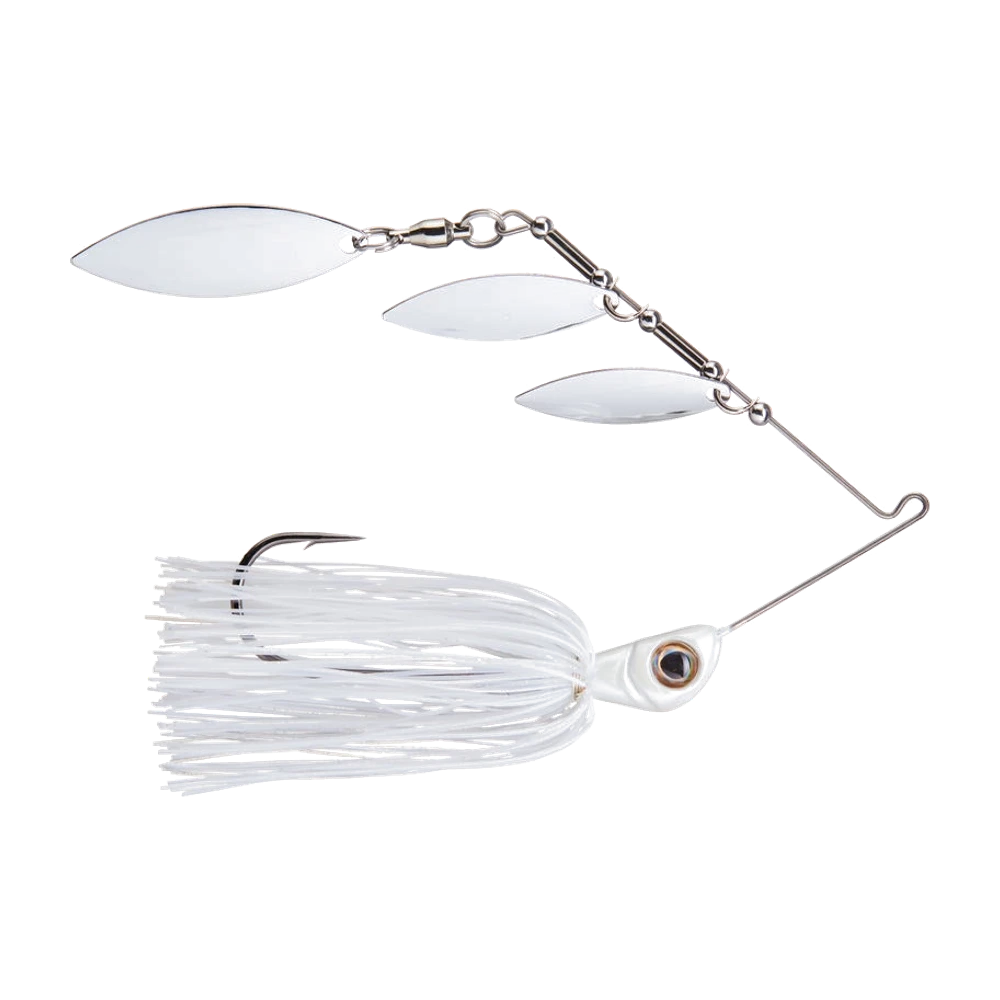
Bizz Baits Fall Fry: three willow blades that imitate a fry ball
Not sure this lure fits YOUR spot today? CarnaFish tells you in 10 seconds, from a photo.
In late August the year's fry gather into tight clouds along the margins, and bass stop hunting single large baitfish to charge straight into the mass. At that exact moment a lure imitating one prey item often gets ignored: what the fish attacks is a shimmering blob. The Bizz Baits Fall Fry is built for that, with three willow blades staggered on the same arm.
Three blades, and why that changes how the lure reads
A standard one- or two-bladed spinnerbait sends out a clearly readable signal: one prey item, moving. With three willow blades in different sizes — #2.5, #3 and #3.5 according to the maker — you get something else. The flashes no longer come from a single point but from three sources offset in space and in time, since the blades neither spin at the same speed nor in phase.
Seen from below, that scatter looks far more like a small group of fish than like an individual. That's precisely what a bass patrolling under a fry cloud is looking for: it isn't attacking a prey item, it's attacking the ball and hoping to connect. The stacked reflections have a useful side effect too — they bury the silhouette of the wire arm and the hook in the flicker.
The staggered sizes have their own logic. The largest blade, out at the end of the arm, meets the most resistance and sets the overall rhythm. The two smaller ones, mounted upstream on intermediate swivels, spin faster and add a higher flash frequency. That offset is what stops the whole thing from looking like an evenly blinking string of lights.
Thin blades that start on nothing
The maker calls these blades razor-thin, and it isn't cosmetic. A thin blade carries less inertia and less lifting surface, so it starts earlier and keeps spinning under very little pull. In practice you feel all three engage on the first turn of the handle, with no need to snap the rod to get them going.
The other consequence is that total drag stays moderate despite the blade count. Three Colorado blades on one arm would be unfishable; three thin willows are not. The bait keeps its ability to run down and doesn't rocket to the surface the moment you speed up. That's what makes it a fast search bait, where the same brand's Big Thump single Colorado plays the exact opposite register.
The wire is 0.035 in, roughly 0.89 mm. That's thin for a spinnerbait, consistent with letting the whole assembly vibrate rather than stiffening it. The trade-off is that you'll re-tune it by hand now and then: a thin arm handles big fish but deforms sooner than heavy wire.
Where and when to use it
The Fall Fry is a clear to lightly stained water bait. Willow blades work on reflection, and reflection doesn't exist in water with 20 cm of visibility. Past that limit, switch to a Colorado blade or a bladed jig.
The two obvious windows are late summer and autumn, once the year's fry have moved out and predators lock onto them. Look at reed edges, shallow flats, points where the wind stacks the forage, and plateaus where your sonar shows clouds of small fish. In Europe this is also a situation perch exploit, often more decisively than bass: a small white spinnerbait run quickly over a school of juveniles draws strikes in series as soon as the perch pack up.
The pass that triggers
The productive move is not a constant retrieve but a break in it. Reel at medium speed, then snap the rod tip: the blades stall for a fraction of a second, the bait falls on its side, then everything restarts. That tiny failure imitates a fry straying from the school — exactly the cue a predator waits for to pick a target.
Another pass worth trying at last light is a slow roll just under the surface, slow enough that the blades wake the water without breaking it. On a calm lake, that surface trace is sometimes enough to raise a fish that had shown nothing.
If you're fishing this in clear water on visible fish, stop the retrieve when a bass follows without committing. The three blades keep spinning for a second while the bait tips over, and that's almost always when the mouth opens.
Rigging, hook and trailer
The Fall Fry carries a black nickel Mustad Ultra Point single hook, visible above the skirt in the photo. The bait keeper is a lead barb moulded onto the shank: it holds a soft trailer, and it's also a part that wears. If your trailer starts sliding, pinch the barb lightly with pliers rather than reaching for glue.
The skirt is wire-tied from very fine strands. That choice gives a compact profile and a silhouette that collapses on the pause, closer to a fry than to a bulky craw. It also makes the skirt more fragile than a banded one: don't fold it to store the bait, lay it flat instead.
On trailers, stay subtle. A small white or translucent 3 in shad extends the profile without breaking the school illusion. A big twin-tail would bulk the thing up and cancel the whole idea. For the connection, a knot or a snap both work; in clear water, 10 to 12 lb fluorocarbon stays discreet while taking the abrasion of reed stems.
The classic mistake
Fishing it too slowly, out of habit from dirty-water spinnerbaiting. Thin willows do spin at low speed, but the school effect only builds from a certain pace onward, the one where the three blades clearly fall out of sync. Too slow and you get three limp reflections that tell the fish nothing.
Not sure what to tie on?
Photograph your spot: CarnaFish reads the scene, cross-checks the conditions and gives you the zone, the lure and the retrieve. Free on iOS and Android.
Colour by water and forage
- Clear water, silver forage: all white, exactly the pattern shown. It's the most direct translation of a fry cloud, and the default pick.
- Lightly stained water: white and chartreuse, which keeps some visibility as clarity drops without tipping into the artificial.
- Clear water in bright sun: a blue or green back, which breaks the white mass and imitates forage seen from above without glare.
Where it sits in the box
The Fall Fry occupies a precise slot: clear water and small forage. A Booyah Blade Double Willow plays a similar register with only two blades, so a more concentrated flash and a more versatile everyday bait. A Berkley Power Blade Double Willow fills the same fast-search role. At the other end of the spectrum, the Big Thump single Colorado takes over as soon as the water colours up and flash stops mattering.
Still, spotting a fry ball and working out where predators are waiting for it matters more than the spinnerbait model. That's exactly what CarnaFish makes easier: a photo of the spot, and the app suggests the zone and the presentation suited to the day. To dig further into fishing small forage, our guide to perch fishing with lures details the spots and speeds worth testing.
Key takeaways
- Three out-of-sync willow blades imitate a small school, not a single fish — that's the whole point of this bait.
- Very thin blades, so rotation starts on the first handle turn and a brisk retrieve stays possible.
- 0.035 in wire (about 0.89 mm): thin and lively, but expect to re-tune it by hand after a big fish.
- A clear to lightly stained water lure; below 20 cm of visibility the flash no longer carries.
FAQ
Why three blades instead of two?
Because three differently sized blades spin at different speeds and never synchronise. The flash comes from three distinct points, which reads as a group of fry rather than an isolated prey item.
How much does this spinnerbait weigh?
The maker lists several sizes but publishes no weight chart. Check the retailer listing before ordering: running depth depends directly on the head weight you pick.
Does the Fall Fry work for perch?
Yes, in the smaller sizes and in clear water it's a strong choice across Europe when perch are hunting the year's juveniles. Retrieve fast just above the school you've located.
Should I add a soft trailer?
Not mandatory, but the lead barb is there for it. Stick to a small white or translucent 3 in shad: a bulky trailer would ruin the slim profile that makes this bait interesting.
Does this lure work in muddy water?
Poorly. Willow blades trade on reflection, and reflection disappears below 20 cm of visibility. In that case switch to a Colorado blade or a bladed jig.
My arm bent after a fish, is that normal?
Yes, the 0.035 in wire is deliberately thin so the whole assembly can vibrate. It straightens by hand: realign the blades with the hook and the bait tracks true again.
The full bass lure guideSeason-by-season strategy: which family of lure, when, and why.Go from theory to fish
CarnaFish reads your spot from a photo and gives you the game plan: zone, lure, retrieve. Free on iOS and Android.