Booyah Blade Double Willow: the two-metal search spinnerbait
This lure shines under specific conditions. CarnaFish tells you in 10 seconds if today is one of them.
You pull up on a bank you don't know, you have twenty minutes before the light goes, and five hundred metres of margin to check. In that specific situation the lure that does the job isn't the most sophisticated thing in your box: it's the one that casts far, comes back fast, slides over weed without fouling, and tells you in ten casts whether there are fish. The Booyah Blade double willow is exactly that tool.
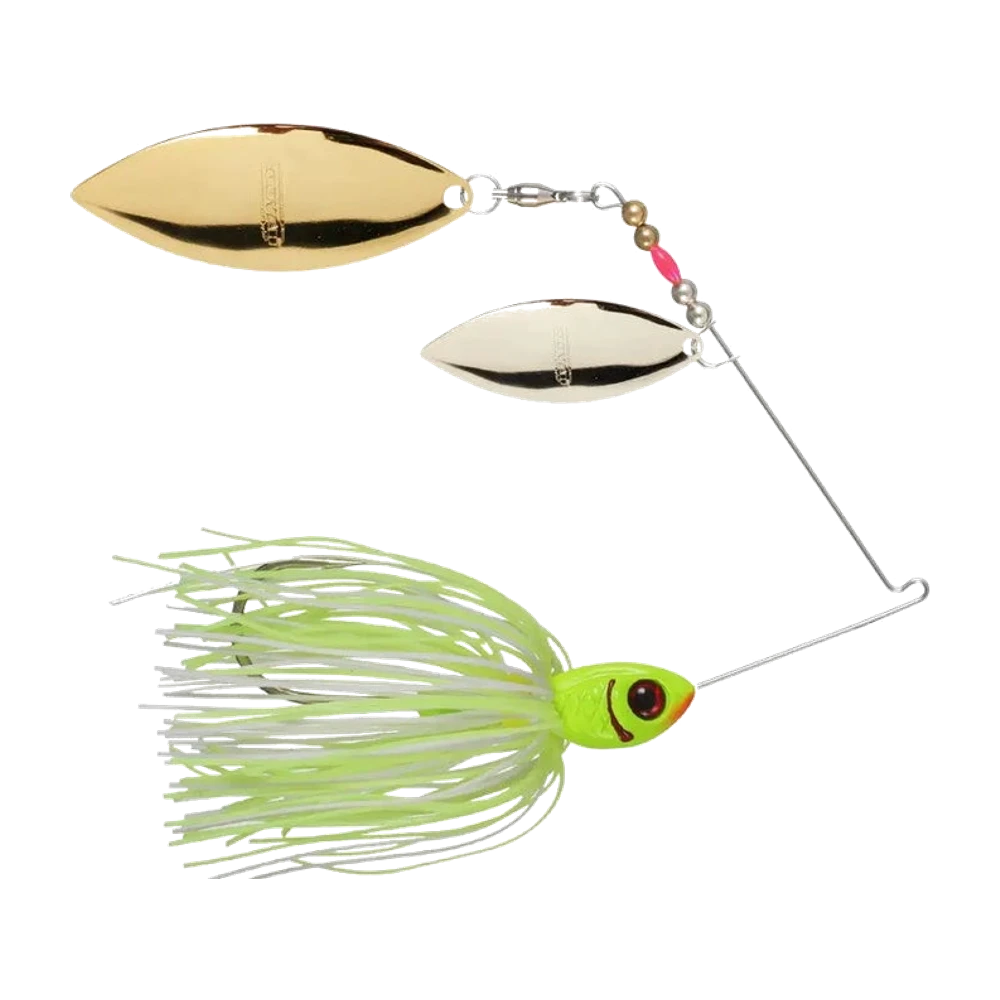
Two willow blades, and above all two metals
What sets the Booyah Blade apart is in the blade detail: one is gold, the other nickel, both plated to a grade that resists corrosion and holds its tone instead of going dull grey after three trips.
That mix isn't cosmetic. Nickel returns a clean, white light, very visible in clear water and under overcast skies. Gold returns a warmer, more diffuse light that carries better in lightly stained or tannic water. Pairing them means you aren't betting on a single condition: whatever the sun angle or the water colour, at least one of the two blades is doing useful work.
The willow shape decides everything else. Narrow and pointed, it meets little resistance, spins fast and tight, and allows quick retrieves without lifting the bait to the surface. That's the opposite of a Colorado blade, which pushes water and forces you to slow down, as on a Bizz Baits Big Thump. A double willow is for covering water, a Colorado is for signalling.
The ball-bearing swivel, and why you shouldn't do without it
The Booyah Blade's large blade runs on a ball-bearing swivel. It's the part you don't look at, and it separates a spinnerbait that starts from one that drags.
A wide willow blade needs a genuinely free pivot to engage: if the swivel binds, the blade takes two metres to spin up, and those two metres are often the ones that pass the spot. With a bearing, it turns as soon as the bait moves, including on the fall if you let it drop down a bluff edge.
Check that part as the seasons go by. A swivel gummed up with sand or salt is obvious at once: limp blade, no vibration in the rod. A rinse in fresh water fixes it most of the time.
The 0.035 in wire and tuning the bait
Booyah specifies a light 0.035 in wire, about 0.89 mm, deliberately soft to maximise the vibration the blades pass on. That choice has a direct consequence: after a big fish or a solid snag, the arm bends.
Tuning your spinnerbait in thirty seconds
A properly tuned spinnerbait has its blade exactly in the vertical plane of the hook, seen head-on. If the upper arm is offset left or right, the bait swims on its side and starts helicoptering the moment you speed up.
To correct it, hold the lure out in front of you by the head, blades up, and sight down it the way you'd sight a bicycle's handlebars. Bend the arm by hand until the two lines overlap. The Booyah Blade's thin wire gives without pliers, and that's exactly why it's thin: heavy wire would need a tool and would snap eventually.
Get into the habit of checking alignment at arm's length before you drop a spinnerbait back in the box. It takes five seconds and it saves twenty minutes of fishing a lure that spirals without you understanding why.
Three retrieves that cover 90% of situations
A straight mid-depth retrieve is the baseline: cast, let it sink two or three seconds depending on water depth, and reel at a constant speed. That's what covers the most ground per hour.
Waking means reeling fast enough for the blades to wrinkle the surface without breaking it. Very effective along weed edges at first light, when fish are high in the column.
Finally, dropping it down vertical structure exploits what most anglers forget: a spinnerbait sinking alongside a piling or a drop-off is still turning, helicopter-style. Cast tight to the cover, let it fall on a semi-tight line and watch the line. A lot of bites come during that fall, with no retrieve at all.
In Europe, the same mechanics work on pike as soon as the weed thickens. Pike take a fast double willow along a weed edge very readily. Use a wire leader then: the single hook often ends up deep in the mouth, and fluorocarbon, however heavy, is no guarantee.
The classic mistake
Fishing it too slowly, out of caution. A double willow emits almost no low-frequency vibration: what it sells the fish is flash and a silhouette going past. At low speed it has nothing left to offer. If you need to slow down, change lures rather than pace.
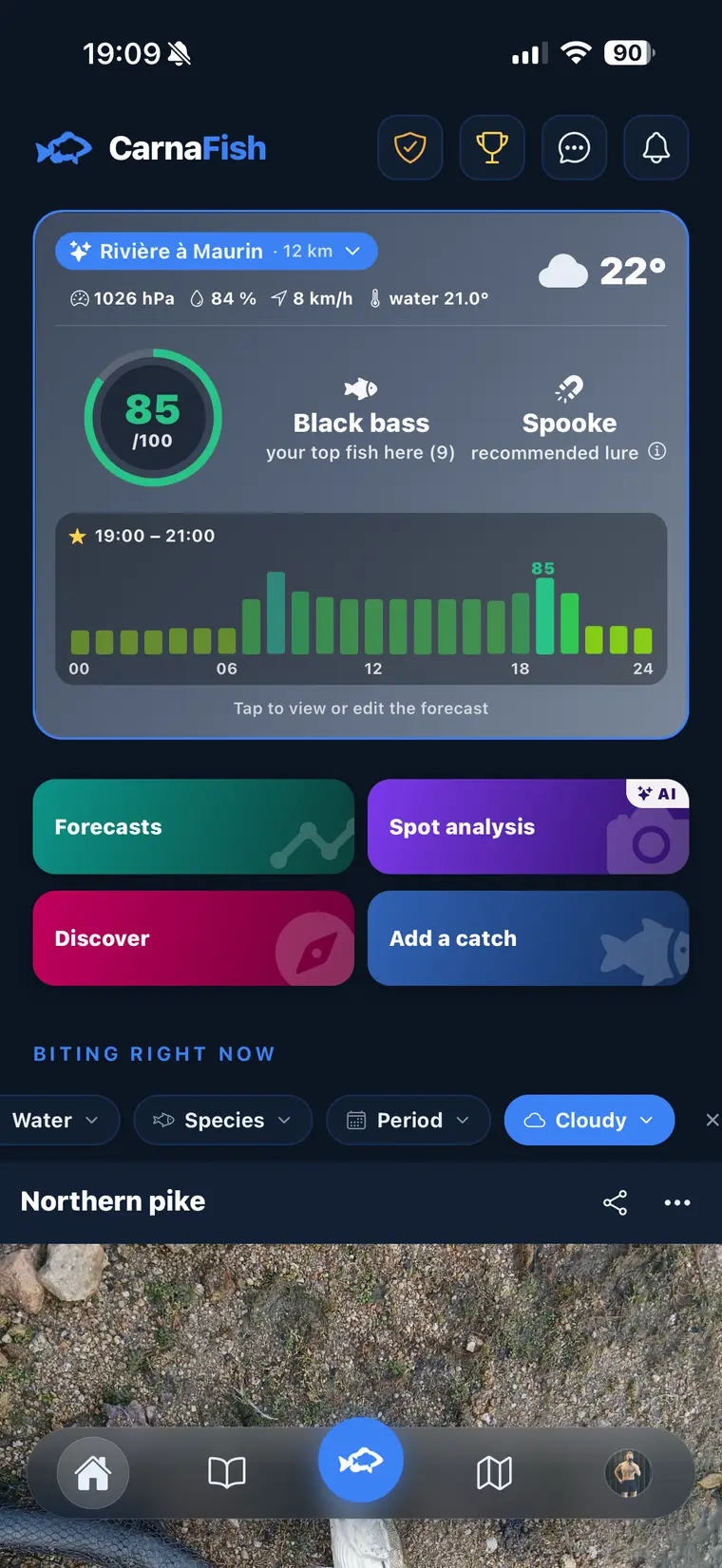
Not sure what to tie on?
Photograph your spot: CarnaFish reads the scene, cross-checks the conditions and gives you the zone, the lure and the retrieve. Free on iOS and Android.
Colour by water
- Lightly stained water: chartreuse and white, the skirt in the photo. It's the compromise that works nearly everywhere and the first to try on unknown water.
- Clear water: silver white or grey-blue, closer to a real baitfish once visibility passes a metre.
- Dark water or low light: black and blue, a clean silhouette, accepting that blade flash then matters less than contrast.
What it does, and what it doesn't
The Booyah Blade is a fast-coverage bait, not a precision one. For a more scattered flash imitating a fry ball, a Bizz Baits Fall Fry triple willow pushes further in that direction. For a more compact, discreet profile in clear water, a Booyah Covert Spinnerbait from the same catalogue is better placed. And as soon as the water colours up to the point where reflection no longer carries, switch to a Colorado blade.
Covering water fast is pointless if you're covering the wrong bank. That's exactly what CarnaFish makes easier: a photo of the spot, and the app suggests the zone to attack first and the presentation suited to the day. If pike interest you as much as bass, our guide to choosing a pike lure is a useful companion to this page.
Key takeaways
- One gold blade and one nickel blade: two qualities of flash, so a wider band of usable conditions.
- Ball-bearing swivel on the big blade: instant start-up, including on the drop.
- 0.035 in wire (about 0.89 mm): soft, lively, and above all realignable by hand in seconds.
- A speed bait: slowing down strips it of its only argument.
FAQ
Why one gold and one nickel blade?
Because the two metals don't return the same light. Nickel gives a white flash that's very visible in clear water, gold a warmer reflection that carries better in stained water. Pairing them widens the range of usable conditions.
Which weight should I pick in the range?
The manufacturer doesn't publish a detailed chart but offers several versions. Choose by target depth: lighter to fish high and fast along the bank, heavier to hold a layer below five feet.
My spinnerbait is spiralling, what now?
The arm is misaligned. Hold the lure by the head facing you and bend the wire by hand until the blade sits exactly above the hook. The 0.035 in wire tunes without tools.
Does this lure work for pike?
Yes, across Europe along weed edges a fast double willow is a solid pike bait. Use a wire leader, since the single hook often sets deep.
Should I add a soft trailer?
It isn't required on this model. A small shad lengthens the profile and slows the fall slightly, but it also costs casting distance, which is one of the bait's strengths when searching.
How fast should I retrieve it?
Medium to fast. Willow blades are made to spin quickly without lifting the bait. If conditions force you to slow right down, move to a Colorado-bladed spinnerbait.
The full bass lure guideSeason-by-season strategy: which family of lure, when, and why.Go from theory to fish
CarnaFish reads your spot from a photo and gives you the game plan: zone, lure, retrieve. Free on iOS and Android.