War Eagle Nickel Spinnerbait Double Willow: flash over thump
One lure, endless conditions. CarnaFish reads your spot from a photo so you are not just guessing.
There are spring mornings when the water is still cold but already clear, when baitfish hold at mid-depth along a reed line, and when a lure that throws light does more than any amount of vibration. That is exactly the situation the double willow spinnerbait was built for: plenty of flash, very little thump, and a retrieve that can stay fast without the lure blowing out.
Willow versus Colorado: two opposite philosophies
A spinnerbait sends two distinct signals: flash, the light thrown off by the spinning blade, and thump, the low-frequency pulse a fish picks up through its lateral line. The blade shape decides the balance between them.
A Colorado blade is wide and rounded, and it spins almost at right angles to the shaft: it pushes water, creates drag and generates a lot of vibration. That is the tool for dirty water, where fish hunt by feel rather than by sight. A willow blade is long and narrow like a willow leaf, and it spins flat along the shaft: low drag, high rotation speed, continuous bursts of light. The trade-off is that it barely vibrates at all.
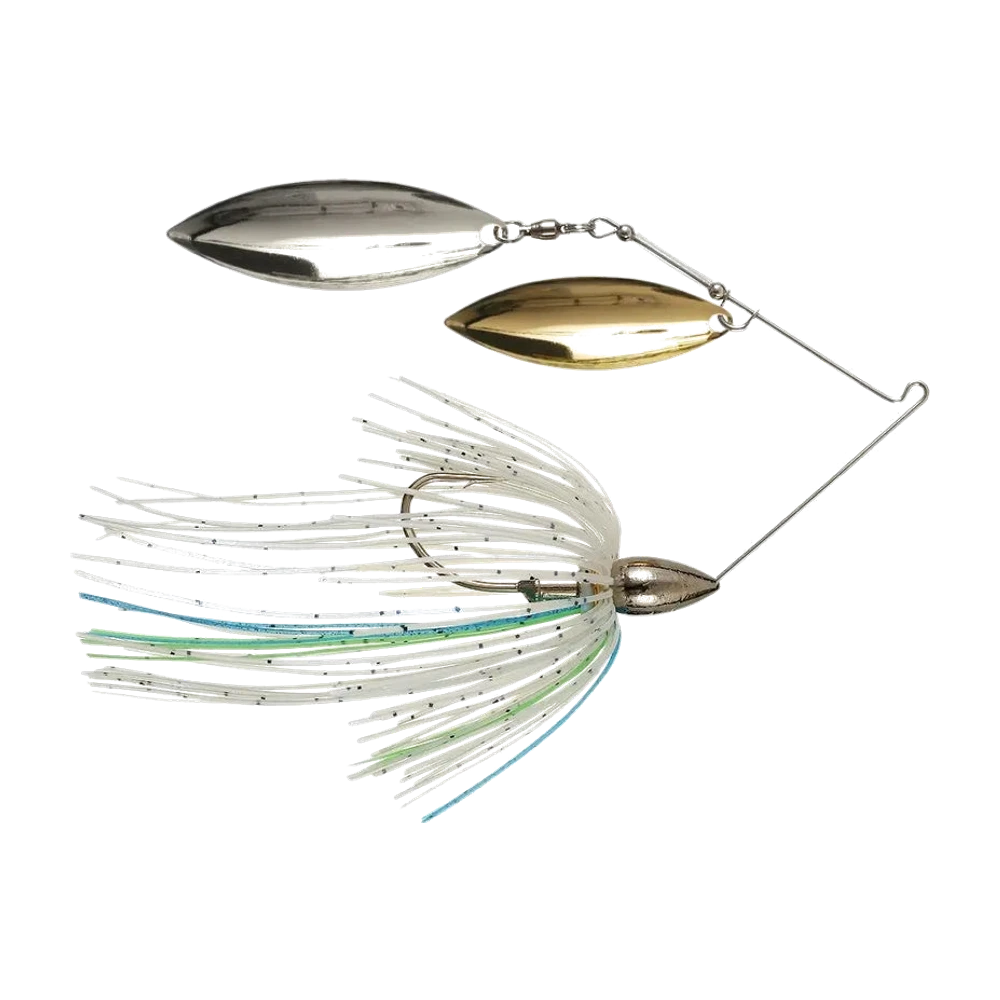
The War Eagle Nickel commits clearly to that second option, with two willow blades in tandem on a stainless wire. The sample photographed pairs a gold blade in the front position with a larger nickel blade behind it: two different tones of flash crossing each other instead of one uniform glare. It is a detail plenty of anglers underrate — varied flash often works better on wary fish than a repetitive one.
A bait that wants speed
Because willow blades create so little drag, this spinnerbait tolerates and actively asks for a brisk retrieve. Where a Colorado model rises as soon as you speed up and eventually skates out of the water, this one holds its line. That makes it a genuine search bait: you cover a breakline, a pad field or a line of docks far faster than you would with a soft plastic.
Three speeds, worth trying in this order on new water. First a fast retrieve just under the surface, blades almost brushing the film — deadly on active bass and pike. Then a medium retrieve at mid-depth, rod low, counting the lure down before you start. Finally the slow roll: a crawl where the lure scrapes bottom and bumps cover, reserved for cold water and fish sitting still.
The most useful adjustment on a spinnerbait is not made at the reel, it is made on the arm. If the lure leans over on the retrieve, bend the upper arm very slightly towards the hook shank. Three millimetres is enough to put it back upright.
The nickel head and the stainless wire
The head is polished nickel, left unpainted. That is not cost-cutting: a bare metal head keeps its shine while paint chips off against rock, and the reflection it produces extends the one coming off the blades. Visually, the whole lure becomes a light source rather than just the two blades.
The arm is heavy stainless wire, and that is what decides how long the lure lasts. Wire that is too soft keeps the shape of the last fish or the last snag, and the spinnerbait no longer tracks straight. Wire that is too stiff transmits vibration poorly. The Sampo swivel fitted between arm and blades stops line twist, which is the other classic failing of cheap spinnerbaits.
As for the business end, the maker specifies a Mustad Needlepoint single hook. A very sharp single matters here: fish hit a spinnerbait from the side, often on the move, and the point has to grab immediately.
The classic mistake: adding a trailer out of habit
The silicone skirt is tied with strands of different lengths, which gives it movement of its own on the pause and on every change of speed. The maker presents it as sufficient without a trailer, and on a fast retrieve that holds true: a swimbait hung behind it slows the lure, weighs it down and costs it part of its swimming speed.
Keep the trailer for two specific cases. The slow roll, where the extra bulk slows the descent and makes up for the willow blades' weak vibration. And fish that follow without committing: a small pale swimbait behind the skirt then gives them an extra focal point.
Not sure what to tie on?
Photograph your spot: CarnaFish reads the scene, cross-checks the conditions and gives you the zone, the lure and the retrieve. Free on iOS and Android.
It works for pike too, with one precaution
In Europe as elsewhere, the double willow spinnerbait works very well on pike along shallow margins and over weed beds, where the natural snag resistance of the arm lets it go where a treble-hooked lure would hang up. One constraint, but an absolute one: a leader. The line running to the upper arm sits right in reach of the teeth, and an average pike cuts 35/100 monofilament without noticing. Fluorocarbon of 60/100 minimum, or a short length of supple wire.
If you want more vibration for coloured water, the Bizz Baits Big Thump Single Colorado is the opposite approach. For a double willow alternative built a different way, the Booyah Blade Double Willow and the Strike King Tour Grade Spinnerbait are the two most telling comparisons.
Colours by water clarity
- Clear water: Pearl White, the black-flaked pearl skirt of the sample photographed, with its handful of blue and green strands. It suggests a school of fry without ever looking loud.
- Lightly stained water: Chartreuse White, a classic that adds a contrast point visible from a metre away without making the lure look artificial.
- Heavy cloud, dark water: Black, so the silhouette stays readable from below. The blade flash does the rest.
A spinnerbait is only worth throwing in the right place: along a margin, a breakline or a current seam, not across a featureless flat. That is exactly what CarnaFish helps with: one photo of the spot, and the AI suggests the zone and the presentation to use. To choose between the main lure families spot by spot, our guide to picking a pike lure is a good companion to this page.
What to remember
- Two willow blades mean a lot of flash and very little vibration: this is the clear-water tool, not the muddy-water one.
- It takes a fast retrieve without blowing out, which makes it an excellent search bait.
- The mixed-length skirt is designed to work without a trailer; add one only for slow rolling or for followers.
- A leader is mandatory wherever pike swim: the line runs straight into the fish's mouth.
FAQ
Which spinnerbait weight should I choose?
The maker description does not list weights, so check the packaging. As a rule, a light 7-10 g / 1/4-3/8 oz model suits shallow margins and light wind, 14 g / 1/2 oz covers most situations, and you move up to 18 or 21 g / 5/8 or 3/4 oz to fish deep or cast into the wind.
Willow or Colorado, if I only buy one?
If your water is usually clear and you fish fast, take the double willow. If you mostly fish stained water or a coloured canal, a Colorado blade gives you the vibration willow blades simply do not produce.
Should I add a swimbait behind the skirt?
Not by default. The mixed-length skirt is designed to move on its own, and a trailer slows the lure. Save it for slow rolling and for days when fish follow without biting.
My spinnerbait leans over on the retrieve, what now?
Almost always the upper arm has been bent out of plane by a snag or a big fish. Squeeze it gently back towards the hook shank, then check the swim visually along the bank before casting again.
How deep does this lure run?
Anywhere from a few dozen centimetres to about 3 m / 10 ft, depending on retrieve speed and how long you let it sink before starting. Unlike a crankbait it has no fixed running depth: you set it at the reel.
Is the spinnerbait a good lure for perch?
Yes, in the lighter weights and along margins. Perch react well to flash, but on an oversized lure they tend to follow and turn away. Stick to short skirts and moderate blade sizes if perch are the target.
The full bass lure guideSeason-by-season strategy: which family of lure, when, and why.Go from theory to fish
CarnaFish reads your spot from a photo and gives you the game plan: zone, lure, retrieve. Free on iOS and Android.