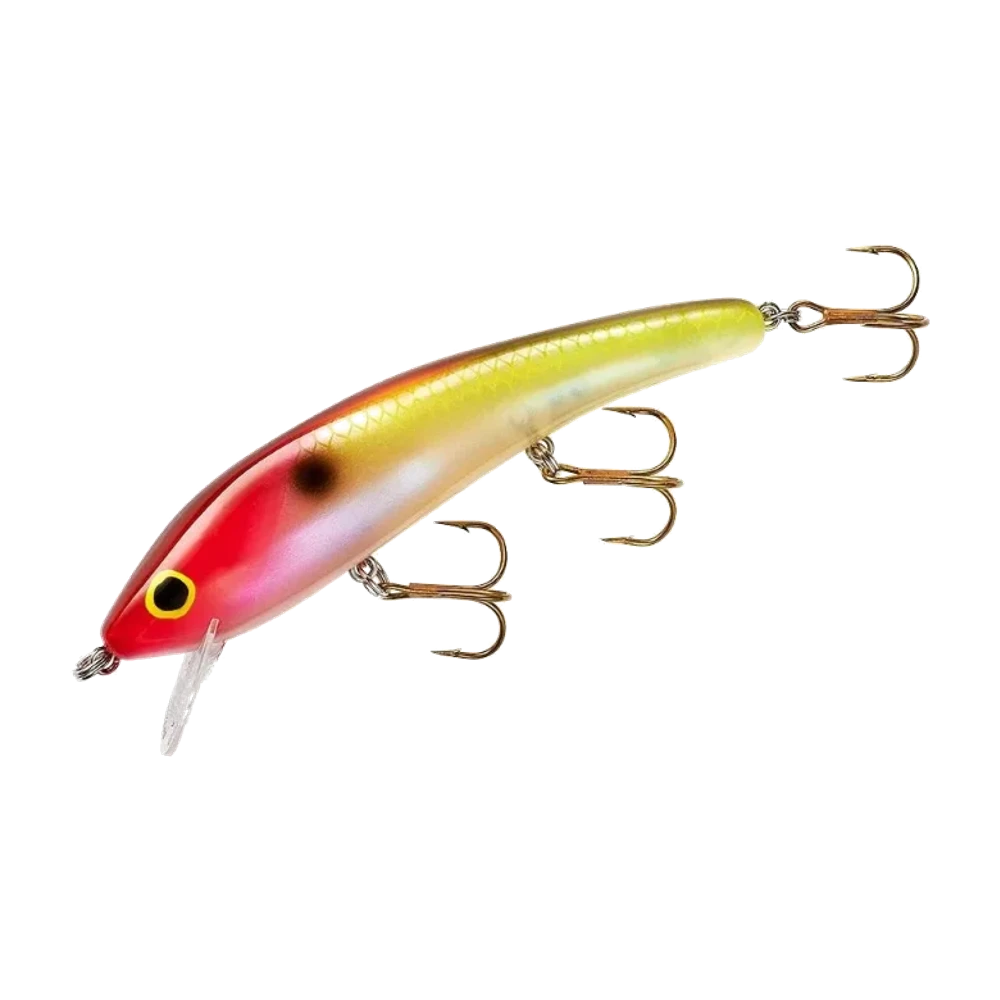
Cordell Red Fin: the V-wake, at the slowest speed you can manage
Before tying this one on, it helps to know if the spot actually calls for it. CarnaFish reads the scene from a photo.
Everyone retrieves too fast. It is the most widespread mistake in lure fishing, and a hard one to correct because winding slowly feels like doing nothing at all.
The Red Fin is the lure that forces you to admit it. Its body is long, slim and very buoyant, and its small lip only pulls it down if you speed up. Retrieved at minimum speed — just fast enough for the lure to hold its action — it keeps its back out of the water and leaves behind it a perfectly clean V-wake on calm water.
That V is the signal of a wounded baitfish on the surface, visible at twenty metres on a moonless night. On sea bass roaming at high water, or on a pike sitting at the edge of a backwater at dawn, it is one of the most triggering presentations there is. And it is exactly the one you miss when you wind at a normal pace.
A body built for minimum speed
- Extreme length-to-depth ratio. The Red Fin is very long for its height. That shape imitates slim forage — garfish, sandeel, bleak, juvenile mullet — and offers a long silhouette seen from below.
- Strong buoyancy, thin shell. The lure is hollow and light for its volume. It pops back up the instant you stop pulling, which is essential to keep the back on the surface.
- A small, shallow-angled lip. It gives just enough bite to set up a slow roll, without ever forcing the lure down. That is what makes the speed setting so touchy: a few extra turns of the handle and the lure disappears under the surface.
- Slow roll, no vibration. You feel almost nothing in the rod. That is not a fault: you control the action with your eyes, by watching the V.
The retrieve: setting speed to the centimetre
- Cast across, or slightly upstream if you are fishing current.
- Start winding very slowly and watch the lure: as long as you see no wake, you are either too slow or too fast.
- Adjust a quarter turn at a time until you get a clean V and a back breaking the surface. That is your reference setting for the session.
- Change nothing after that. No twitches, no pauses. The continuous V is the retrieve.
- If a fish follows without taking, allow yourself one variation: a full one-second stop, then pick up at the same speed. The lure barely sinks before finding its wake again.
- Set on the weight, never on the boil. Surface takes on a slow lure are often grabs from behind.
In current the maths change: the current provides the speed. Cast upstream and let the lure swing while you just keep contact; it holds its V with almost no winding from you.
| Situation | Handle speed | What you are after |
|---|---|---|
| Calm water, night | Minimum, back breaking the surface | Continuous V-wake |
| Light chop | One notch faster | Lure just under the film |
| Tidal current | Almost none, controlled swing | The current does the swimming |
| Daylight, clear water | Faster, 30 to 60 cm down | Rolling action below the surface |
On the water: if you cannot wind slowly enough, it is not your wrist, it is your reel. A high gear ratio makes minimum speed physically impossible to hold for more than thirty seconds. Change reel, or fish with the rod high and pull the lure with the rod instead of the handle.
Why it works best at night
At night, fish hunt with their lateral line and on silhouette. A lure that leaves a wake produces a regular train of waves, very easy to home in on, and its outline stands out against the sky — even without a moon, it stays lighter than the water.
A lure retrieved fast produces a shorter, more confused signal. This slow wake, by contrast, gives the fish time to move underneath and come up. That is why night takes on this kind of presentation are often heavy and slow rather than explosive.
The same reasoning holds at dawn in freshwater: a pike sitting in a lily edge hears the V long before it sees the lure.
Where it excels, where it is beside the point
It excels over rocky plateaux under one or two metres of water late in the flood, at creek mouths, and along any calm margin at night. In freshwater it works at dawn on backwaters and pond tails, on pike feeding high.
It is wrong as soon as you need depth: it will never go and find a fish sitting at three metres. It is also wrong in strong wind and a rough sea, where the wake disappears and its relatively light weight limits casting. Finally, in full sun over clear shallow water it is simply too visible: this is a low-light lure.
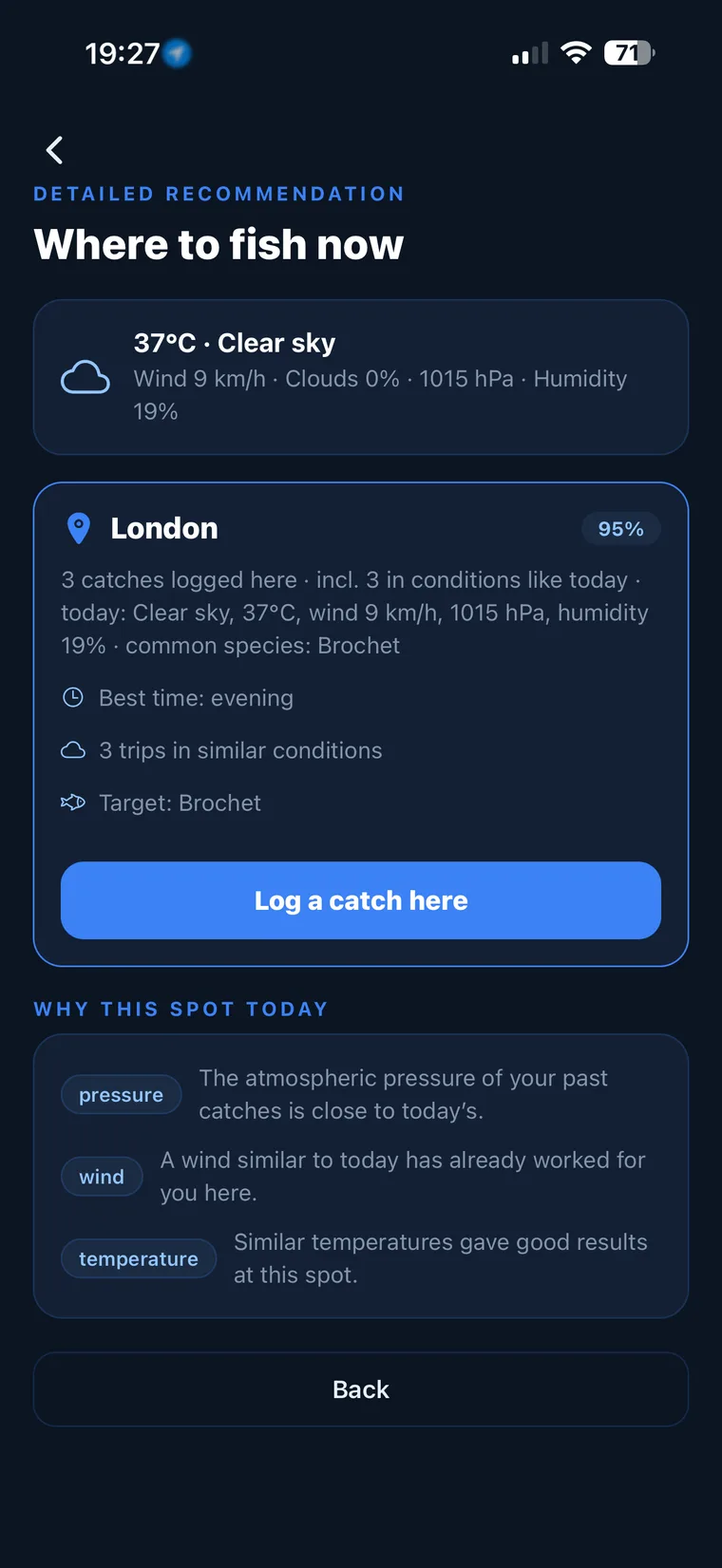
Not sure what to tie on?
Photograph your spot: CarnaFish reads the scene, cross-checks the conditions and gives you the zone, the lure and the retrieve. Free on iOS and Android.
The tackle that makes slow possible
Three things decide whether you can hold minimum speed for an hour without cheating.
The reel. A low ratio, around 5:1, recovers less line per turn and lets you wind at a comfortable cadence. With a high ratio you will inevitably end up speeding up without noticing.
The line. Fine braid for casting and contact, with a metre of 0.40 mm fluorocarbon leader. A floating braid even helps keep the lure's back on the surface.
The rod. Soft in the tip, so you do not pull the hooks on a close-range take and so you can pull the lure with the rod when the handle gets too quick.
Red Fin or a classic floating minnow
The Rapala Original Floater F11 works in the same slow register but with a shorter profile and a very light balsa body: it is more discreet, better on small rivers and trout, but it does not cast far and copes badly with a sea wind.
The Bomber Long A shares the Red Fin's slim profile but swims deeper and faster: it is the choice when you want to work the 1 to 1.5 m layer instead of the surface film.
Finally, if the fish want movement rather than a continuous trace, switch to a walking bait such as the Bomber Badonk-A-Donk: zigzag against wake, two opposite calls, and it is common for one to work when the other is refused. Our guide to sea bass lure fishing covers the tide windows that suit it. And if you are torn between wake and zigzag as you reach the spot, CarnaFish analyses a photo of the spot and gives you an answer.
Key takeaways
- Minimum speed is the setting: back breaking the surface, a clean V-wake.
- That V is a continuous wave signal, perfectly readable at night.
- No added animation: twitches break the trace.
- In current, let the current do the swimming and just keep contact.
- Pointless beyond 1 m of depth, and in a rough sea.
FAQ
How do I get the V-wake with the Red Fin?
Retrieve as slowly as you can while keeping the lure's back breaking the surface, then adjust a quarter turn of the handle at a time until you see the trace form. If the lure sinks, you are too fast; if it leaves no trace at all, you are too slow for it to swim.
Is it really a night lure?
That is where it is most effective, because the wake and the silhouette replace sight. It works in daylight too, but you then have to retrieve a little faster so it works below the surface rather than as a wake bait.
Can you fish it for pike?
Yes, especially at dawn along calm margins and pond tails. Add a 30 cm wire trace: it weights the nose slightly, which will force you to retrieve a fraction slower to keep the wake.
What size should I choose?
The small models around 11 cm cover most bank situations. The bigger sizes, being heavier, cast far further and suit windy spots and big fish better, at the cost of a slightly higher minimum speed.
Why do I miss surface takes?
Because you are striking on sight. On a slow lure, the fish often takes from behind or comes back over it. Keep winding at the same pace until you feel the weight in the rod, then set by leaning into it, without a big sweep.
Should I change the hooks?
In saltwater, go to stainless trebles of the same size from the first session and keep an eye on the nose ring. In freshwater the stock trebles are fine, but remember that a heavier hook kills the wake at minimum speed.
The full sea bass lure guideSeason-by-season strategy: which family of lure, when, and why.Go from theory to fish
CarnaFish reads your spot from a photo and gives you the game plan: zone, lure, retrieve. Free on iOS and Android.