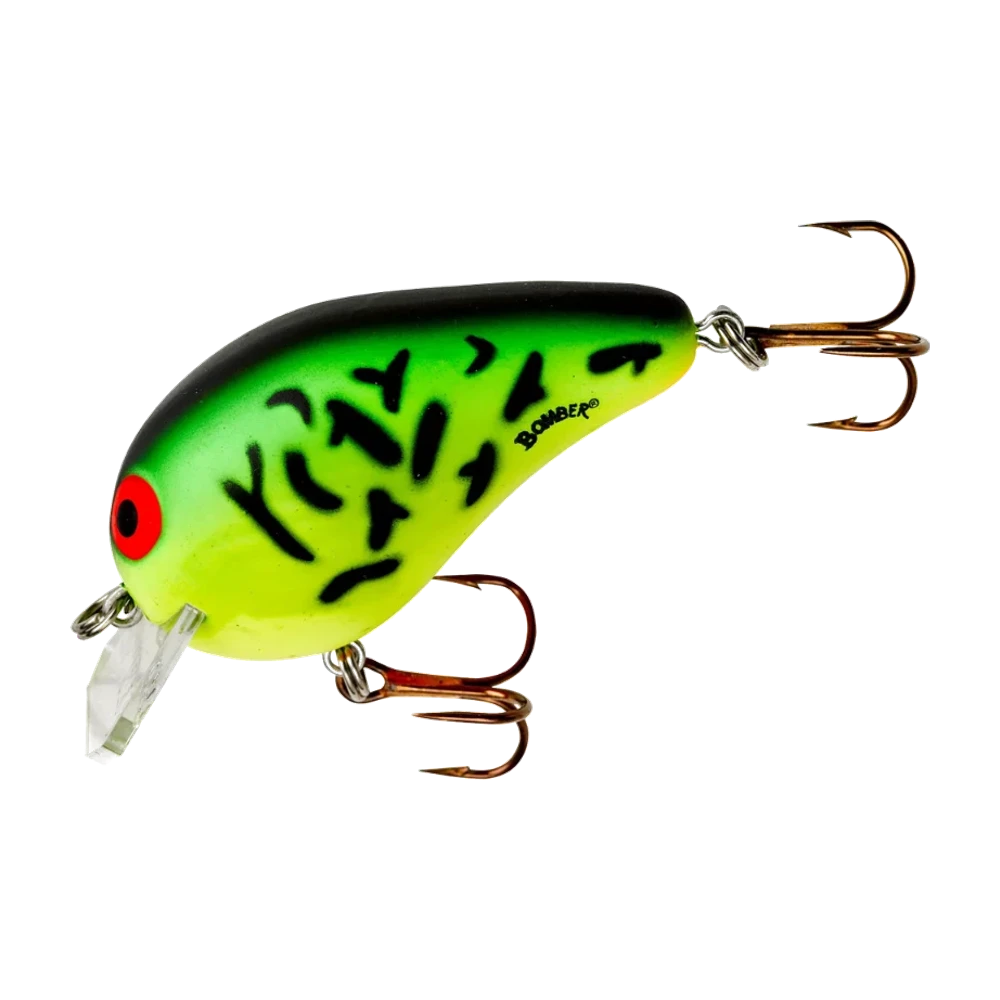
Bomber Square A: banging into timber without hanging up in it
One lure, endless conditions. CarnaFish reads your spot from a photo so you are not just guessing.
Sunken timber is the best bass spot on a water and the one everybody avoids. The reason is simple: a normal crankbait leaves its trebles in there on the third cast, and after two lures lost you move on to something else. The result is that those stumps almost never see a hard bait.
The Square A is built to go in. Not because it is magically snag-proof — there is no such thing as a snag-proof crankbait — but because its square lip makes it bounce off the obstruction instead of going around it. When the lip hits a branch, it throws the lure's nose sideways and the body kicks off at a violent angle.
That involuntary lurch is precisely what makes fish bite. The rest of this page is about causing that contact deliberately, as often as possible, without leaving your box in the branches.
Why a square lip does not behave like any other
Three mechanical differences, and they hang together.
- A very open angle of attack. The square lip sits almost vertically in the water. It presents a large surface to the flow, which limits depth but gives a wide action, slow to get going and easy to feel.
- Head-on contact rather than sliding contact. A round or trapezoidal lip slides along the obstruction and often brings the trebles onto it. A square edge hits squarely and pivots the lure a quarter turn: the hooks pass by the side.
- Marked buoyancy. As soon as you stop winding, the Square A rises quickly. That is your escape button: when it is wedged under a branch, giving slack lifts the lure up along the obstruction instead of driving it in.
Reading a stump before you cast at it
This is the step most anglers skip, and it is the one that makes the difference between three bites and none.
- Find the submerged part, not the visible part. A leaning stump has its bulk underwater on the side it leans towards.
- Choose your angle so the lure crosses the structure lengthways, not across it. A parallel pass stays in contact longer.
- Cast past the obstruction, two or three metres beyond, so the lure is already at depth and already working when it arrives.
- Wind at medium speed until the first contact.
- On contact, give half a second — stop the handle, let the lure float up a few centimetres — then resume. That pause is what lifts it clear and offers the fish a slowed-down target.
- Chain the contacts until you are out of the structure. Do not try to finish the retrieve tidily: the useful zone is two metres long.
On the water: on a stump, never cast twice from the same angle. The Square A does not trigger because it passes close to the fish, but because it deflects in front of it. Move three paces between casts and you completely change the point where it kicks.
Adjusting depth without changing lure
The Square A does not run deep — that is deliberate. But you have three levers to adjust 30 to 60 cm without changing anything else.
| Lever | Effect on depth | When to use it |
|---|---|---|
| 0.25 mm line instead of 0.35 mm | +30 to 40 cm | Deep timber, late summer |
| Rod held high through the retrieve | −30 to 50 cm | Weed near the surface, shallow bars |
| Very long cast | +20 cm over the useful phase | Wide expanse of branches |
Be careful with line all the same: in timber, dropping below 0.30 mm means accepting a break-off on the first decent fish that gets into the branches. Fluorocarbon in 0.30 to 0.35 mm is the right strength-to-abrasion compromise.
The tackle that goes with it
A squarebill pulls hard and works in contact: the gear is not a side issue here.
The rod. Moderate or moderate-fast action, medium power. A stiff blank transmits contact better but pulls the trebles when a bass hits mid-deflection, at a moment when you are not under tension. A soft blank absorbs the shock and keeps the hooks in place.
The reel. Moderate ratio, around 6:1. With a very fast ratio you will tend to skim over the obstruction instead of staying in it, and you will lack sensitivity at the moment of impact.
The hookset. Never strike with a big upward sweep: you risk driving the fish into the stump. Strike sideways, rod low, and pull the fish straight out of the structure. The first few seconds decide the outcome.
Not sure what to tie on?
Photograph your spot: CarnaFish reads the scene, cross-checks the conditions and gives you the zone, the lure and the retrieve. Free on iOS and Android.
Its window — and where it has no business
It excels in everything hard and shallow: stumps, fallen trees, jetty piles, rip-rap, boulders. It is also an excellent stained-water lure, where its wide action and heavy water displacement compensate for poor visibility. Spring and early autumn are its natural seasons, when bass are glued to structure in under two metres.
It is wrong as soon as depth exceeds 1.5 to 2 m: it does not go down, full stop. It is equally wrong in dense weed, where its lip collects vegetation instead of pushing it aside — there, a Texas-rigged soft plastic or a frog will get through. Finally, in very clear, calm water on educated fish, its wide noisy action is usually too much for the situation.
Square A or KVD Squarebill
The Strike King KVD Squarebill plays the same water but not with the same gesture: it has a wider body, more buoyancy and a more explosive deflection — it bounces further from the obstruction. The Square A has a more compact profile and a shorter kick, which keeps it in the contact zone longer. On an isolated stump, the KVD's explosion is more convincing; in a tangle of branches where you want to chain ten contacts over two metres, the Square A stays at work longer.
If you want the same search speed but in open water and deeper, take the Bomber Model A instead, which is the same mindset with a lip built to dive. And for the same approach in an even more buoyant body, the Cordell Big O rises faster on the stop.
Our beginner's guide to bass fishing explains how to rank the structures on a water. And if you are unsure which angle to attack a fallen tree from when you reach the bank, CarnaFish analyses a photo of the spot and answers.
Key takeaways
- The square lip bounces the lure off the obstruction: the trebles pass by the side.
- Contact is not an accident, it is the retrieve. Make it happen.
- Half a second of slack after each impact lifts the lure clear and triggers bites.
- Fluorocarbon 0.30-0.35 mm minimum in timber: abrasion decides.
- Pointless beyond 1.5 to 2 m and in dense weed.
FAQ
How deep does the Bomber Square A run?
Between 0.8 and 1.5 m depending on line and rod position. It is a shallow lure by design: trying to force it deeper means you have picked the wrong tool.
Does a squarebill really hang up less?
Less, but not never. The square lip hits the obstruction and pivots the lure, which swings the trebles clear. In fine tangled branches you will still hang up: the lure's buoyancy is then your best way of freeing it.
What do I do when the lure is stuck in a stump?
Let the line go completely slack and wait two or three seconds. The Square A floats and often comes back up along the branch on its own. If that is not enough, a sharp pull from the opposite side to your retrieve direction frequently frees it.
Should I change the stock hooks?
In timber, yes, for trebles of the same size but heavier wire. You lose a little sharpness but you avoid opened hooks when a fish drags you into the branches.
Which colour in stained water?
A dark back over a chartreuse belly, or a brown-orange craw pattern in spring. In dirty water it is contrast and vibration that work, not the subtlety of the finish.
Can you fish it in winter?
Hardly. The wide action and violent contact are built for a reactive fish glued to shallow structure. Below 10 °C, bass drop deeper and a suspending jerkbait or a slow soft plastic will be more effective.
The full bass lure guideSeason-by-season strategy: which family of lure, when, and why.Go from theory to fish
CarnaFish reads your spot from a photo and gives you the game plan: zone, lure, retrieve. Free on iOS and Android.