Bomber Model A: the tight-wobbling crankbait you fish on speed
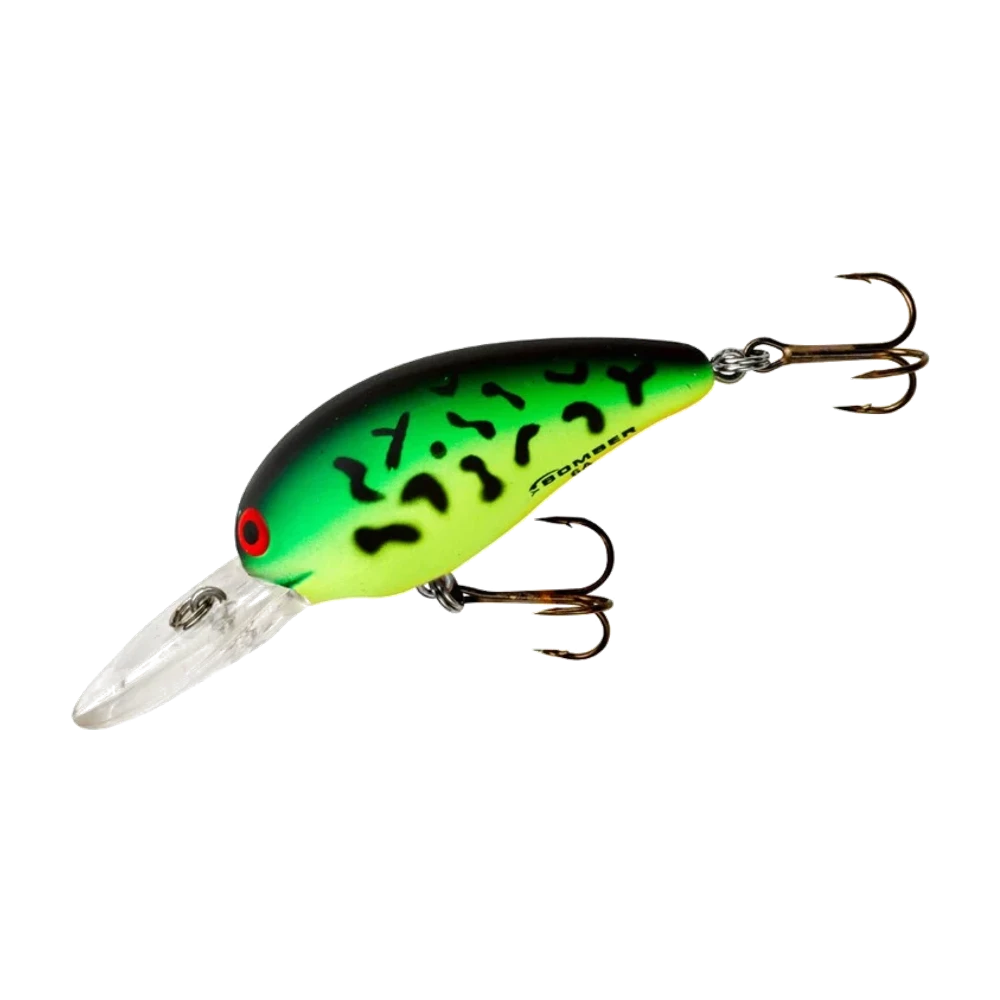
This lure shines under specific conditions. CarnaFish tells you in 10 seconds if today is one of them.
You turn up at water you do not know, with two hours of daylight left and three hectares to cover. The problem is not working out which lure the fish prefer: it is working out where they are. Until you have found the zone, the perfect lure choice is worth nothing.
That is exactly the Model A's window. This is not a crankbait for picking a spot apart, it is a sweeping tool: cast, wind fast, move a few metres, do it again. Its technical quirk — a very tight action that does not fall apart when you speed up — lets you wind it far faster than most crankbaits without it blowing out.
Once the first fish has hit, you know where to slow down. And then you can bring out the rest of the box.
Trapezoidal lip, high-frequency action
The Model A's lip is neither round nor square: it is trapezoidal, wider at the tie point and cut straight at the end. Combined with a fairly slim, tall body, it produces a very recognisable action.
- Low amplitude, high frequency. The lure does not waddle widely from side to side, it vibrates tight. Through the rod you feel a fine continuous buzz rather than dull thumps.
- Stability at speed. This is what sets it apart. Many round-bodied crankbaits blow out and corkscrew upwards when you wind fast. The Model A holds its track well beyond "normal" speed.
- Fast diving angle. It reaches depth in three or four handle turns, which counts when your casts are short and you want to be fishing the right layer straight away.
That tight signature also explains its limits: in very cold water or on apathetic fish, a wide slow action usually goes down better. The Model A is a lure for reactive fish.
The retrieve: speed as the main variable
There is no complicated twitching to learn. What you set is the handle rhythm.
- Cast long, beyond the zone you want to fish, so the lure is already at depth when it gets there.
- Three or four fast turns to make it dive, then settle into your cruising speed.
- Wind continuously, rod pointed down and slightly to the side, without jerks.
- Put in a speed burst every six to eight seconds: half a handle turn faster, then back to the rhythm. That brief acceleration is what converts followers.
- Fan out from the same spot, only three or four casts, then move.
Setting speed by temperature:
| Water | Handle rhythm | Goal |
|---|---|---|
| Above 20 °C | Fast to very fast | Trigger the reflex, cover the maximum |
| 14 to 20 °C | Medium to fast | Reference rhythm, the most versatile |
| 10 to 14 °C | Medium, with one-second stops | Give them time to follow |
| Below 10 °C | Switch to another lure | The tight action loses its point |
On the water: when you feel the vibration going irregular through the rod, that is not the bottom — it means you have gone past the lure's speed limit. Remember that rhythm: the speed just below blow-out is almost always the one that produces the most bites on active fish.
Choosing the size by layer
The Model A comes in several sizes, and that is the only real depth parameter. There is no "slow" or "fast" version: there is one size per layer.
| Target depth | Size to pick | Typical situation |
|---|---|---|
| 1 to 1.8 m | The smallest | Margins, weedy flats, perch |
| 1.8 to 2.7 m | Middle size | Gentle drop-offs, gravel bars |
| 2.7 to 3.5 m | The biggest | Slopes, channel edges, late autumn |
Two secondary levers shift those figures by 30 to 50 cm: line diameter (0.25 mm fluorocarbon easily gains half a metre over 0.35 mm) and cast length (the longer the cast, the longer the phase spent running at maximum depth).
Where it makes the difference, and where it is off the mark
It excels over open water with an even bottom: flats, gravel bars, clean margins, low weed. Anywhere you can wind fast and straight without hanging up. It is also very good on shoals of active perch spotted on the surface or on the sounder: its tight vibration imitates a small bait fish fleeing.
It is wrong in dead timber, stumps and branches: its thin lip does not deflect like a square lip and it hangs up. It is equally wrong in cold water, where its high frequency becomes an aggressive signal fish will not follow. Finally, over soft silt it bogs down and loses its action.
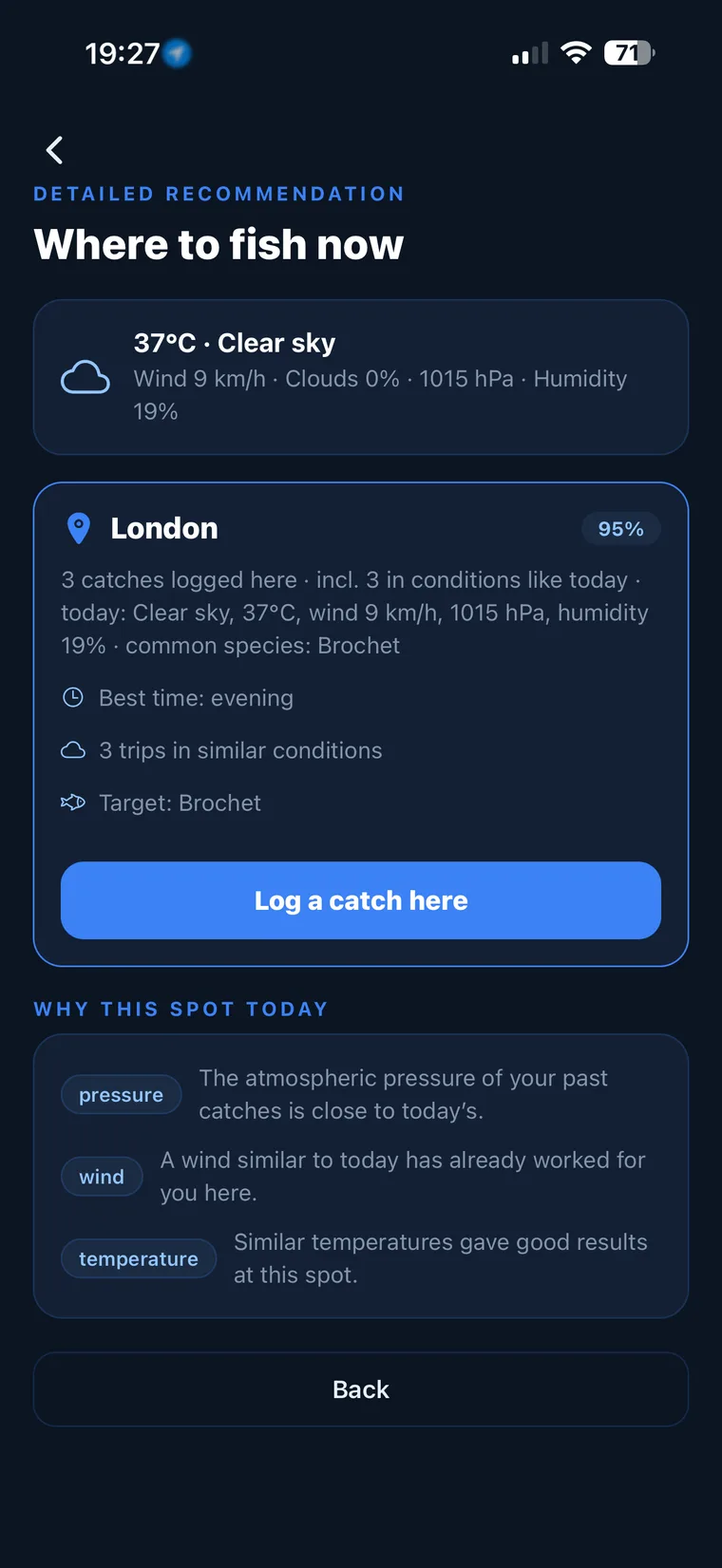
Not sure what to tie on?
Photograph your spot: CarnaFish reads the scene, cross-checks the conditions and gives you the zone, the lure and the retrieve. Free on iOS and Android.
Colours
- Clear water, visible bait fish: bleak and roach imitations, silver flanks, green or blue back.
- Stained water or gravel bottom: craw tones, brown-orange, dark red. That is where the Model A does its best work in spring.
- Low cloud and murky water: black back over a chartreuse flank, for the silhouette more than the colour.
Model A or a round-bodied crankbait
Against a chunkier, wide-wobbling crankbait like the Bomber Fat Free Shad, the Model A loses raw signal but gains finesse and speed tolerance: the Fat Free displaces more water and carries further, the Model A gets past wary fish better and comes back faster.
Against a deep crankbait like the Norman Deep Little N, the difference is first of all a difference of job: the Norman is built to reach a precise layer and hold it a long time, the Model A to sweep the widest possible zone in the fewest casts.
And if you want the same search speed but in among stumps, the Bomber Square A is the one to take — same brand, same philosophy, with a lip built to deflect. Our beginner's guide to bass fishing covers how to chain these search phases together. And if you are unsure which layer to attack when you arrive, CarnaFish analyses a photo of the spot and answers.
Key takeaways
- Tight, high-frequency action: little amplitude, plenty of vibration.
- It holds its track at speeds where most crankbaits blow out.
- The speed just below blow-out is the reference setting.
- Model size sets the depth: there is no other main adjustment.
- Avoid it in dead timber and in water below 10 °C.
FAQ
How deep does the Bomber Model A run?
Between 1.2 and 3.5 m depending on the size you pick. The small models stay around 1 to 1.8 m, the biggest reach 3 m and a little beyond with fine line and a long cast.
Can you wind it very fast without it blowing out?
Yes, that is its main quality. Its tight action stays stable well beyond a crankbait's usual speed. You feel the limit through the rod: as soon as the vibration goes irregular, back off a notch.
Which rod should I use with this crankbait?
A moderate or moderate-fast action rod. Too stiff a rod pulls the trebles out on takes at full speed, whereas a soft blank absorbs head shakes.
Fluorocarbon or braid for the Model A?
Fluorocarbon in 0.25 to 0.30 mm in the vast majority of cases: it sinks slightly, helps the lure hold its depth and cushions the hookset. Braid is only justified for very long casts in stained water.
Is the Model A any good for perch?
Very good, in the small sizes. On a shoal of active perch, its tight vibration imitates a fleeing fry and produces bites in runs. Drop your line diameter and lighten the trebles.
Why do my bites stop after a few fish on one spot?
Because the Model A is a search lure: it takes the most reactive fish in a zone, and then the zone goes quiet. That is the signal to either move, or slow down with a more discreet lure in the same place.
The full bass lure guideSeason-by-season strategy: which family of lure, when, and why.Go from theory to fish
CarnaFish reads your spot from a photo and gives you the game plan: zone, lure, retrieve. Free on iOS and Android.