Booyah Poppin Pad Crasher: the frog that chugs inside the pads
The right lure in the wrong spot still catches nothing. CarnaFish spots the zone that works, from a single photo.
A standard frog slides over a mat of lily pads without making much noise, and most of the time that's exactly right. But the day the wind puts a four-inch chop across the zone, or when you pull up on a weedy bank where the fish have already seen three frogs go past this morning, silence turns into a handicap. The lure has to announce itself some other way: louder, for longer, without leaving the square metre you're working.
What the cupped mouth actually changes
The Poppin Pad Crasher keeps the outline of the original Booyah Pad Crasher but swaps the pointed nose for a cupped, scooped mouth. The difference isn't in casting distance or in how it crosses cover: it's in the volume of water moved. On every sharp pull, the cup grabs water, shoves it forward and releases it in an audible spray, with that deep chug you get from wide-mouthed poppers.
That mouth has a knock-on effect few anglers anticipate: it lets you fish the bait on the spot. Where a pointed-nose frog travels 20 to 30 cm / 8 to 12 in on every rod snap, the Poppin Pad Crasher barely moves if you don't take up slack between pops. You can therefore work a dinner-plate-sized hole in the pads for ten full seconds, which is exactly what a hesitant, holding fish needs.
The manufacturer makes a second point: the frog moves enough water to work in open water too, like a conventional popper. That use is worth remembering along a reed edge or over a clean shallow flat, where you keep the benefit of a weedless body without needing cover to cross.
Two sizes, two distinct jobs
The manufacturer's table lists a Jr. at 2 in / 0.38 oz, roughly 5 cm and 11 g, and a standard size at 2-1/2 in / 0.55 oz, roughly 6.4 cm and 15.5 g. Both are classed as topwater.
The standard is the one that does the work in the slop: the weight carries, punches through wind and lets you skip a low cast under an overhanging branch. In exchange it demands a genuinely heavy outfit.
The Jr. is not a "beginner's" version. It earns its place when fish refuse the bigger profile: late summer on pressured water, clear conditions, average-sized fish that follow without committing. Eleven grams for 5 cm is still dense, so it casts properly — which is rarely true of small frogs.
Land the frog on a pad rather than in the water, let it sit for three seconds, then slide it into the hole with a small rod snap. The sound of it dropping off the leaf, followed by a pop, triggers far more bites than the same lure landing straight in the water.
Working it: rhythm matters more than force
In heavy cover
Work in bursts of two or three sharp pops, then stop everything for three to five seconds. The pause is when the bass comes up. The most common mistake is chaining rod snaps without ever leaving the lure alone: the fish moves, but never gets to close the deal.
Always keep a little slack between pops. A tight line transmits the pull straight into the frog's body and stops it pivoting, whereas slack line lets it settle sideways after each pop — a small detail that makes the whole presentation far livelier.
In open water
Here, switch to walking the dog: shorter, closer-spaced rod taps from a loose wrist, and the frog zigzags while pushing a little water with every move. That's the presentation for clean banks and evening flats. It pairs well with a prop bait like the River2Sea Whopper Plopper 130 or a hard popper, neither of which will cross vegetation. And if you want a hollow-body frog with a more conventional nose, no cupped mouth, the SPRO Bronzeye Frog covers the other half of the job.
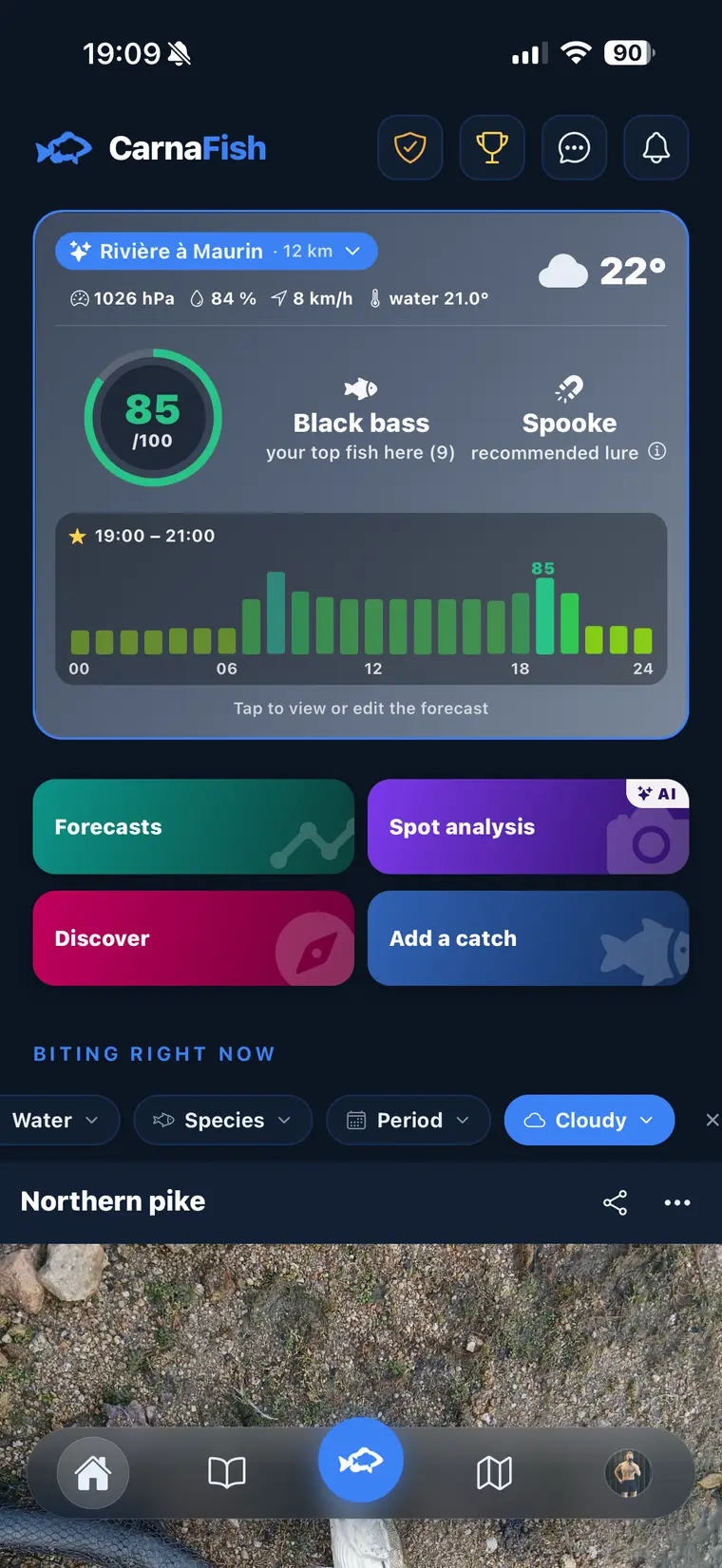
Not sure what to tie on?
Photograph your spot: CarnaFish reads the scene, cross-checks the conditions and gives you the zone, the lure and the retrieve. Free on iOS and Android.
The real issue: converting the bites
The feature the manufacturer leans on is the thin, soft body that collapses easily, hence a better strike-to-hookup ratio. That's genuine, and it's the whole battle with this family: a frog that's too stiff means the fish closes down on hard plastic and the double hook's points never reach the jaw.
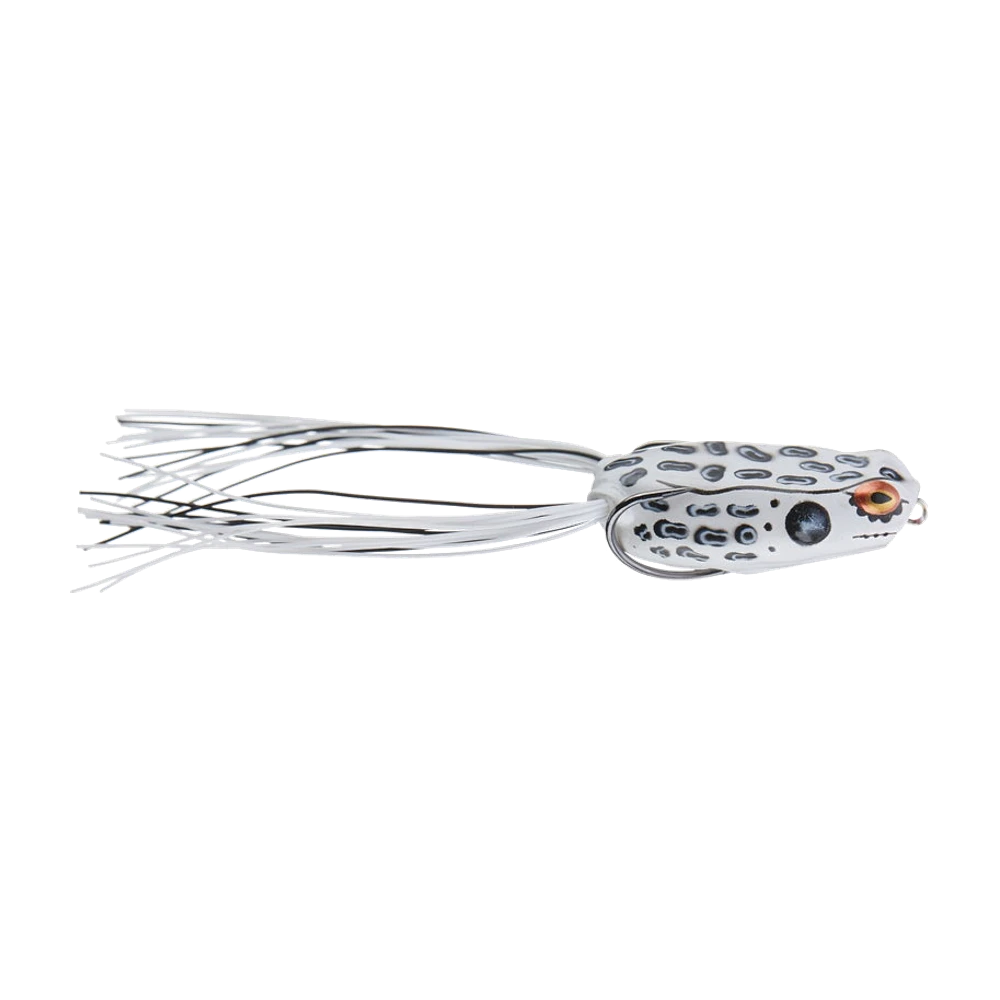
But tackle matters as much as the lure. In the photo the double hook is fitted with its points laid flat along the back, tight to the body. To make those points come through you need:
- 50 lb braid at minimum, with no fluorocarbon leader — stretch kills the hookset at distance;
- a powerful rod with a tip fast enough not to cushion the strike;
- and above all a delayed hookset. You see the blow-up, you do nothing. You wait until you feel the fish's weight in the line, then sweep low and wide. Setting on the sound pulls the lure out of the mouth nine times out of ten.
The classic mistake
Fishing a frog on a general-purpose bass setup rigged with fluorocarbon. It works at five metres and stops working at twenty. That's the number one reason behind the "bites that never stick" reported on this type of lure, well ahead of the lure's own quality.
Remember to drain the body as well: a frog that has caught fish fills with water and loses buoyancy. A squeeze between casts is enough.
Colors by light
- Clear water, thin cloud: the white-and-grey Leopard in the photo, subtle from below and easy to track by eye from the bank.
- Full sun or fishing into the light: a dark pattern, black or brown. The fish sees the frog as a silhouette against the sky, so only the outline matters — the back color is irrelevant in that case.
- Stained water, murky margins: chartreuse or a bright green back, which keeps usable contrast when the surface film is loaded.
Knowing where to drop a frog matters more than which model you pick: you have to find the right bank, the right weed density and the right time window. That's what CarnaFish is built for — photograph the water and the AI suggests the zone and the presentation that fit the conditions. For the groundwork on fishing bass along cover, our beginner's guide to bass fishing covers tackle and reading spots.
The short version
- The cupped mouth moves water and lets you work one spot, where a pointed-nose frog travels on every snap.
- Two sizes, both listed as topwater: roughly 5 cm / 11 g in Jr. and 6.4 cm / 15.5 g in standard.
- Soft collapsing body: a good hookup ratio depends as much on 50 lb braid and a delayed hookset as on the lure.
- It also works in open water, walked like a dog, along a clean bank or over a flat.
FAQ
How does it differ from the standard Pad Crasher?
The mouth. The Poppin version trades the pointed nose for a cup that shoves a lot of water and produces a deep chug. The trade-off is that it travels less on each pull, which helps when working one precise hole and hurts when covering a large area quickly.
Which size should I buy first?
The standard, around 6.4 cm / 15.5 g. It casts far, punches through wind and matches the forage size an active bass is hunting along cover. Keep the Jr. for tough days in clear water or on heavily fished lakes.
Do I really need braid?
Yes, and with no fluorocarbon leader. The double hook's points sit flat against the body, and you need a stretch-free connection to drive them home at distance. That's the single factor separating a lost fish from a landed one.
What's the correct hookset?
Don't set on the sound. Let the fish close its mouth, wait until you feel the weight in the line, then sweep low and wide to the side. A reflex set at the moment of the blow-up simply yanks the lure clear of the jaw.
Can it be fished outside the pads?
Absolutely. The manufacturer also presents it as a popper usable in open water, and that's a real second string: along a reed line or over a clean flat, the weedless body stays an advantage even with no cover to cross.
Does it work on pike in Europe?
Yes, along weedy margins and lily mats where pike hunt in summer. Plan for a strong leader, and bear in mind that a pike's bony jaw makes hooking harder than a bass's: the delayed hookset becomes even more decisive.
The full bass lure guideSeason-by-season strategy: which family of lure, when, and why.Go from theory to fish
CarnaFish reads your spot from a photo and gives you the game plan: zone, lure, retrieve. Free on iOS and Android.