SPRO Dean Rojas Bronzeye Poppin' Frog 60: the frog that spits loud
One lure, endless conditions. CarnaFish reads your spot from a photo so you are not just guessing.
Some mornings the pad field is so thick that noise is the only weapon you have left. The fish is under there, it can see nothing, and a frog that slides along in silence passes half a metre from its nose without ever registering. That is what the Bronzeye Poppin' Frog 60 is for: the same hollow body as the rest of the series, but with a cupped face that cracks on every pull.
A cupped face, and what it actually buys you
SPRO presents this frog, part of the Dean Rojas signature series, as designed to draw bass out of the thickest cover with its loud popping sound. That is a manufacturer claim, and it does describe the difference in use: where a smooth frog leaves nothing but a wake, this one throws a sheet of water ahead of itself on every rod stroke.
The noise is not a gimmick. A bass sitting under a mat works largely on hearing and lateral line, and a sharp pop travels under the vegetation where a silhouette simply cannot be seen. But there is a cost: a loud frog works less well on a wary fish in clear, open water. Keep the popping version for thick cover and stained water, and go back to a smooth frog like the SPRO Bronzeye Frog the moment the water opens up — SPRO itself presents the two as counterparts.
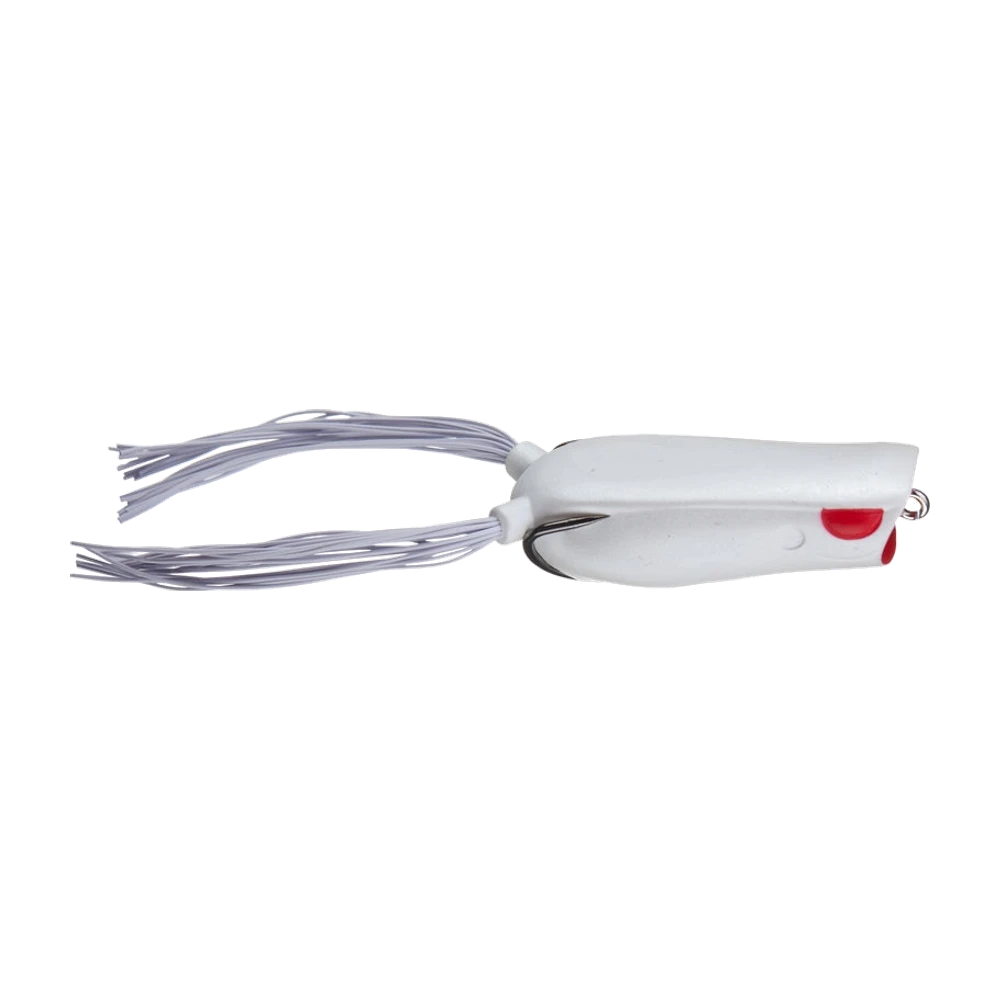
In the product photo the model is all white, with a red patch on each side of the head, a small unpainted raised eye, a metal ring at the tip of the nose and a clearly cupped front face. The source does not name this color.
Three retrieves, one lure
SPRO lists three ways to work it: walk-the-dog, pop it, chug it. They do not answer the same situations.
The hard pop is the obvious one: rod tip down, sharp ten-centimetre pulls, two or three in a row, then a two- to four-second pause. That is the retrieve for a hole in the vegetation or the edge of a mat.
The chug, longer and softer, moves the lure by pushing a bulge of water without really cracking. It suits very calm water and fish that come up without committing: less aggressive, more continuous.
Walking the dog needs softer pulls and simultaneous slack recovery; the cupped face gets in the way of the glide compared with a smooth frog, so the zigzag is shorter and tighter. Useful for sweeping a bank without making noise the whole way along it.
What you are allowed to cut
The description states that the live rubber legs can be cut down to further manipulate the frog's action. That is a genuine tuning lever, and badly underused. Long strands slow the lure, lengthen the pause and give a broad silhouette at rest: ideal on sluggish fish. Short strands, trimmed to two or three centimetres, free the body, tighten the zigzag and speed everything up. In the photo the two bundles come out of side collars and reach well past the body, which is factory length.
Cut at an angle and in small steps, never all at once: a trimmed bundle does not grow back.
Before you shorten anything, just pull three or four strands out of each bundle. You keep the broad silhouette on the pause while reducing drag, and that is often the right compromise on water where fish come up without taking.
Specs and hooks: reading the table
The table in the source is fuller than on most lures: four columns, Length, Weight, Class and Hook, and a single row under the heading Pop Frog. It gives 2 3/8 in and 1/2 oz, so about 6 cm and 14.2 g, consistent with the 60 in the name. The Hook column reads Gamakatsu 3/0 EWG: a hook size and nothing else, with no millimetres to extract from it.
The Class column reads Surface. That is a usage category, not a measured buoyancy: nowhere does SPRO state this model is rated floating. A hollow body full of air stays on top until it fills, but I would rather give you the exact reading of the table.
Two further claims deserve to be quoted as what they are, manufacturer statements: the frog is said to cast like a rocket, and to be weighted to land upright every time. The second is the one that matters in practice — a frog that lands on its side has to be recast, and in mat fishing every wasted cast costs time and noise.
Tackle and the hookset
Nothing specific to this frog, but nothing negotiable either. A powerful casting rod from 1.95 to 2.15 m, stiff enough to lift the lure out of a mat. Braid in the 50 to 65 lb class tied straight to the ring: no fluorocarbon leader, no snap. A high ratio reel.
The hookset follows the rule that governs every frog: you wait. The pop and the explosion of the strike push you to set instantly, and that is the mistake behind most of the fish you lose. Count one second, feel the weight, then set to the side without slacking off.
The mistake everyone makes early on
Popping too fast and for too long. A popping frog is not a fast search bait: every burst of two or three pops has to be followed by a real pause, during which the rubber strands keep moving. String them together with no pause and you make noise but never give the fish time to decide. Over a mat, the pause is the retrieve.
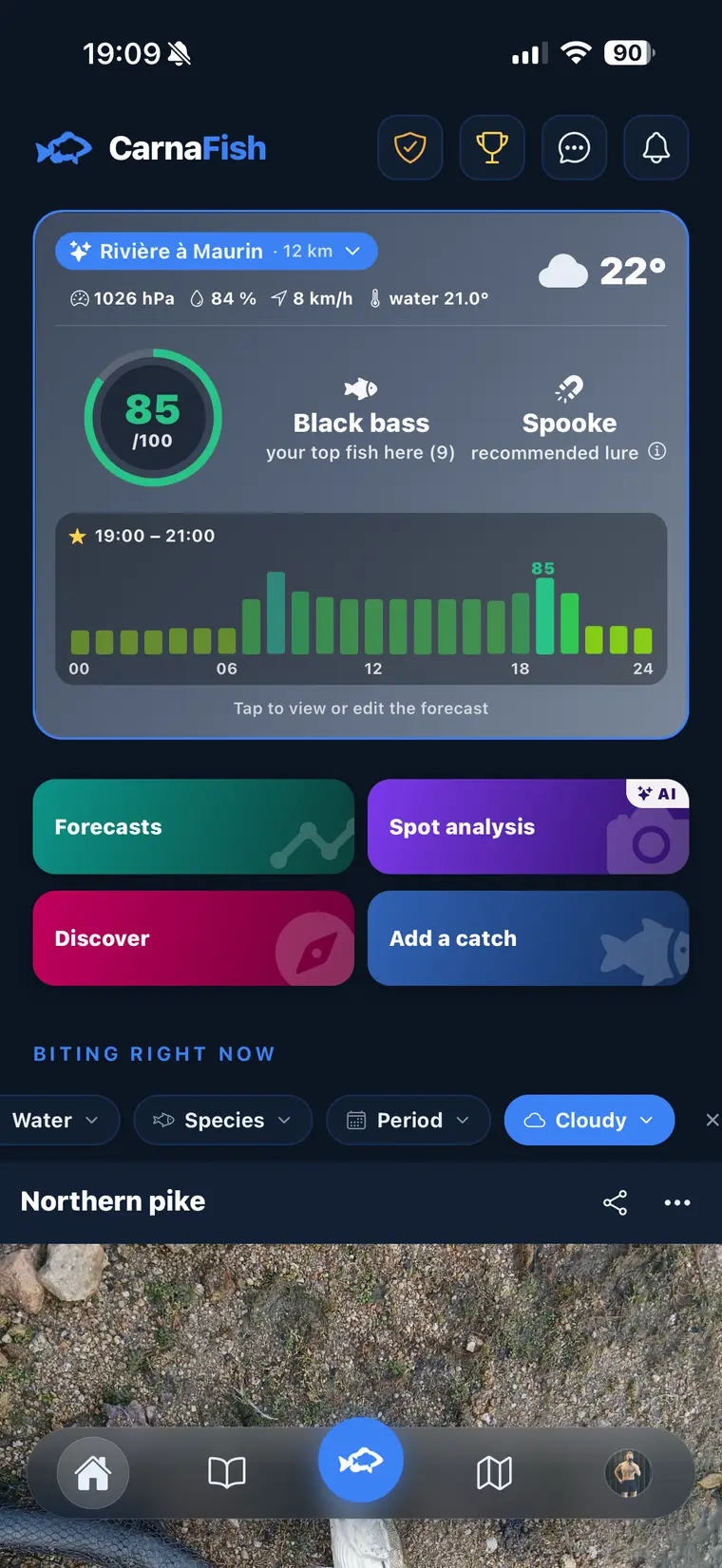
Not sure what to tie on?
Photograph your spot: CarnaFish reads the scene, cross-checks the conditions and gives you the zone, the lure and the retrieve. Free on iOS and Android.
Where to use it, and on what
Its natural ground is cover: lily pads, duckweed, flooded timber, reed edges. In open clear water it still works but loses its edge against a conventional popper, which is more precise and more discreet.
In Europe, the mats that hold bass also hold pike, and a loud frog brings them up without trouble. Six centimetres is small for a big pike, but a 3/0 double holds well; run heavy braid rather than a wire leader, which weighs the nose down and ruins the pop.
Colors by light and bottom
- Plain white, like the photographed version: the best visual reference for you, at distance and against the light. From below the fish only ever sees a silhouette anyway.
- Natural greens and browns: in clear shallow water over a weedy bottom, when the fish has time to look before it commits.
- Black: under a low sky, at dusk, or over a very dense mat that filters the light. It is the outline that carries, not the shade.
Where it sits in the box
Between a smooth frog and a buzzbait, the Poppin' Frog 60 holds the slot of the loud but slow cover bait. If you want more flash and a continuous retrieve, the SPRO Bronzeye Blade Frog 65 pushes further in that direction; if you want a direct equivalent from another maker, the Booyah Poppin' Pad Crasher plays exactly the same role.
Which leaves the question that comes before any lure choice: is that mat worth fishing today at all? That is precisely what CarnaFish answers from a photo of the spot, suggesting a zone, a depth and a lure family suited to the conditions. And to know when weedy edges really come good through the year, our season-by-season guide to predator fishing lays out the calendar.
The short version
- A cupped face that cracks: this is a bait for dense cover and stained water, less relevant in clear open water.
- Three retrieves listed by SPRO — pop, chug, walk — with a mandatory pause between bursts.
- About 6 cm / 2 3/8 in for 14.2 g / 1/2 oz, factory 3/0 Gamakatsu EWG double; the Class column reads Surface, a usage rather than a stated buoyancy.
- The rubber strands are meant to be trimmed to tune the action: cut little, test, repeat.
FAQ
How does it differ from a standard frog?
The face. Cupped, it throws water and cracks on every pull, where a smooth frog only leaves a wake. The upside is noise under dense cover; the downside is reduced glide when walking it and a less discreet presentation in clear water.
What hook size comes on it?
A 3/0 Gamakatsu EWG double, listed in the Hook column of the manufacturer's table. That is a hook size, not a dimension: there is no conversion to millimetres to make.
Should I cut the rubber legs?
Not necessarily, but it is a tuning option the manufacturer builds in. Long strands slow the lure and widen the silhouette on the pause; short strands speed everything up and tighten the zigzag. Start by pulling three or four strands from each bundle before you actually shorten them.
Does this frog float?
The table reads Surface in the Class column, which denotes a usage rather than a measured buoyancy. SPRO does not explicitly state a floating model. A hollow body full of air stays on top until it fills with water, but that is not a specification from the source.
How long should I wait before setting the hook?
About a second, long enough to feel the weight of the fish load the rod. The surface explosion pushes you to set at once, and that is how you pull the lure out of a mouth that has not closed on it yet. Then set hard and to the side, without easing off.
The full bass lure guideSeason-by-season strategy: which family of lure, when, and why.Go from theory to fish
CarnaFish reads your spot from a photo and gives you the game plan: zone, lure, retrieve. Free on iOS and Android.