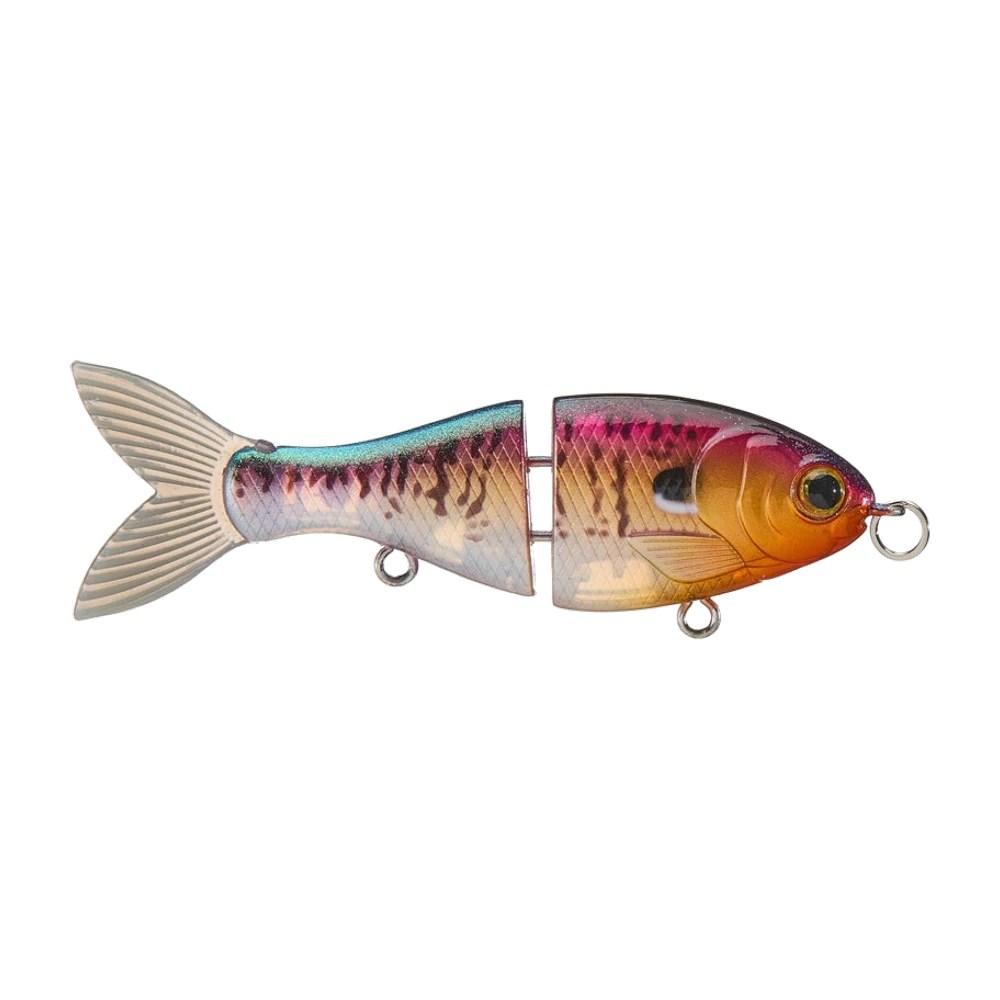
Bucca Brand BFS Trick Shad 2.5: the glide bait built to fry size
Rather not fish it blind? Photograph your spot — CarnaFish cross-checks the conditions and points you the right way.
There are late-summer days when bass feed visibly along a weed edge and refuse anything over four inches. Fry scatter at the surface every thirty seconds, your usual glide bait crosses the zone without drawing a single follow, and you end up deciding the fish are inactive. They are not: they are eating two-inch forage and will open their mouths for nothing else. The Bucca Brand BFS Trick Shad 2.5" answers that exact situation.
A jointed glide scaled down to a fry
Mike Bucca has been building jointed swimbaits long enough to know what disappears when you shrink a glide bait: momentum. An eight-inch glide carries on after each pull, and that carry is what creates the side-to-side travel. At 6.35 cm — a figure taken from the model name, since the manufacturer's spec table leaves the length column blank — there is almost no mass left to sustain the movement. The BFS Trick Shad compensates with a single mid-body joint and a soft tail section that finishes the stroke after the hard body has already stopped.
In the water, the bait kicks sideways on each impulse, pivots around its joint, and the soft tail trails a fraction of a second longer. That lag gives a bait this small a signature no one-piece minnow can produce. Stated weight is 3/16 oz, about 5.3 g, and the manufacturer rates it Slow Sink. That is not a footnote, and it drives everything below.
ABS instead of resin: what it actually changes
Most American custom glide baits are poured in resin by hand, then painted one at a time. The BFS Trick Shad is moulded in ABS, and the maker points to two consequences: better impact resistance, and above all access to finishes resin cannot deliver.
The practical gain for an angler sits elsewhere. An injection-moulded body leaves the mould with the same density every time, where a hand-poured resin body can vary by a few tenths of a gram. On a 5.3 g bait rated slow sink, a few tenths of a gram visibly change the rate of fall. You can buy the same model in another colour and get exactly the same sink rate back — something no hand-poured swimbait ever guarantees.
Before the first cast, drop it beside you in a metre of water with a watch running and count the seconds per metre. That number is the only thing that lets you later swim the bait at the right height over a drop-off you cannot see. A slow-sinking glide you do not count is a glide fishing at random.
Slow sink, and the retrieve that follows from it
A floating glide bait works on or just under the surface and climbs on every pause. The BFS Trick Shad does the opposite: left alone it settles slowly, level, without nosing down or rolling over. That horizontal descent is a fishing phase in its own right, not dead time.
The basic retrieve has three beats. Cast, count it down to the depth you want, then string together short, crisp rod-tip taps — two to four inches of travel, no more — taking up slack between each one. At this size a long sweep of the arm does not send the bait further sideways; it tears the bait off its line and kills the movement. Every four or five taps, pause for two seconds and let it sink level again. That is very often when the bite comes, exactly as on a suspending jerkbait.
The tackle that matches
BFS stands for Bait Finesse System: a casting setup built to throw lures standard gear cannot move. At 5.3 g you sit right at the bottom edge of a normal baitcaster — it works, but you will fight the brakes. A BFS reel with a lightened spool, or simply a light spinning outfit, makes casting comfortable and above all lets you land the bait softly rather than slapping it down.
For the rod, aim at light to medium-light power in 1.90 to 2.10 m (6'3" to 7'), with a tip soft enough to deliver small taps without forcing. Fluorocarbon of 0.22 to 0.26 mm (8 to 12 lb) straight through, or fine braid with a metre of fluoro leader. On any water holding pike, step up to 0.40 mm fluoro or a thin titanium trace: the bait is small enough to be swallowed whole.
The classic mistake
Tying straight and tight to the nose ring. On a jointed glide the nose has to pivot freely for the body to break hard to one side and then the other; a tight knot blocks that travel and the bait simply wobbles forward. Loop knot or a small round snap, every time. The matching mistake is swapping the factory Mustad Triple Grip trebles for heavier hooks. On a 5.3 g bait, an extra gram on the belly is enough to tip the attitude and turn a level descent into a nose-down one.
Where and when to use it
This is a late-season bait, for the weeks when the year's fry reach 4 to 7 cm (1.5 to 3 in) and predators lock onto them. Weed edges, dock frontages, the tips of rocky points, gravel breaks under three metres: anywhere you can work the bait through the whole water column without snagging it. It wants reasonably clear water, because its main argument is visual and a side-to-side glide produces almost no pressure wave.
In Europe it finds a second use the American market ignores: big perch. A jointed hard bait this size, sunk slowly over a boulder field or alongside a piling, interests perch that refuse a soft bait on a jig head. For pike it is simply too small to be anything but an accident. If you want comparable glide in a size a pike will genuinely commit to, look instead at the 6th Sense Speed Glide 100.
Not sure what to tie on?
Photograph your spot: CarnaFish reads the scene, cross-checks the conditions and gives you the zone, the lure and the retrieve. Free on iOS and Android.
Colours by water clarity
- Clear water: a translucent pearl finish with iridescent flanks, like the one shown, which returns light without ever turning into a mirror. That is the natural register of a baitfish fry.
- Lightly stained water: a dark back over a chartreuse belly. The back-to-belly contrast stays readable from underneath even when visibility drops to a metre.
- Low light, dawn, or coloured water: solid black. Against the sky it is the silhouette that counts, not the hue.
A format that fills a gap rather than replacing anything
The BFS Trick Shad does not take the place of a search bait. It occupies one precise slot: the jointed hard bait small enough to match tiny forage, in a register soft plastics cover poorly. Next to it, a Keitech Easy Shiner 3 on a jig head is quicker to deploy and far cheaper to lose; a Baitsanity Micro BFS Glide Crank Minnow plays the same ground with a rolling rather than gliding action. Choosing between the three comes down to what you have seen in the water, not to a standing preference.
And reading the spot decides the rest: the depth, the type of edge, the wind direction. CarnaFish answers that from a photo of the swim, suggesting a zone and a presentation consistent with the day's conditions. To build the groundwork for lure choice on a bass water, our guide to getting started in bass fishing covers tackle and the classic holding spots.
Key points
- A jointed glide of 6.35 cm (2.5 in) for about 5.3 g (3/16 oz), rated slow sink by the maker: the level descent is part of the retrieve.
- The single joint and the soft tail compensate for the lack of momentum inherent to small sizes.
- Short rod-tip taps, never long sweeps: at this size amplitude kills the glide instead of widening it.
- Loop knot or snap is mandatory, and no hooks heavier than the factory ones unless you want to upset the attitude.
FAQ
Does the BFS Trick Shad float or sink?
The manufacturer rates it Slow Sink. Left alone it settles gently and stays level, which lets you fish it at a chosen height by counting it down after the cast.
Do I need a BFS setup to cast it?
No. At about 5.3 g a light spinning outfit throws it easily and lands it more softly. A BFS reel mainly buys comfort on the short, accurate casts you make under overhanging branches.
What size of fish does it target?
Bass of any size locked onto small forage, and in Europe good perch. It is not built to select big fish: its purpose is to get bites when predators refuse larger profiles.
How do you work a 6 cm glide bait?
With short, crisp rod-tip taps of two to four inches, taking up slack between each, and a two-second pause every four or five taps. Long sweeps of the arm pull the bait off its track.
Can you fish it for pike?
It will catch pike by accident, but that is not its format. A 6 cm bait gets swallowed whole and demands a strong leader; to genuinely target pike, a glide of at least 10 cm makes more sense.
Should I change the factory hooks?
No. The Mustad Triple Grip trebles fitted at the factory suit the weight of the bait. Heavier trebles unbalance it and make it nose down on the fall, which costs it most of what makes it worth fishing.
The full bass lure guideSeason-by-season strategy: which family of lure, when, and why.Go from theory to fish
CarnaFish reads your spot from a photo and gives you the game plan: zone, lure, retrieve. Free on iOS and Android.