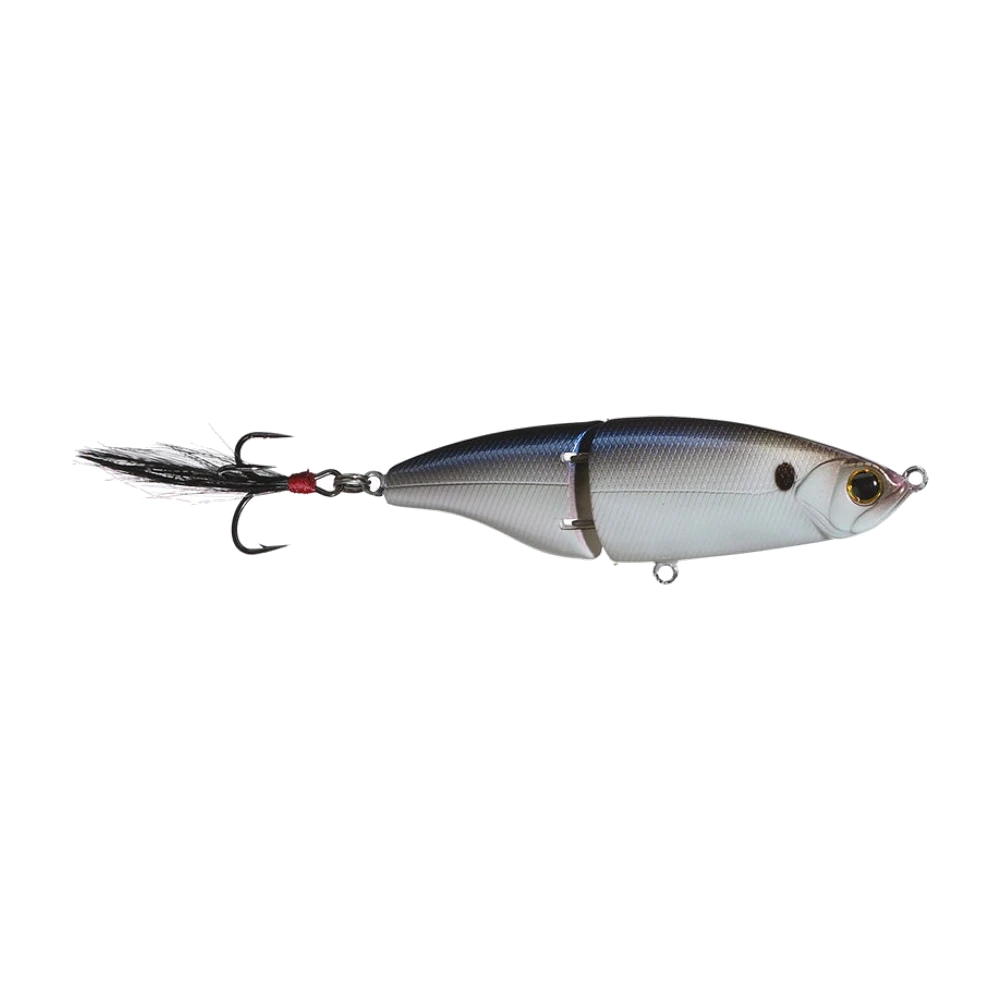
6th Sense Speed Glide 100: the 4 in glide bait that casts a mile
Rather not fish it blind? Photograph your spot — CarnaFish cross-checks the conditions and points you the right way.
Glide baits have a size problem. The family grew up around lures of 7 to 10 inches, beautiful to work but reserved for big fish and muscle rods. The result is that most anglers own none at all, because none of them is usable on a water holding average-sized bass. The 6th Sense Speed Glide 100 attacks the problem from the other end: 4 inches, 0.88 oz, and the same S-glide.
Four inches for 0.88 oz: what that changes
That size-to-weight ratio is the key to the lure. For a 4 in body, 0.88 oz is a high density — it is the weight you would normally find on a 5 or 5.5 in hard bait. 6th Sense describe a heavy weighting system designed explicitly for casting distance, and you feel it in the hand: the lure leaves like a stone and cuts through wind without helicoptering.
There are two consequences. First, you can actually cover water with a glide bait, which is almost a contradiction in a family normally fished with precision over a located spot. Second, the lure sinks decisively — you have to count it down like a lipless, not treat it like a topwater. Over a five-foot flat, one second of sink is enough before you engage the swim; on a thirteen-foot break, count six to eight.
There is a trade-off and it is worth knowing: a short body produces a narrower glide than a large glide bait. Where a 7 in model draws an S twenty inches wide to each side, the Speed Glide 100 works within eight. The swim is the same, the scale is not. If you are after the hypnotic effect of a big glide sweeping slowly in front of a pike, this is not that lure.
Two opposite presentations, and that is the whole point
6th Sense list two usage modes, and they really are distinct.
The slow, steady retrieve gives you the clean glide-bait swim: the lure alternates left and right continuously, each tail kick sending it to the other side, with zero rod input. This is the presentation for a fish you have located, on a slow pass in front of cover. It demands absolute consistency on the reel — one involuntary acceleration breaks the S and the lure tracks straight.
Burning broken up with jerks is the exact opposite. You reel fast and snap the rod tip: the lure loses its path entirely, breaks sideways, rights itself, takes off again. 6th Sense describe the action as very erratic, and that is precisely it — you are imitating a baitfish fleeing in panic, not a fish swimming. This is the reaction presentation, the one that triggers a fish that was not asking for anything.
The classic mistake: jerking a glide bait like a jerkbait
A billed jerkbait is fished with short sharp downward snaps, rod tip pointed at the water. Apply that stroke to a glide bait and the result disappoints: the lure dives, rolls onto its side and leaves its gliding axis.
A glide bait is worked with the rod tip high, at eleven o'clock, with short crisp pulls given on the horizontal plane, then an immediate release of line tension. The release is what matters: the lure needs a foot and a half of slack to finish its lateral glide. An angler who keeps the line tight throughout will never get more than a cheap minnow's wobble.
Always count two beats after your jerk, rod still, before the next pull. It is during those two beats that the lure finishes sliding sideways — and that is also when a following fish makes up its mind. A glide bait worked continuously catches almost nothing.
Rigging: the slack matters more than the rod
A snap on the dorsal tie is mandatory. A knot cinched against a glide bait's eye is even more penalising than on a crankbait: it is the freedom of rotation at the pull point that lets the body tip from one side to the other.
Twenty-pound braid to transmit the jerks, with three to four feet of 20 lb fluorocarbon leader. Fluorocarbon, stiffer and denser than mono, helps carry the rod stroke without damping it. If you fish pike with this lure — and a 4 in glide bait is a good average-pike bait — step up to a heavy 50-60 lb leader.
A word on the hooks, because there is an ambiguity worth knowing: 6th Sense describe the Speed Glide as fitted with super sharp wide-gap EWG-style hooks, while also offering replacement trebles on the same product page. Check the actual hook setup on the lure you buy before you order spares — it takes two seconds to look, and it saves you ordering the wrong part.

Not sure what to tie on?
Photograph your spot: CarnaFish reads the scene, cross-checks the conditions and gives you the zone, the lure and the retrieve. Free on iOS and Android.
Colours by water clarity
- Clear water: silver or roach, with those raised gill plates catching the light. A glide bait is seen in profile throughout its slide, so the flank matters more than the back.
- Grassy bottom or green water: a dark green back that does not over-contrast with the surroundings and lets the swim do the work.
- Stained water or low light: a high-contrast finish, black-and-white or firetiger. You lose realism, but on a lure that constantly changes direction, contrast helps a fish lock onto its target.
Where it sits among glide baits
Against a Jointed Claw, the Japanese benchmark that popularised the family, the Speed Glide 100 is far smaller, denser and much easier to cast — but it has neither the same glide width nor the same refinement at very low speed. Compared with a Westin Swim Glidebait or a 3D Bleak Glide Swimmer, two lures built for European pike, it is more compact and more flexible about target fish size. And against a Slide Swimmer 175 you change category outright: the Deps is a big-fish selection tool, the Speed Glide a search bait.
That is in fact its real place in a box: the glide bait you tie on when you are not sure there are big fish around, where the large models require that you be sure. Still, choosing lure size without having read the spot is shooting blind. That is exactly what CarnaFish is for: a photo of the spot, and the AI suggests a zone, a depth and a presentation style matched to the conditions. To frame pike lure choice by spot and season, our guide to choosing a pike lure walks through the families.
Key takeaways
- 4 in for about 0.88 oz: a high density that buys very long casts and a decisive drop, to be counted down like a lipless.
- Two opposite presentations: a slow, perfectly steady retrieve for the S-glide, or jerked burning for an erratic path.
- The glide is narrower than on a large glide bait — that is the price of the compact format, not a design flaw.
- Rod tip high, short pulls on the horizontal plane, and above all a slack release after every jerk.
FAQ
Does the Speed Glide come in several sizes?
6th Sense list a single format for this model, the Speed Glide 100, given as 4 in for 7/8 oz — about 10 cm and 24.5 g — in the sinking class. Variation is in the colours.
Is a 4 in glide bait big enough for pike?
Yes, for average-sized pike, especially in late summer and autumn when available forage is small. To target big fish specifically in winter, a 6 to 8 in glide bait stays more selective. Either way, run a heavy 50-60 lb fluorocarbon leader.
How deep does this lure fish?
At whatever depth you choose, since it sinks. Count one second of drop over a shallow flat, six to eight seconds to reach a thirteen-foot break, then engage the retrieve. The S-glide holds at any height in the column.
Why does my Speed Glide not glide in an S?
Three causes, in order of frequency: a knot tied straight onto the eye instead of a snap, an inconsistent retrieve that breaks the alternation, or line kept tight after the jerk. The lure needs a foot and a half of slack to finish each lateral slide.
What hooks does it come with?
6th Sense describe super sharp wide-gap EWG-style hooks, while also offering replacement trebles on the same product page. The published information is ambiguous on this point: check the hooks visually on the lure you receive before ordering spares.
Can it be fished on a straight retrieve with no rod work?
Yes, and that is actually the lure's cleanest presentation. It does demand absolute consistency on the reel, though: one involuntary acceleration is enough to break the S-glide and send the lure tracking straight. A slow-gear reel helps a lot here.
The full bass lure guideSeason-by-season strategy: which family of lure, when, and why.Go from theory to fish
CarnaFish reads your spot from a photo and gives you the game plan: zone, lure, retrieve. Free on iOS and Android.