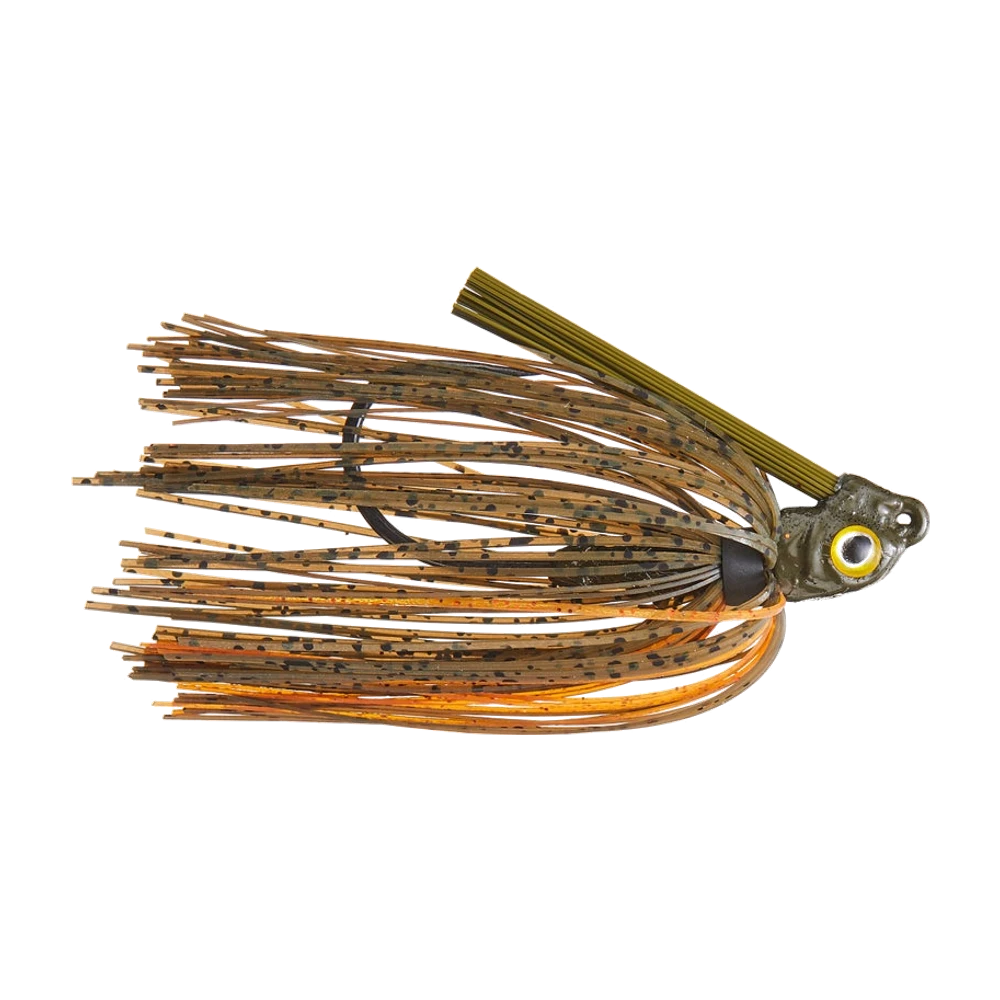
Buckeye Brush Panda: the swim jig built for thick cover
Not sure this lure fits YOUR spot today? CarnaFish tells you in 10 seconds, from a photo.
A cluttered river arm, a willow line with branches dipping into a metre of water, submerged brush you guess at more than you see. That is exactly the kind of spot where most lures last three metres before burying themselves, and where the biggest bass in the lake happen to live. The Buckeye Lures Brush Panda, developed with Jacob Powroznik, is built for that scenery and nothing else.
What makes a heavy cover swim jig different
An ordinary swim jig is a lightened jig with a streamlined head, retrieved on a straight line instead of hopped along the bottom. It gets through light vegetation, but there comes a point where the cover wins: the guard folds, the point grabs, and you spend the day pulling free.
The Brush Panda works on three precise points. The first is the hook: a black nickel model described as zero-flex, which is more than catalogue copy when the job is dragging a three-kilo fish out of a tangle of limbs. A hook that opens a millimetre under load means a lost fish and a lure left in the wood. The second is the dual-lock bait keeper with traction rings: the trailer stays put after ten passes through brush instead of sliding down the hook shank. The third is the geometry of the weed guard, connected to the hook point rather than planted beside it, so the whole forms a continuous ramp that deflects off an obstacle instead of wedging into it, and that collapses against the jaw on the hookset rather than screening the point.
Setting the weed guard takes two minutes at the water's edge and is worth half the result. Fan the fibres out by hand before you start, and on a particularly dirty spot pinch ten of them between your fingers and pull them out. You trade a little protection for a clear gain in penetration. The reverse rarely happens: an over-full guard shows up on the first missed fish, never before.
The retrieve: one speed, and above all some hesitations
A swim jig is not fished like a spinnerbait. Cast beyond the obstacle, let the jig drop for a second or two, then retrieve at a moderate, steady pace while keeping contact with the cover. The whole game sits in that contact: the moment the head touches a limb, a lily stem or a reed, speed up by half a turn of the handle to make it deflect, then release immediately. The jig kicks aside, hesitates, and the skirt flares open — that is the instant a bass commits.
This is the point most anglers miss when they first pick up a swim jig: they reel at a constant speed and treat contacts as accidents to be avoided. The contacts are the fishing. A swim jig retrieved through open water, far from anything, is worth less than a paddle-tail shad on a jig head, which swims better and costs less to lose.
Choosing the trailer
The trailer decides both the silhouette and the rate of fall. A craw with broad claws slows the drop and adds a pronounced side kick: it is the default choice, the one that goes best with a green pumpkin skirt in flooded wood. A paddle-tail shad lengthens the profile, makes the jig run higher and suits fish keyed on fry. A trailer with slim appendages, a twin grub for instance, cuts resistance and lets the jig fall faster into a narrow hole between two stumps.
Whatever the shape, thread it on dead straight. A trailer fitted crooked makes the jig roll, and that slow rotation wrecks any impression of a live creature without you ever seeing it happen under water.
The classic mistake
Fishing the Brush Panda on gear that is too light. The lure is designed to haul a fish out of brush by force, not to play it finely. Braid of 30 to 50 lb, a fast rod of 2.00 to 2.10 m (6'6" to 7') in medium-heavy power at the least, drag locked down. With thin fluorocarbon and a parabolic rod, the hook point never gets through the guard, and the fish leaves with the jig in a tangle you will not recover it from.
Where to use it, and on which species
The Brush Panda's natural ground is wood: fallen trees, willow bases, brush carried in by a flood, dock pilings. It is equally effective over dense surface weed and lily pads, where it travels through places a crankbait would not even attempt. Between 30 cm and 2.5 m (1 to 8 ft) of water, in clear to stained conditions — in genuinely muddy water a bladed bait works better.
In Europe it does more than bass duty. A swim jig rolled slowly along a bed of pondweed takes pike, often good ones, because a skirted profile travels where a treble-armed lure would hang up. In that case a 0.60 mm fluorocarbon leader (around 50 lb) or a short titanium trace is not optional: the strike lands on the head of the jig, centimetres from the knot. If you want a slimmer profile for less active fish, the Berkley PowerBait Finesse Swim Jig covers that register; for a vertical presentation in the same cover a flipping jig remains a better fit than a swim jig forced into a job that is not its own.
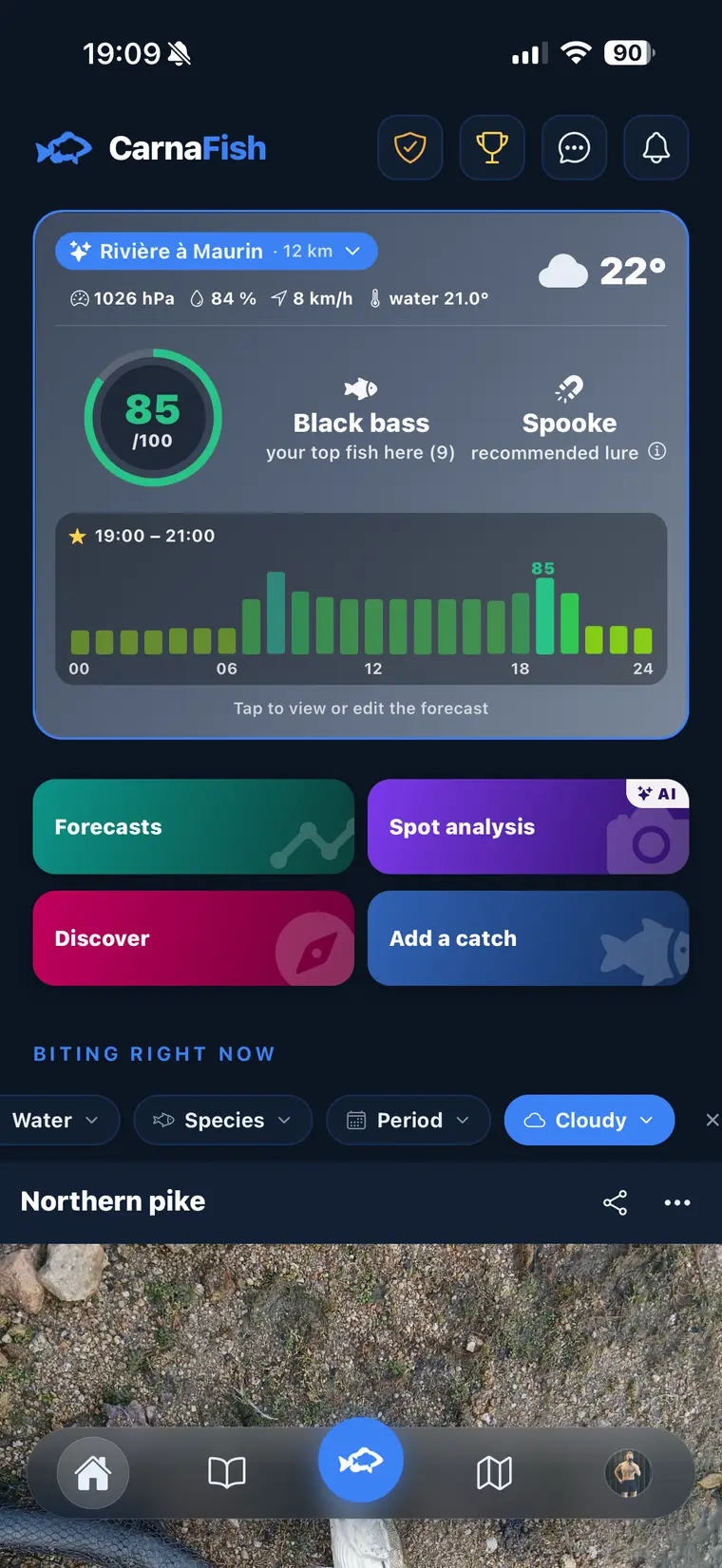
Not sure what to tie on?
Photograph your spot: CarnaFish reads the scene, cross-checks the conditions and gives you the zone, the lure and the retrieve. Free on iOS and Android.
Colours by cover and water
- Flooded wood, clear to lightly stained water: green pumpkin with a few orange strands, exactly the finish shown here. It is a crawfish tone and it works anywhere there is hard bottom.
- Dark water, overcast skies or silt bottom: black and blue. A clean silhouette is what reads best once visibility drops under a metre.
- Fry at the surface, clear water: white or pearl white with a matching shad trailer. The jig stops imitating a crawfish and becomes a stray baitfish.
A specialist tool, and that is its strength
The Brush Panda makes no claim to versatility. In open water it is unremarkable; in a foot of water in the middle of a brush pile, it does a job no treble-armed lure can. It is a lure you mount on a dedicated rod, keep in hand for an hour along one bank, and then put away. Spot selection matters more here than lure selection, which is exactly what CarnaFish is for: from a photo of the swim it suggests a zone and a presentation consistent with the day's conditions. And to learn to pick out those cluttered banks before you even tie a lure on, our guide to reading a fishing spot sets out the method.
Key points
- Zero-flex black nickel hook and dual-lock bait keeper: the Brush Panda is built for pulling, not for finesse.
- The weed guard tied into the hook point deflects off cover instead of wedging, and collapses on the hookset.
- The fishing happens on contacts with cover: half a turn of the handle on the obstacle, then release at once.
- Heavy gear is mandatory — 30 to 50 lb braid and a powerful fast rod — or the point will not penetrate.
FAQ
Which Brush Panda weight should I choose?
The maker lists several weights without publishing the individual figures. The principle is the same as for any swim jig: the lightest weight that keeps you in contact with the cover at the speed you want, heavier if there is wind or current.
Is a trailer compulsory?
Yes. Without one the jig falls too fast, loses most of its bulk and its action goes flat. The dual-lock keeper and its traction rings exist precisely so the trailer stays put pass after pass.
What is the difference between a swim jig and a flipping jig?
A swim jig has a streamlined head and a lighter skirt so it can be retrieved on a straight line through cover. A flipping jig has a more compact head and more weight so it drops vertically into a chosen hole. Both fish the same cover, but not in the same way.
Does the Brush Panda catch pike?
Yes, in Europe, along dense weed beds. Its skirted profile and weed guard let it travel where a treble-armed lure hangs up. Plan on a 0.60 mm fluorocarbon leader or a short titanium trace, because the strike comes on the head of the jig.
How do I set the weed guard?
Fan the fibres out by hand before fishing. On a very dirty spot you can pull out around ten fibres to improve hook penetration, accepting slightly less protection against snagging.
How deep does this swim jig fish?
From just under the surface down to about 2.5 m (8 ft), depending on the weight chosen and the retrieve speed. Deeper than that the sink time gets too long and the point of the lure, which is to track a shallow cover line, disappears.
The full bass lure guideSeason-by-season strategy: which family of lure, when, and why.Go from theory to fish
CarnaFish reads your spot from a photo and gives you the game plan: zone, lure, retrieve. Free on iOS and Android.