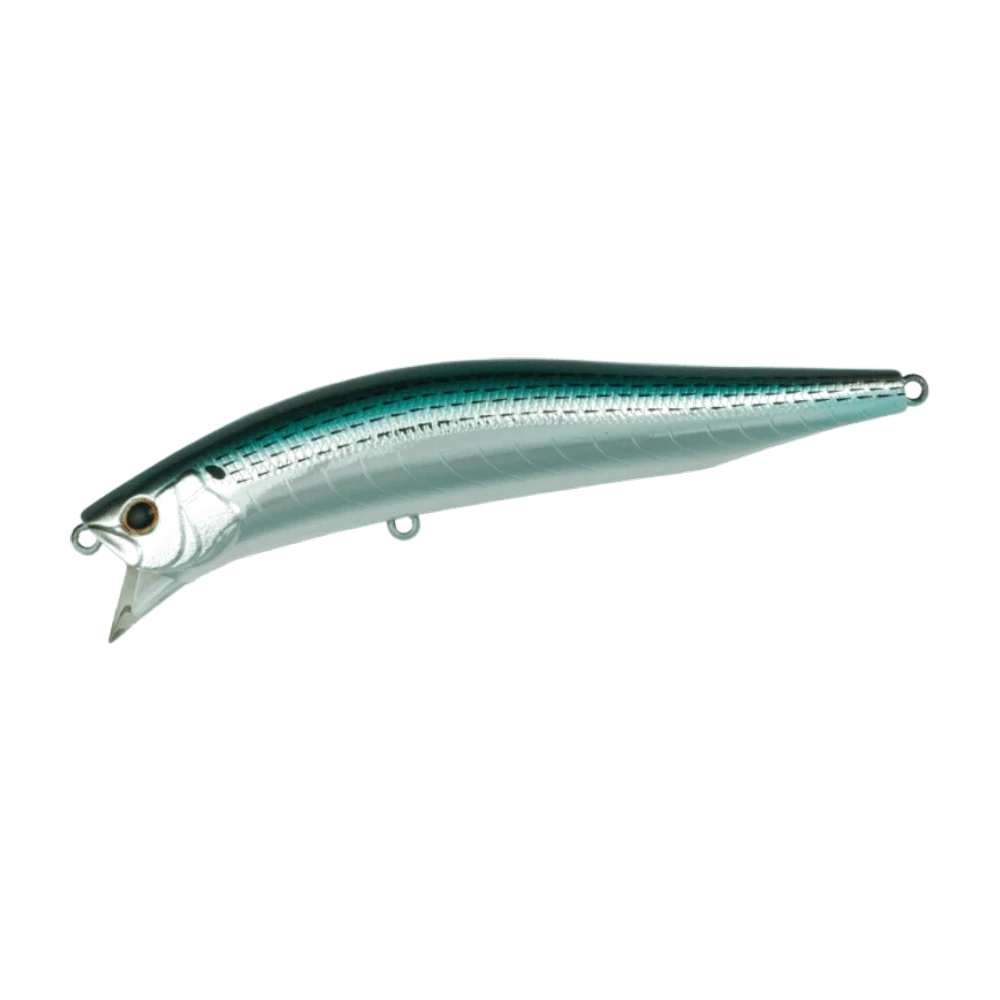
Daiwa Morethan Crosswake: the V-wake that gives the lure away on the surface
Not sure this lure fits YOUR spot today? CarnaFish tells you in 10 seconds, from a photo.
A June night, sea flat as a table, flood tide over a rocky plateau in a metre and a half of water. You hear discreet rises, soft sucking sounds rather than splashes. You put on a stickbait, you walk it: nothing. You put on a popper, you pop it: you scatter everything that was within ten metres.
What was missing there is a third surface register, the one we use least and the one that solves exactly this situation: the wakebait. Not a lure that jumps, not a lure that spits. A lure that stays just under the film and bulges it as it moves, leaving a V-wake behind it, like a mullet cruising up or a baitfish swimming in no hurry.
The Crosswake belongs to that family. It is a slow linear retrieve lure, with no animation, and that is precisely what makes it effective when the other two fail.
Wakebait, stickbait, popper: three incompatible signals
Confusing these three families costs a lot of fish. Here is what really separates them.
The popper has a cupped mouth. It throws water upwards and produces a loud, brief noise. The signal is discontinuous and acoustic. It calls from a distance, it works on active fish, it scatters them on flat calm water.
The stickbait has neither lip nor mouth. It does nothing on its own: you are the one making it zigzag with successive twitches. The signal is erratic and visual, that of a wounded fish bolting in all directions. It needs constant animation, and it gets too frantic for wary fish on flat water.
The wakebait has a short, steeply angled little lip that permanently holds it a few centimetres under the surface instead of making it dive. The signal is continuous, regular and above all hydrodynamic: the V-wake and the push the fish picks up on its lateral line before it even sees the lure. It asks for no animation at all.
That last point is what matters. On a flat sea at night, a regular, discreet signal is readable from a very long way underwater, whereas a violent, discontinuous one breeds suspicion. The wakebait is the calmest surface lure there is, and that is what makes it a tool for difficult situations.
The retrieve: doing nothing, but doing it well
This is the most counter-intuitive part. There is no retrieve to learn, there is a speed to find and hold.
- Cast across or slightly down the current seam or the tidal flow. You want the lure to cross the zone working, not to swing back along the current's axis.
- Close the bail and lift the rod tip to about ten or eleven o'clock. That high position holds the lure near the surface throughout the retrieve.
- Start winding very slowly and watch the lure. You are looking for the exact point where the back breaks the surface and a clean V forms behind it. That is your target speed.
- Hold that speed without varying all the way in. A steady handle, no acceleration, no pause. Regularity is this lure's whole argument.
- One variation is allowed: a very slight slowdown of two or three seconds as the lure passes the sweet spot — the corner of a rock, a weed edge, the current seam. The lure rises imperceptibly, and that is often enough to trigger.
- Do not set on the noise. On a wakebait, the take is often visible before it is felt. Wait until you feel the weight in the rod, then set by leaning into it.
On the water: if you cannot see the V behind the lure, you are either too slow or too fast, and in both cases you are not fishing a wakebait. Too slow and the lure sinks and becomes a poor sub-surface minnow. Too fast and it lifts off, skips out of the water and throws bubbles. At night, when you can see nothing, set your speed at dusk by eye and memorise the handle cadence — count the turns per second and reproduce them.
Setting the depth of the wake
| Setting | Effect |
|---|---|
| Rod tip high (11 o'clock) | Stronger wake, lure higher |
| Rod tip low (towards the water) | The lure sinks, the V disappears |
| Fine braid + 0.35 mm fluorocarbon leader | The right compromise, good contact |
| Leader too thick (0.50 mm and up) | Floats too much, chokes the action and the roll |
| Slow steady retrieve | Clean V, readable roll |
| Fast retrieve | The lure lifts off and loses all effectiveness |
Two rigging points deserve attention in saltwater. The hooks: if you fish the rocks and sea bass over 60 cm, go to heavy-duty trebles — but check that the lure still stays on the surface at your target speed, because weighting the nose makes it sink. The leader: fluorocarbon of 0.35 to 0.40 mm is the right compromise between discretion and abrasion resistance on rock. For pike in freshwater, swap it for a wire trace without hesitation: it barely alters the action of a lure fished on a straight retrieve.
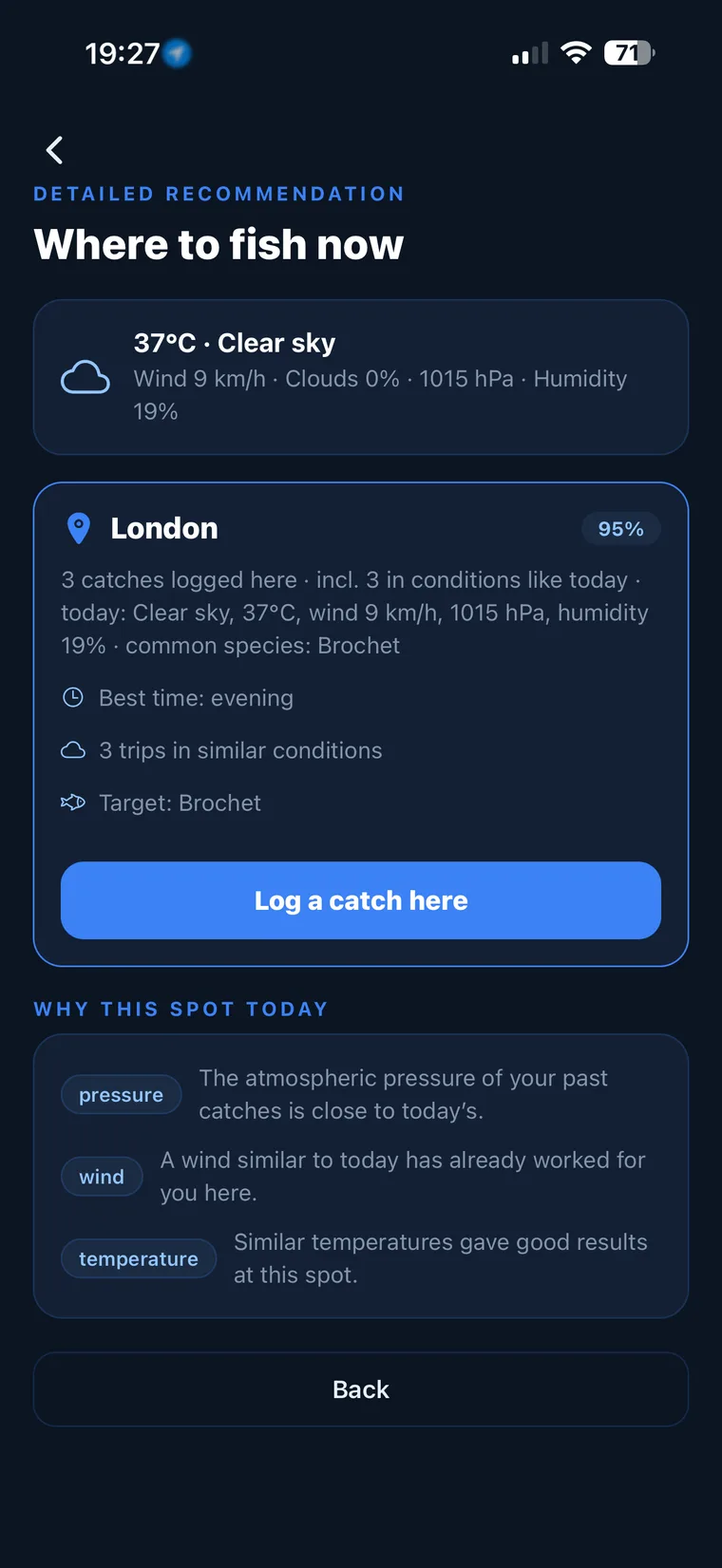
Not sure what to tie on?
Photograph your spot: CarnaFish reads the scene, cross-checks the conditions and gives you the zone, the lure and the retrieve. Free on iOS and Android.
Where it excels, where it should stay in the box
In saltwater, it excels at night or at dawn on a flat sea, over rocky plateaux of one to three metres, in tidal currents and at estuary mouths. It is also an excellent summer lure when the water is warm and sea bass are feeding high but refusing the popper.
In freshwater, its window is pike on shallow flats: pond tails, reed edges, weed plateaux in a metre and a half, typically in late summer and early autumn when the fish are feeding high. The slow, steady retrieve suits a sitting pike that has to move three or four metres to attack.
There are three cases where it should stay in the box. In a rough sea or heavy chop: the V is lost in the general disorder, and the lure comes out of the water on every wave. On active fish smashing the surface: there, a popper or a stickbait that calls from a distance will pay far better. And over more than three or four metres with no high structure: the fish will not come up for a lure that discreet.
Crosswake or a louder surface lure
The Daiwa Morethan Switch Hitter is its direct neighbour in the range, but it works below the surface: it is a sinking pencil retrieved in the top fifty centimetres, with a more undulating action and far better casting ability. You switch from the Crosswake to the Switch Hitter as soon as the wind gets up or distance becomes the limiting factor.
Against the River2Sea Whopper Plopper 130, you are at the opposite end of the spectrum: the Whopper Plopper's rear prop produces a very loud gurgle and a churned-up wake. It calls from much further away, it is devastating on active fish — and it becomes unusable on the calm, pressured waters where the Crosswake takes over. Finally, if you want a genuinely loud saltwater popper, look at the Shimano World Pop.
Our guide to sea bass lure fishing covers reading tidal coefficients and tide times. And if you are torn between a loud lure and a discreet wakebait as you arrive on a plateau, CarnaFish analyses a photo of the spot and gives you an answer.
Key takeaways
- The wakebait stays under the film and leaves a V: a continuous signal, no sharp noise.
- No animation. Only one thing to set: the minimum speed that produces the wake.
- No visible V, no wakebait — you are fishing something else without knowing it.
- Main window: flat sea at night over a shallow plateau, or pike on the flats in late summer.
- Unusable in a rough sea, and beaten by the popper on fish feeding on the surface.
FAQ
What is the difference between a wakebait and a stickbait?
The stickbait does nothing on its own: you impose a zigzag on it with continuous twitches. The wakebait works by itself on a straight retrieve and stays just under the surface, leaving a steady wake. One is erratic, the other is calm and constant.
How fast should you retrieve a wakebait?
At the minimum speed that produces a clean V behind the lure. That is usually very slow, around one turn of the handle per second or less. Too slow and the lure sinks; too fast and it lifts off and skips out of the water.
Can the Crosswake be fished in daylight?
Yes, but its best window remains night, dawn and dusk, when discretion counts. In broad daylight and clear water it loses ground to more visible lures or to lures fished deeper.
Can it be used for pike in freshwater?
Yes, on shallow flats — pond tails, reed edges, weed plateaux — especially in late summer and early autumn. Fit a wire trace; it does not disturb the action of a lure fished on a straight retrieve.
What leader should I use in saltwater?
Fluorocarbon of 0.35 to 0.40 mm, joined to fine braid. Thicker, it floats too much and chokes the lure's roll; finer, it will not stand up to abrasion on rock or to sea bass teeth.
Why does the lure sink instead of staying on the surface?
Three possible causes: you are holding the rod tip too low, you are retrieving too slowly, or you have weighted the nose by changing the trebles. Raise the rod to eleven o'clock, speed up slightly, and check the weight of the hooks you fitted.
The full sea bass lure guideSeason-by-season strategy: which family of lure, when, and why.Go from theory to fish
CarnaFish reads your spot from a photo and gives you the game plan: zone, lure, retrieve. Free on iOS and Android.