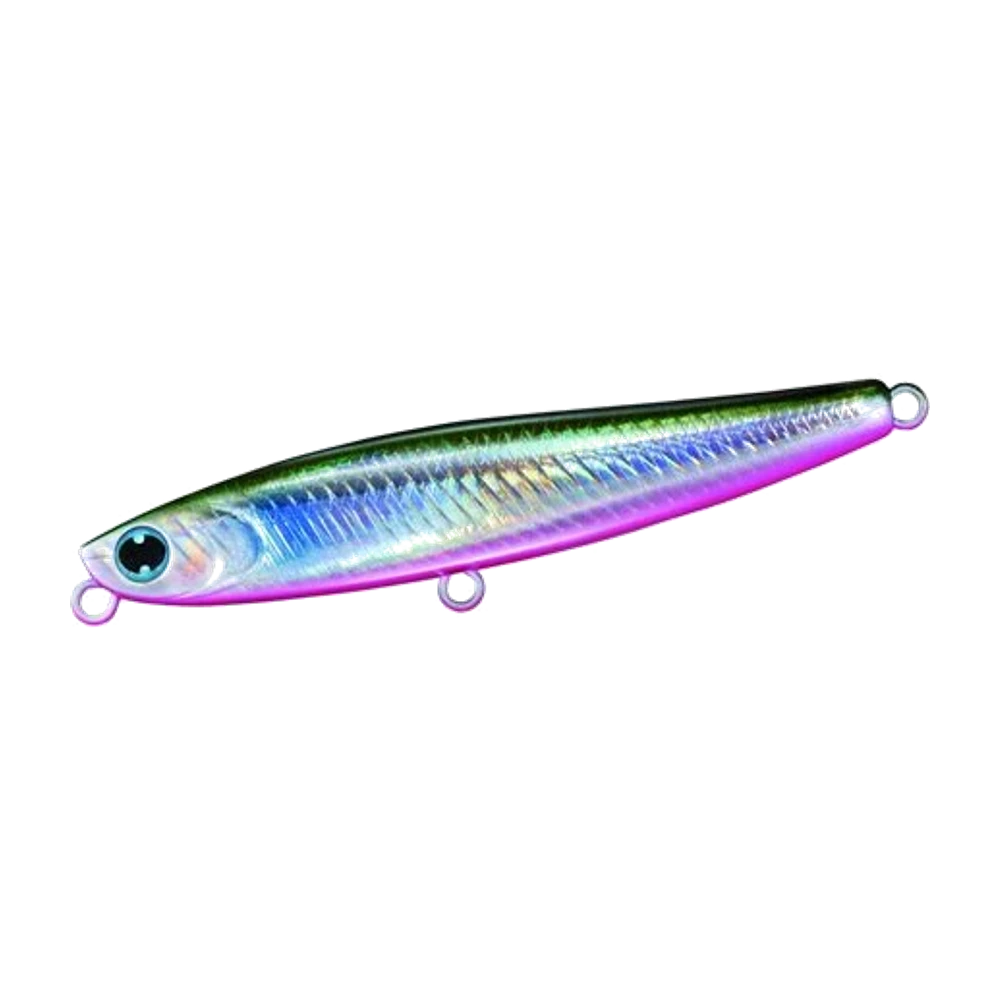
Daiwa Morethan Switch Hitter: the sinking minnow built for the night swing
One lure, endless conditions. CarnaFish reads your spot from a photo so you are not just guessing.
Fishing sea bass in a tidal current, at night, is like nothing else. You cannot see your lure. You cannot see where the current speeds up. All you have is the tension in your line and the sound of water against the rocks. In those conditions a sophisticated retrieve makes no sense: you cannot steer what you cannot see.
What you need is a lure that lets the current carry it while staying readable at the end of the line, that does not climb to the surface as soon as the flow picks up, and that does not spin out when you pull a little too hard. A lure that fishes on its own, in short, while you manage position.
The Switch Hitter is built for that. It is a very slim sinking minnow, weighted to cast far into wind, whose action is deliberately reduced to a discreet roll under tension. It is not spectacular. That is precisely what is asked of it.
A slim profile and a moving weight
Two features explain its behaviour in the sea.
The profile. The body is narrow, almost tapered, with a very short lip. It moves little water, it has no wide action, and it does not try to dive. Under tension it rolls finely on its axis and holds its line; on a free drop it noses down slowly while keeping its trim. That discretion matches what sea bass eat at night — sandeels, elvers, small shrimp — far better than a lure that vibrates hard.
The moving weight. Like many Japanese saltwater lures, it carries balls that slide to the rear on the cast, lengthening and stabilising the flight. In practice you gain metres, and above all you gain them into wind, the situation in which an unweighted lure helicopters. On a beach where the fish are forty metres out, those metres decide the session.
The flip side: once cast, it sinks. Leave it too long without tension over rocky ground and you will lose it. This is fishing on a tight line, almost all of the time.
The controlled swing: the core technique
The way you fish it explains the way it is built. You do not animate it, you place it.
- Read the direction of the current before casting — foam, eddies, the lie of the weed.
- Cast up and across, at about forty-five degrees to the current, never straight downstream.
- Let it sink two to five seconds depending on depth and the strength of the flow.
- Keep minimum tension and let the lure cross the seam. You barely retrieve at all: you follow the line with the rod tip and just take up slack.
- Follow it through the end of the swing as the lure comes below you. That is the moment it straightens up and lifts slightly — the take very often comes at exactly that instant.
- Retrieve it slowly over the last few metres, hugging the margin.
On a beach with no marked current, replace the swing with a very slow straight retrieve, just fast enough to feel the roll, with a two-second stop every ten turns.
On the water: at night, the first take tells you at what point in the swing the fish are sitting, not just where. Note mentally how many seconds have passed since the cast. Reproduce exactly the same timing on the next cast, aiming at the same point: on a current seam, sea bass hold a fixed position and you can take several fish on the same count.
Choose the size by the flow, not by the bait
| Size | Indicative weight | Situation |
|---|---|---|
| 6.5 cm | around 5 g | Calm water, fish on very small prey, finesse fishing |
| 8.5 cm | around 12 to 14 g | All-round, beach and estuary, moderate current |
| 10.5 cm | around 17 to 20 g | Headwind, strong current, hunting for distance |
| 12 cm | around 24 to 26 g | Heavy tidal current, big swell, big fish |
The deciding factor is not primarily the size of the bait but the lure's ability to stay in its layer despite the flow. A model that is too light in a strong current is immediately flushed to the surface and goes dead. If you notice your lure rising and skating on the surface during the swing, go up a size without hesitating.
On the rigging side, fine braid — 0.12 to 0.18 mm — gives you distance and sensitivity. Add one to two metres of 0.30 to 0.40 mm fluorocarbon leader for abrasion against rock and shell, joined with a slim knot, not a bulky swivel.
Not sure what to tie on?
Photograph your spot: CarnaFish reads the scene, cross-checks the conditions and gives you the zone, the lure and the retrieve. Free on iOS and Android.
Its best windows and its blind spots
It is at its best:
- At night or at dawn, when sea bass hunt with reduced vision and refuse showy lures.
- In current seams: estuary channels, gullies, harbour mouths, rocky points on the ebb.
- Into a headwind, where its casting distance becomes a decisive advantage.
- On educated sea bass in heavily fished areas, where a surface lure or a loud jerkbait no longer produces anything.
It is poorly suited:
- Over very broken rocky ground with no current, where its sink rate will cost you lures.
- When sea bass are clearly feeding on the surface: a well-worked topwater is more effective and easier to read.
- Beyond two metres of useful depth, where you need a heavier lure or a jig head.
- On large forage fish — if the bass are on mullet or big sandeels, the size does not keep up.
Switch Hitter or a surface lure
The contrast with a surface stickbait like the Rapala Skitter Walk is sharp and useful. The topwater works on triggering: it makes noise, it draws from a distance, it provokes a visible, spectacular attack. It excels when sea bass are feeding high and when there is enough light for the fish to see the silhouette cut out against the sky.
The Switch Hitter does the opposite. It does not trigger, it presents. It passes through the fish's corridor, at the right moment in the swing, with a minimal signal. It is the lure of the small hours and the dead time, when nothing is hunting on the surface but the fish are there, holding in the current.
In the same discreet register, a DUO Tide Minnow Slim offers a floating profile that stays higher in the layer, better over rock. Our guide to sea bass lure fishing goes back over tides and timing. And if you are torn between attacking on the surface or sinking on a rocky point, CarnaFish analyses a photo of the spot and gives you an answer.
Key takeaways
- Fished on the swing in current, with minimum tension rather than any animation.
- Cast at forty-five degrees upstream; the take often comes at the end of the swing.
- Pick the size by the flow, not by the size of the bait.
- Moving weight: real casting distance into wind, a decisive advantage from the shore.
- Avoid it over rock with no current, and when sea bass are clearly feeding on top.
FAQ
How do you fish the Switch Hitter in current?
Cast at forty-five degrees upstream, let it sink two to five seconds, then keep minimum tension while the lure crosses the seam. You barely retrieve: you follow it, and you wind it slowly once it has passed below you.
What size should I choose for sea bass?
The 8.5 cm is the all-round shore size; go to 10.5 or 12 cm as soon as a headwind or the current demands more weight. The 6.5 cm is reserved for calm water and fish on very small prey.
Is it effective in daylight?
Yes, but it is at its best at night and at dawn. In daylight and full sun, an active bass will often respond better to a surface lure or a showier jerkbait; the Switch Hitter takes back the advantage on educated fish and during the dead hours.
What line should I use?
Fine braid of 0.12 to 0.18 mm for distance and sensitivity, with one to two metres of 0.30 to 0.40 mm fluorocarbon leader. Avoid bulky swivels, which cost distance and upset the lure's nose.
Does it sink fast?
No, the drop is slow and the lure keeps its trim. That is what lets you swing it for a long time in a current seam, but it also means you should avoid leaving it slack over broken rocky ground.
Why does it rise to the surface in current?
Because it is too light for the flow. In a strong current, an undersized model is flushed upwards and stops working. Go up a size, and check that you are not pulling too hard during the swing.
The full sea bass lure guideSeason-by-season strategy: which family of lure, when, and why.Go from theory to fish
CarnaFish reads your spot from a photo and gives you the game plan: zone, lure, retrieve. Free on iOS and Android.