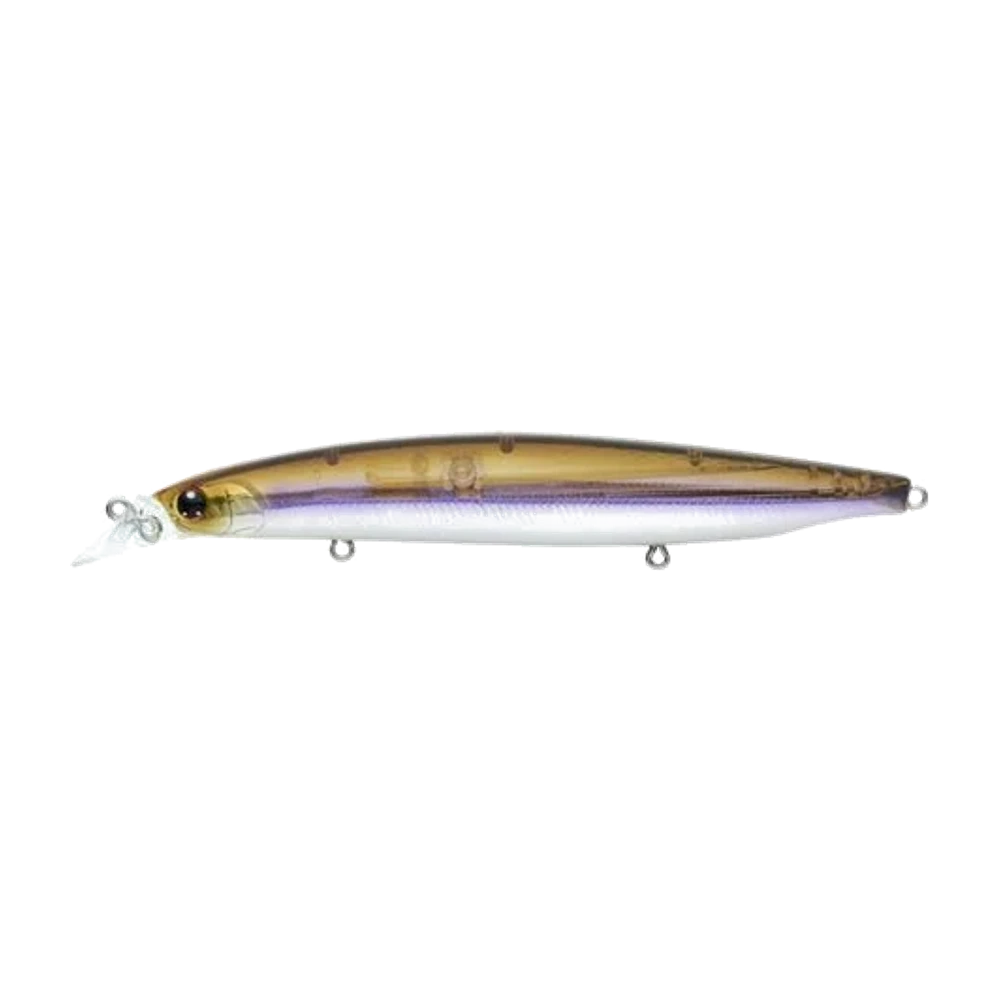
Daiwa Shoreline Shiner Z Vertice: casting far into a headwind
Rather not fish it blind? Photograph your spot — CarnaFish cross-checks the conditions and points you the right way.
On a shore sea bass spot, distance is rarely a luxury. The bar where the bait piles up is forty metres out, the wind is coming in off the sea, and your 12 cm minnow helicopters at twenty-five metres. You fish a zone with nothing in it, conscientiously.
The problem is mechanical. A classic floating minnow has its weight spread through the middle of the body. In flight, the lighter nose turns sideways, the lure spins on itself and loses all its energy. The stronger the wind, the heavier the penalty.
The Shoreline Shiner Z Vertice is built around the answer to that problem: a weight transfer system that sends a heavy ball to the rear of the body at the moment of the cast. The lure flies out like an arrow, tail first, on a stable axis. On landing, the ball returns forward and locks into the swimming position.
How weight transfer actually works
The principle is simple, the execution less so. Inside the body, a channel houses one or more free balls.
On the cast, the acceleration throws the ball backwards. The centre of gravity moves well back, the lure behaves like a fletched arrow and flies on its axis. That is where the metres are won: a stable trajectory cuts through wind far better than a lure that spins.
On entering the water, the ball has to come back forward and seat itself. If it stays jammed at the rear, the lure swims badly, tail down. That is the weakness of every system of this kind, and it is on this point that models differ: the quality of the return and of the locking.
On the Z Vertice, the return happens within the first few turns of the handle. In practice, always give two firm turns after landing before starting your retrieve: you make sure the lure is in position, and you tighten the line.
A less obvious consequence: this type of lure does not like soft casts. An escorted cast, with no firm acceleration, does not trigger the transfer properly. On a slightly parabolic rod, load the blank and accelerate all the way through.
An action that holds at low speed
Casting far is no use if the lure will not swim once it gets there. The Z Vertice keeps a steady, tight wobble at a slow retrieve speed, which is precisely what you need for sea bass.
Its running depth sits in the immediate sub-surface, between thirty centimetres and a little over a metre depending on the model and the speed. That is the useful layer on most shore spots: above the rocks, above the kelp, in the surface flow off a point.
| Situation | Retrieve | Detail |
|---|---|---|
| Sparsely covered rocky plateau | slow and steady | rod high to limit snagging |
| Surface feeding frenzy | fast with two stops | cast to the edge of the shoal, not the middle |
| Current off a point | lure cast upstream | let it swing, only take up slack |
| Estuary, churned water | slow with twitches | brighter tones |
The retrieve: four moves are enough
- Cast by loading the rod and accelerate firmly right to the end of the movement.
- Two immediate turns after landing, to lock the weight and tighten the line.
- A slow straight retrieve, feeling the steady vibration in the rod.
- A break every ten seconds: two twitches of the rod tip, or a one-second stop during which the lure rises slightly.
On a following fish, the stop beats the acceleration. Being a floater, the lure rises slowly and shows its flank; plenty of sea bass attack on that rise.
On the water: on a point with current, do not retrieve your lure. Cast upstream, let the seam carry it, and content yourself with taking up slack to keep contact. A lure drifting with the current, with no drag on it, is infinitely more credible than a lure being hauled back against the flow.
Rigging and saltwater maintenance
Three non-negotiable points on the coast.
The leader. Fluorocarbon of 0.30 to 0.35 mm, one metre to a metre and a half long, behind braid of 0.15 to 0.20 mm. It takes the rubbing on rock and shell.
Rings and trebles. Saltwater models come out with heavy-duty hardware, but it is still a wear item. Check it after every session, replace at the first spot of rust or as soon as a point is blunt.
Rinsing. Fresh water, systematically, every time you get back. Salt destroys split rings and jams the transfer balls inside the body. A lure that no longer casts as far as it used to has often simply got a clogged channel.
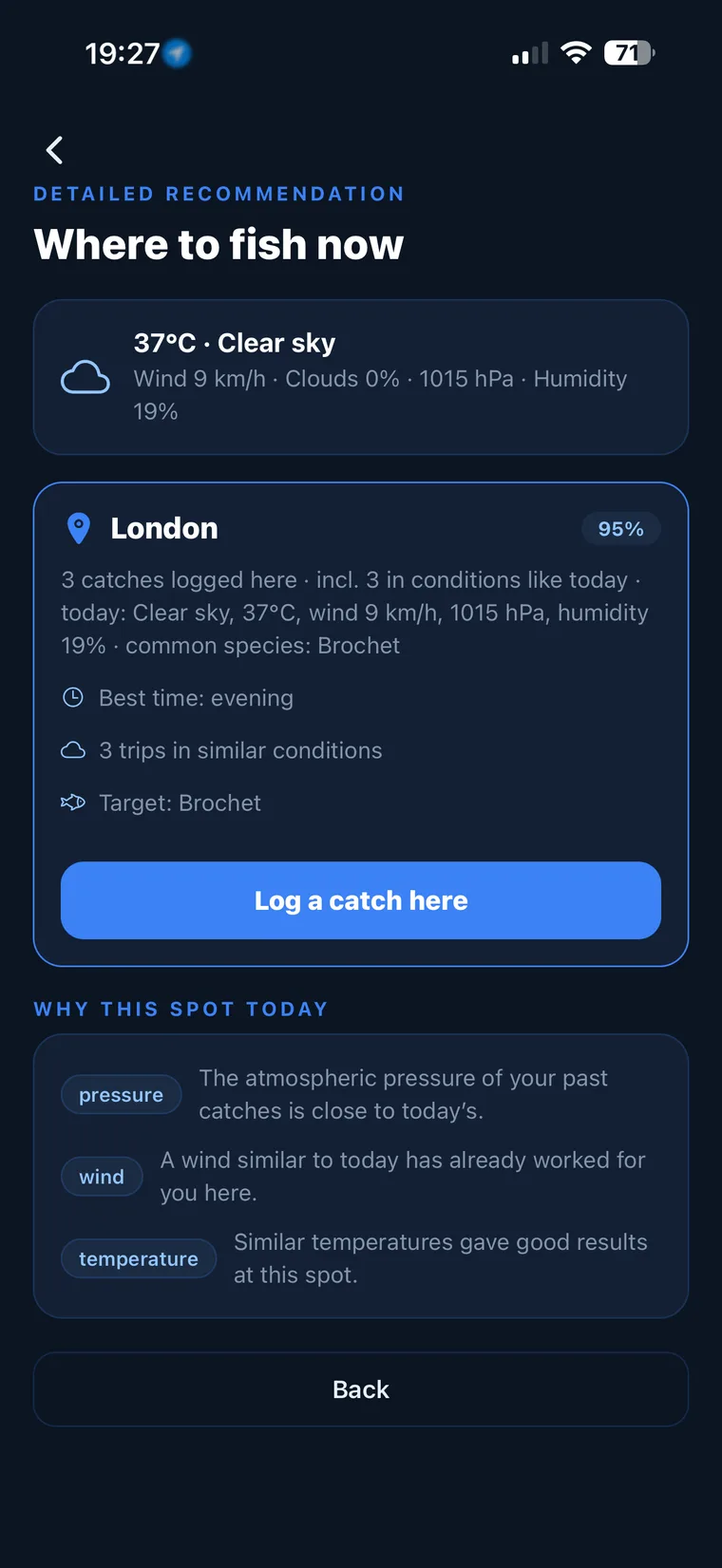
Not sure what to tie on?
Photograph your spot: CarnaFish reads the scene, cross-checks the conditions and gives you the zone, the lure and the retrieve. Free on iOS and Android.
What it does not do
- Fish deep: it stays in the sub-surface. Over a hole or a drop-off, you need a sinking lure or a weighted shad.
- Get through dense kelp: two bare trebles collect everything.
- Work in a rough sea: beyond a certain amount of chop, the action is lost.
- Convince sea bass on very small bait: if the fish are on three-centimetre fry, a 12 cm lure often goes ignored.
Z Vertice or a surface stickbait
Against a stickbait such as the Xorus Patchinko 140, the choice comes down to the water layer and the state of the sea. The stickbait works strictly on the surface and demands constant animation; it is unbeatable when sea bass are visibly feeding and the sea is not too rough.
The Z Vertice works just underneath, comes back effortlessly on a straight retrieve, and stays effective when nothing at all is happening on the surface — that is to say, most of the time. Over a full session, it is the more versatile searching lure.
Against an Illex Bonnie 95, another coastal lure, the difference is sharper still: the Bonnie is a compact stickbait for precise spots, the Z Vertice a long-range minnow for covering open water.
Our guide to sea bass lure fishing covers the tide phases and the spots to favour. And if you are torn between sub-surface and surface as you arrive on the spot, CarnaFish analyses a photo of the spot and gives you an answer.
Key takeaways
- Weight transfer stabilises the flight: markedly better distance, especially into wind.
- Load the rod and accelerate firmly; a soft cast does not activate the system.
- Two turns after landing to lock the weight before you start working it.
- A steady sub-surface action at low speed, which is the useful layer on shore spots.
- Rinsing in fresh water is compulsory, or the balls jam and the distance collapses.
FAQ
How does a lure's weight transfer system work?
A free ball slides to the rear of the body at the moment of the cast, which moves the centre of gravity back and stabilises the flight. On landing it returns forward and locks into the swimming position. Two turns of the handle are enough to make sure of it.
Why does my weight transfer lure no longer cast as far?
Most often because the internal channel is clogged with salt and the ball no longer slides freely. Rinse systematically in fresh water after every saltwater session. A second cause is a soft cast, with no firm acceleration.
How deep does the Shoreline Shiner Z Vertice swim?
In the sub-surface, between about 30 cm and a little over a metre depending on the model and the retrieve speed. That is the useful layer over rocky plateaux and exposed points, above the kelp.
What rig for sea bass from the shore?
Braid of 0.15 to 0.20 mm and a fluorocarbon leader of 0.30 to 0.35 mm, a metre to a metre and a half, tied straight to the lure. Check rings and trebles after every session: they are wear items in saltwater.
How do you fish it in current?
Cast upstream and let the lure drift with the seam, contenting yourself with taking up slack to keep contact. A lure going down with the current is far more credible than one dragged against it.
What do you do when a sea bass follows without attacking?
Mark a one-second stop rather than accelerating. Being a floater, the lure rises slowly showing its flank, and a large proportion of attacks are triggered on exactly that rise.
The full sea bass lure guideSeason-by-season strategy: which family of lure, when, and why.Go from theory to fish
CarnaFish reads your spot from a photo and gives you the game plan: zone, lure, retrieve. Free on iOS and Android.