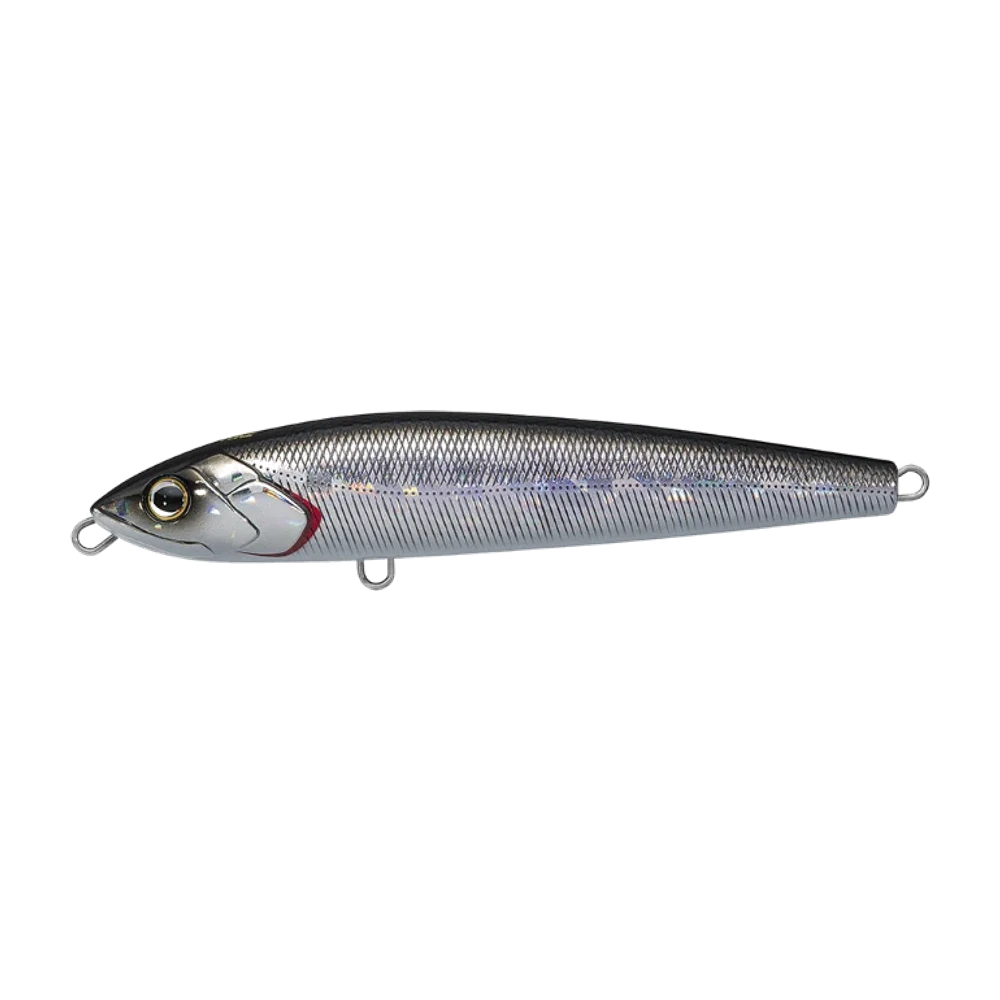
Daiwa Saltiga Dorado Slider: the sinking stickbait for fishing in the wind
The right lure in the wrong spot still catches nothing. CarnaFish spots the zone that works, from a single photo.
The day they really feed, there is wind. It is almost a rule on the coast: the waves churn, the food breaks up, sea bass come up — and your favourite floating stickbait helicopters in the gusts, lands at thirty metres and gets flushed out of the water by the first wave. You can see fish smashing bait at eighty metres and you cannot reach them.
The sinking stickbait exists for that moment. The Dorado Slider, in the Saltiga range, is a lure that is compact, heavy for its length and shaped to cut through wind. It casts far because its mass is concentrated, and it stays in the water because it has no reason to float. From there, the way you work it looks nothing like a surface pencil.
This is a lure for distance and rough seas, not for flat calm.
Why it casts so far
Three things explain the distance, and each has a consequence for how you fish it.
High mass for a moderate length. Thirty to sixty grams over ten to fourteen centimetres is a density that has nothing to do with a floating stickbait of the same size. The lure carries, but you need a rod that can take it: a saltwater blank rated 30 to 60 g minimum, or you lose distance and wear out your tackle.
A tapered profile and a small cross-section. Little wind resistance in flight, little tendency to tumble. The lure goes out in a straight line instead of spinning.
Pronounced rear weighting. It stabilises the casting trajectory, and above all it dictates the action: the lure pivots around its tail, which produces a wide lateral glide when you sweep the rod, rather than a simple surface zigzag.
The trade-off is simple: the moment you stop winding, it goes down. There is no pause available as there is on a suspending lure. The retrieve has to be continuous.
The retrieve: speed first
The freshwater angler's reflex is to slow down. In the sea, on a sinking stickbait and on feeding sea bass, that is the mistake that costs the most bites.
- Cast long, feathering the spool at the last moment to straighten the line before impact — the lure enters the water nose first instead of slapping down flat.
- Count the drop according to the depth you want: two to three seconds to stay just under the surface, five to eight seconds to work a little lower over a plateau.
- Start fast as soon as you pick up. Five or six sustained turns of the handle to bring the lure into its layer and get it working.
- Sweep the rod sideways over 40 to 60 cm while continuing to wind. That combined movement is what produces the S-glide: the lure runs a long way to one side, breaks, and heads off the other way.
- Never stop completely. If you want to mark a variation, reduce speed for half a second then accelerate sharply; that burst is what triggers the follower.
On the water: when fish are smashing bait, do not cast into them. Cast ten metres past and retrieve across the edge of the zone. A lure landing in the middle of the fish scatters the feeding frenzy; a lure arriving from outside looks like a fish fleeing the melee, and that is almost always the one that gets eaten.
Settings by conditions
| Conditions | Size / weight | Drop count | Speed |
|---|---|---|---|
| Flat sea, visible fish | 10-12 cm / ~30 g | 2 to 3 s | fast |
| Chop, force 3 to 4 wind | 12-14 cm / 40-50 g | 3 to 5 s | fast, wide sweeps |
| Rough sea, strong wind | 14 cm / ~60 g | 5 to 8 s | very fast, rod low |
Tackle is not a detail with this lure:
- 0.20 to 0.30 mm braid for distance and transmission, with a neat connection knot that runs through the guides.
- 0.50 to 0.70 mm fluorocarbon leader, one to two metres, against abrasion on rock and shell.
- Heavy-duty split rings and trebles: this is a lure that takes violent hits at the end of long casts, and the smallest undersized component is the first to go.
- A 2.70 to 3.10 m rod rated 30-60 g to make use of the mass on the cast and keep control in a crosswind.
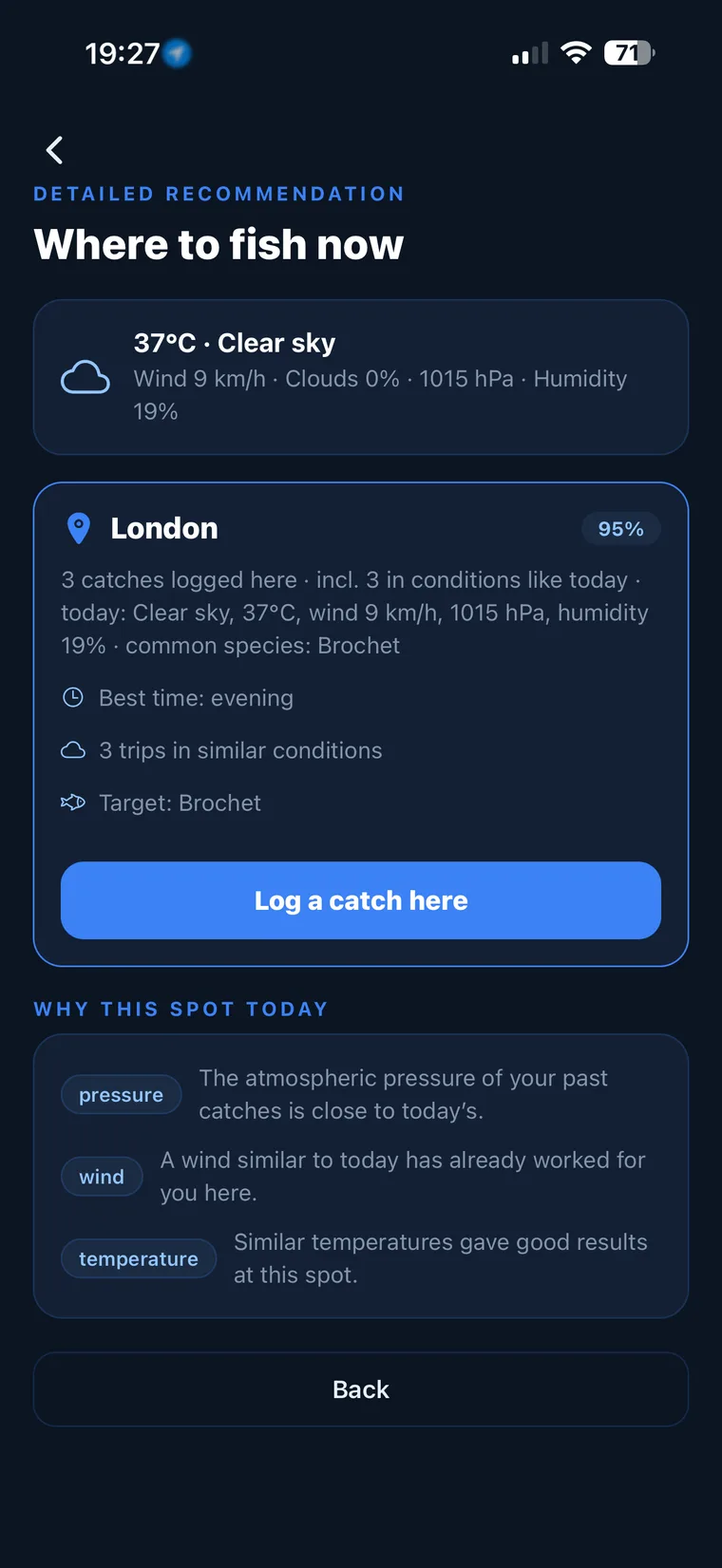
Not sure what to tie on?
Photograph your spot: CarnaFish reads the scene, cross-checks the conditions and gives you the zone, the lure and the retrieve. Free on iOS and Android.
Its windows, and where it is beside the point
This lure is built for uncomfortable conditions.
- Exposed rocky points and breakwaters, where distance changes everything and light lures are unmanageable.
- Headwind or three-quarter headwind: that is precisely its argument.
- Distant feeding frenzies on shoals of small fish, when you have to reach seventy to a hundred metres.
- Churned, foamy water, where a discreet lure goes unnoticed.
On the other hand, it is poor in very shallow water: it sinks and you pick up bottom before the action has even started. It is also unsuited to slow fishing in late autumn on apathetic sea bass — with no pause available, you cannot produce the discreet register the situation calls for. Finally, in a sheltered bay on an oily calm, its size and speed work against you: a slimmer, slower surface lure will take more.
Against surface stickbaits
The Duo Realis Pencil 130 SW stays on the surface and is fished walking the dog, with usable dead time. It is the right choice on a calm sea, on sea bass coming up gently, and when the visual take is part of the pleasure. The Dorado Slider gives that dimension up entirely: you cannot see it after the cast, and you fish by feel.
The Xorus Patchinko 140 is the benchmark floating stickbait for sea bass, with a wide surface glide. Its limit is well known: as soon as the wind gets up and the sea builds, it becomes hard to work and hard to cast. That is exactly the slot the sinking model comes to fill.
Our guide to sea bass lure fishing covers the choice between floating and sinking according to the state of the sea. And if you are unsure what drop count to use on a rocky plateau, CarnaFish analyses a photo of the spot and gives you an answer.
Key takeaways
- A distance lure: concentrated mass, tapered profile, built for wind and rough seas.
- No pause possible — it sinks. The retrieve is continuous, fast, with lateral sweeps.
- The drop count after the cast is your only depth setting.
- Cast past the feeding fish and cross the zone from outside rather than casting into it.
- Beside the point in shallow water, on an oily calm and on apathetic sea bass.
FAQ
Do you have to retrieve a sinking stickbait fast?
Yes. A sinking stickbait is animated by speed: it is the continuous pull that gives it its lateral glide. Retrieved slowly, it drops without action and behaves like a lead. When in doubt, speed up rather than slow down.
How do you set the working depth?
Only with the drop count after impact and with the retrieve speed. Two to three seconds to stay just under the surface, five to eight seconds to work a little lower, and a faster retrieve to bring the lure back up.
What rod and braid should I use?
A 2.70 to 3.10 m rod rated 30-60 g, braid of 0.20 to 0.30 mm and a fluorocarbon leader of 0.50 to 0.70 mm. Undersizing the rod cuts casting distance sharply and wears out your tackle.
Can it be used in shallow water?
Barely. Under a metre and a half it touches bottom before the action is established. On beaches and shallow ground, a floating or shallow-diving lure stays more relevant.
Should I change the stock hooks?
Check them systematically and replace them as soon as they open up or corrode. On hits at seventy metres with low-stretch braid, the split rings and trebles are the first parts to give.
What is the difference with a floating stickbait?
The floater stays on the surface, is fished slowly and allows pauses and a visual take. The sinker trades all of that for distance and for holding up in wind and chop. These are two opposite sea states, not two versions of the same lure.
The full sea bass lure guideSeason-by-season strategy: which family of lure, when, and why.Go from theory to fish
CarnaFish reads your spot from a photo and gives you the game plan: zone, lure, retrieve. Free on iOS and Android.